Showing posts with label The Arts and Culture. Show all posts

Tuesday, March 18, 2008

Hard-core Divas Hit the Stone: Sharon, Gertrude, Lynn


I have recently attended a conference in Reims on the interesting topic The Cultural Kernel. On popular demand, for those that can't wait for the paper to come out in Imaginaires, here's a preview. This pre-publication is also in response to Stuart Noble's call for papers dealing with American women writers.

My essay takes its point of departure in contemporary poet Lynn Emanuel’s work. Emanuel’s poetry is engaged in making cultural statements which are often based on a link between portrayal and ideas – character portrayal, object portrayal, and depictions of places and personalities from Gertrude Stein to Sharon Stone. I argue that Emanuel’s poems establish themselves as cultural texts, and as such, as discourses that address several levels of reality: 1) in order for the poems to work communicatively, they have to put into operation and activate the author’s and reader’s cultural awareness; 2) in order for the poems to make themselves intelligible, relevant, and aesthetic, (a tall order for any text) they have to be involved in a deliberate reworking of cultural elements. We never experience culture as something complete or at a distance. The cultural kernel is not just an object that is in the poems, but can be thought of as more of a process of collaboration between the author, poems, and the reader. These levels show the extent to which the author’s intent of pulling the reader into her world can be said to change the reader’s perspectives which in turn rework the interpretations of the poems.

By means of illustrating what culture does in terms of the collaborative, I begin here with a consideration of the title of the conference: The Cultural Kernel. When the call for papers came, I looked at the keywords and I could see that the ones I liked were the ones that hit me in my own poetic gut. Thus, my first question to myself for a potential paper was this: will there be any stones in it? I stumbled over Lynn Emanuel’s poem "Homage to Sharon Stone" from her 1999 collection Then Suddenly, and decided that it was no small pebble. In it there were definitely stones. I was ready to dig. I reproduce the poem here:

It's early morning. This is the "before,"
the world hanging around in its wrapper,
blowzy, frumpy, doing nothing: my
neighbors, hitching themselves to the roles
of the unhappily married, trundle their three
mastiffs down the street. I am writing this
book of poems. My name is Lynn Emanuel.
I am wearing a bathrobe and curlers; from
my lips, a Marlboro drips ash on the text.
It is the third of September nineteen**.
And as I am writing this in my trifocals
and slippers, across the street, Sharon Stone,
her head swollen with curlers, her mouth
red and narrow as a dancing slipper,
is rushed into a black limo. And because
these limos snake up and down my street,
this book will be full of sleek cars nosing
through the shadowy ocean of these words.
Every morning, Sharon Stone, her head
in a helmet of hairdo, wearing a visor
of sunglasses, is engulfed by a limo
the size of a Pullman, and whole fleets
of these wind their way up and down
the street, day after day, giving to the street
(Liberty Avenue in Pittsburgh, PA)
and the book I am writing, an aspect
that is both glamorous and funereal.
My name is Lynn Emanuel, and in this
book I play the part of someone writing
a book, and I take the role seriously,
just as Sharon Stone takes seriously
the role of the diva. I watch the dark
cars disappear her and in my poem
another Pontiac erupts like a big animal
at the cool trough of a shady curb. So,
when you see this black car, do not think
it is a Symbol For Something. It is just
Sharon Stone driving past the house
of Lynn Emanuel who is, at the time,
trying to write a book of poems.

Or you could think of the black car as
Lynn Emanuel, because, really, as an author,
I have always wanted to be a car, even
though most of the time I have to be
the "I," or the woman hanging wash;
I am a woman, one minute, then I am a man,
I am a carnival of Lynn Emanuels:
Lynn in the red dress; Lynn sulking
behind the big nose of my erection;
then I am the train pulling into the station
when what I would really love to be is
Gertrude Stein spying on Sharon Stone
at six in the morning. But enough about
that, back to the interior decorating:
On the page, the town looks bald
and dim so I turn up the amps on
the radioactive glances of bad boys.
In a kitchen, I stack pans sleek with
grease, and on a counter there is a roast
beef red as a face in a tantrum. Amid all
this bland strangeness is Sharon Stone,
who, like an engraved invitation, is asking
me, Won't you, too, play a role? I do not
choose the black limo rolling down the street
with the golden stare of my limo headlights
bringing with me the sun, the moon, and
Sharon Stone. It is nearly dawn; the sun
is a fox chewing her foot from the trap;
every bite is a wound and every wound
is a red window, a red door, a red road.
My name is Lynn Emanuel. I am the writer
trying to unwrite the world that is all around her. (53-54)

Emanuel’s poem here is an example of how the cultural kernel as that which resists us can be overcome by observing domestic practices. While we may not always understand another culture and thus be able to crack its literary productions due to missing implicit referents and indigent symbolizations, daily routine is something that most of us can relate to. We all have bad hair days. Not only does Emanuel establish a close proximity between herself and her reader, by bringing her reader into her house, but she also collaborates with the reader towards understanding the workings of collective cultural competence. If the kernel resists us, or creates a gap, we go for the nearest association. We will understand something, if it must be through misreading. In considering Sharon Stone, the reader who may not know the famous actress, may be prompted to think of the infamous 70s hit song by Smokie: “Who the fuck is Alice?” (Sharon, Gertrude, Lynn):1

Sally called when she got the word,
She said: "I suppose you've heard -
About Alice".
Well I rushed to the window,
And I looked outside,
But I could hardly believe my eyes -
As a big limousine rolled up
Into Alice's drive...

Oh, I don't know why she's leaving,
Or where she's gonna go,
I guess she's got her reasons,
But I just
don't want to know,
'Cos for twenty-four years
I've been living next
door to Alice.
Alice, who the fuck is Alice?

If we don’t stumble over stones in this song, we certainly get hit by a car. A big car. A limo, to be more precise. Is Emanuel thinking of Alice, when she sees Sharon, one would like to ask? Lynn Emanuel, the speaker of Emanuel’s poem definitely wants to know what Sharon is up to. And she clearly knows who Sharon is. But Sharon is taken out of her context, which makes the act of observing even more significant, particularly as it relates to consolidating the condition of all cultural understanding and subject constitution: look first, imitate, and understand later. So Lynn does what any good amateur anthropologist should: observe what’s going on. In this poem it begins with her taking a seat: by the window, by the door, by the desk. She positions herself strategically in relation to the objects and people that surround her. The aim is to put something on paper. Encircle. What she notices is that the neighbors are also engaged in their routine, namely, playing the role of unhappily married.

The poem shifts quickly between observations that depict cultural manifestations as they happen and their aesthetic translation into text. Characters in their roles, while taking their roles for granted or accepting them as part of societal constraints, are also in a position to pass judgment on their culture’s relentless emphasis on creating sameness. The poem thus suggests that even though we all do the same things, culture itself is a generator of difference. The poem concludes with a desire to “unwrite the world that is all around her,” Sharon Stone, and presumably Lynn Emanuel alike, but not before the reader gets to witness “the carnival of Lynn Emanuels” as a composite of another character embodiment expressed in the wish to be “Gertrude Stein spying on Sharon Stone at six in the morning” (53). What this example demonstrates is that we never experience culture as something ineffectual. The assumption is that we learn to distinguish between the internal and external origins of inspiration by standing in close proximity to “actuality”, or the very thing that happens while it happens.2

As Emanuel’s poem writes itself through the metaphors of cracking the kernel and smashing the core-stone, the style that emerges from the collaboration between the poet, her subject, the poem, and the reader, also demonstrates that the act of portraying establishes a close relationship between the verbal and the visual. While the depiction of Sharon Stone relies on creating an image-world for the reader, which goes beyond language, the fact that the images conjured up are all context-based and anchored in cultural competence points to the significance of how language works in use and the consequences of its being self-referential. What we are dealing with here is a poem which expresses not just ideas (as poems often do primarily) but also a conscious awareness of the workings of language in and through time. While we can easily see Sharon Stone diva’ing about in a limo in 1999, we do not in the same breath associate the idea of a diva with the 50s tradition.

Emanuel portrays herself as a 50s housewife, mocking the last decade of glamour, and contrasts herself here with another ‘housewife’ of the new millennium for whom even the chore of curling the hair involves external agency (as Sharon Stone probably has somebody else attending to her hairdo). The 50s housewife is thus recast in the passive role of watching, observing, and ultimately identifying, yet not with the character under scrutiny, but the character’s role. The irony is that the 50s housewife is endowed with double agency: on the one hand, she has to make sure that the status quo is maintained, (she stays a product of her culture: she is a housewife, before she is a writer), and on the other hand, she has the potential to become someone else, precisely because this potential is activated by the writer within the housewife.

The subtle point that the poem expresses is that while Emanuel may not be a confessional writer who writes in the same vein as Sylvia Plath, Anne Sexton, Robert Lowell, Allen Ginsberg, and Frank O’Hara, at the same time she both acknowledges and subverts the long tradition of articulating mundane situations in highly crafted poetic constructions. She brings in literary figures such as Gertrude Stein, whom the reader familiar with either her writings or photos of her will instantly recognize as being situated in the opposite direction of glamour: not thin, no curls, no housewife. The fact that Stein, who was also concerned with craft and composition, and wrote in a most ordinary language, is here taken as a barometer – as Emanuel would like to hear Stein’s confessions about Stone – indicates a performative gesture on Emanuel’s part which consists of pulling the reader into the image world of ‘stone on stone’, and ultimately letting her carve her own inscriptions.

This example points to the way in which language works as a cultural construct, and how it configures the human condition according to a specific aesthetics. Emanuel’s poem with its concatenation of language awareness and cultural images is ultimately a poem on portraits, a portrait of a poem, a portrait of a (self)portrait and a poem about itself. In other words, a narrative in verse that is not only a manifestation of, but also a gesture towards cultural understanding.

One of the other implicit messages in the poem that we can extrapolate an understanding from is that where culture is concerned events come and go. What remains are portraits, photographs, descriptions of people in other media. What connects us to events either current or the ones that remain distant in the past and thus only have significance for people who have experienced them first hand is that they remind us of something else. In Emanuel’s poem, language itself traverses with and through these events and is shown to adapt itself easily to new modes of representation. We thus go from the event of writing, in which something must be recorded, to activating a memory about a film with Sharon Stone, or a picture that Gertrude Stein portrayed with words. Thus, what Emanuel suggests is that pictures collaborate to inspire writing, and that writing in turn ‘reminds’ us of fleeting visual moments.

All these alternative modes or representations that are the result of cultural manifestations following a dominant in a certain time and age – writing, film, music, painting – are furthermore shown to collaborate towards the process of de-mystifying seemingly strange relations. We take seriously Emanuel’s advice, not to think of big, black cars as symbols for something, but a quick glance at the way in which her writing shapes itself on the page, shows that her “Symbol for Something” is spelled in capital letters which makes us think that Emanuel’s writing betrays her at the very moment its graphical representation takes place. Where this reader is concerned, I can’t stop thinking about the mob driving mysteriously in their black Cadillacs in the 50s. The depiction of Sharon invites that very association insofar as she is portrayed as being a bit mysterious and distant. Any diva with respect for herself will know how to play the mystery part. Roles are thus played seriously. Actors are generous. Directors are merciless. And bit-players take it all in, and then they write about it.

In Emanuel’s poem, the smart move from the trivial associations that we get from linking picture to picture – film to film, song to song, writing to writing – to overcoming the state of ‘this merely reminds me of something’ is done through bringing in a master who knows a thing or two about strange relations. In her famous book, The Making of Americans, written in 1909 and published in 1925, Gertrude Stein repeatedly insists that she writes for herself and strangers. What can culture do in the face of such enunciations, or questions, one is tempted to ask? Or what is the textual cultural practice that enables or conditions the articulation of such enunciations, or questions? What can strangers do for one’s writing, and what can one’s writing do for them? This reminds me of my own writing practice these days when I find it difficult to get out of the essayistic mode, especially when attempting to be most scholarly. More than ever technology has enabled what Stein has prophesied: I blog to myself and strangers. So we associate. But there is nothing new in that. So we associate incongruous events. Nothing new in that either. Perhaps it’s more interesting. So we associate symbolic events. While the situation of ‘nothing new’ presents itself again, we can at least claim self-authorial legitimacy for this or that interpretation.

The knack to dealing with the cultural kernel is not in the cracking, but in the playing of parts. Lynn Emanuel finds Sharon’s question: “Won’t you, too, play a role?” attractive. She is a bit-player, like the rest of us. What is suggested in the line immediately before this question: “amid all this bland strangeness is Sharon Stone” is that in the face of remaining speechless in our encounter with the strange, especially the bland kind, or strangers, especially the blond ones, we can start singing our own praises. The picture that Lynn Emanuel depicts of the other Lynn in the poem, the one who is engaged in a very similar writing practice to our nowadays blogging, is suggestive of the kind of impersonations we are capable of in the face of performing. We assign roles to one another and play the parts too by taking turns at being the other.

But what about the third of September? Is that Sharon’s birthday? Or Gertrude’s? Or Lynn’s? Or is it really about the 15th of November when T.S. Eliot went to see Gertrude in Paris, which made Gertrude write that portrait poem that has wool and silk in it? Lynn says Sharon’s head is swollen, and Gertrude says Eliot’s mouth is woolen. Speech impediment. Or is it about me, having to skip a meeting on the 12th of March, because I have to bash my brain and write on the writers of dates for this gathering here? I collaborate too. I let my friend and colleague, a polyglot punster and professor of German, Hartmut Haberland, know that I’m on my way to France – no pilgrimage on stones – but by flight through air, and this is what he gives me: “Gertrude Stein was born on February 3 as so many other good people. (Joyce was one day early, which must have been a mistake. Groundhog day! Who would eat a ground hog? Well, I better mince my words ...) I was always wondering if Alice B. Toklas was a real name or a pun. I hope your topic doesn’t leave you speechless. ‘Talkless in Reims’ sounds like a take-off on ‘Speechless in Seattle’ (You have my permission to use it.)” And so I do, here, now, to our collective stunning astonishment.

We step around the cultural kernel by looking at the alphabet. Grammar of the stepping-stone. It’s all in there: in the stoning of the text. Gertrude says in her To Do: Book of Alphabets and Birthdays: “alphabets and names make games and everybody has a name and all the same they have in a way to have a birthday” (Stein, 2001: 5). Groundhog day is here to stay. Baptism day.

P.S. The story doesn’t end here. There was a mail from my colleague, one day after he had sent me the above, in which he says: “of course I meant ‘Sleepless in Seattle’. Maybe you thought it was intended (and since we are talking about open texts here), who gives a fuck for my intention?”

It goes to show that if the cultural kernel resists us, we have a couple of choices we can make, at least where authors’ intentions are concerned. The tongue won’t know the difference, if it sleeps, slips, or remains speechless.


~~~

[1] In the original version played by Smokie, there is no reference to the f-word. However, whenever they often played the song in Ireland, the audience would shout "Who the fuck is Alice?" when the main line was sung, "I've been living next door to Alice". The band then decided to do a spoof of their own song and insert the line in their subsequent recording of it. They collaborated for this with the foul-mouthed Roy Chubby Brown, a stand-up comedian.

[2] Russell Edson wrote a collection of prose poems, The Very Thing that Happens (1964) which influenced a number of poets interested in the relationship between readers, writers and the materiality of power in language.

The Beat Goes on...

The final instalment in my Beat Generation Revisited course dealt with Beat aftermaths, in the sense of what cultural legacies of the Beat Generation texts and ideals might still be present in the 21st century - whether specifically in the US, or in a Danish/Scandinavian context - or at large in a globalized space/time compressed world... For this session I had asked my students to mail in references they might have come across, whether specific intertextual references or just Beat traces and influences they thought were apparent. 10 of my great students came through with links or tips that they shared with me and the class. This post will mainly serve as a reservoir of those references...

One way of systematising such legacies is to first distinguish between texts that really are straightforward adaptations of Beat texts, on the one hand - and more indirect textual influences, on the other. An example of the first would be movies based on iconic Beat texts, such as Cronenberg's version of Naked Lunch, or the horrible old Hollywood version of Kerouac's The Subterraneans. Both these would be examples of adaptations, but of course adaptations that either add or subtract essential elements of their original 'seed-texts': Cronenberg's film adds a substantial amount of biographical material on Burroughs which is not to be found in his novel, whereas The Subterraneans a la Hollywood has removed the central tension of the novel, which is a portrait of an inter-racial love affair...

Overall, there are surprisingly few film adaptations of Beat novels, and most other Beat inspired films are based on autobiographical material, such as Heart Beat (based on Carolyn Cassady's memoirs), or The Source, based on reenactments of biographical scenes from the lives of prominent Beats (We need this one out on DVD now, please!). TV has also virtually only used stock stereotype characters and incidents in its representations of Beats and Beatniks, and not really done major adaptations. Maynard Krebs is cool, but we could use some real Beat characters on the small screen - why not do Dharma Bums as a mini-series? Anyone? Mr. Spelling??


These and other adaptations are also examples of remediations of Beat texts - all involving shifts from the written medium of literature to other more visually oriented media. A very good example of this is the comix that one of my students found, which is a remediation of Kerouac's life as The Shadow - a reference also to his novel Doctor Sax. Mark Beebe's A Vision of Kerouac as the Shadow is terrific noir stuff, but ultimately also more of a Beebe memoir than a real adaptation of Kerouac.

Other remediations would involve turning Beat characters or narratives into songs, and there are literally hundreds of those, so that would be impossible to cover fully here. Some of my favourite songwriters such as Tom Waits and Van Morrison, should be mentioned here, though, as Beat fans and remediators... If for some reason you are into modern crooners, working in commercial styles that would have sounded familiar to Kerouac and his generation of radio listeners, you could do worse than checking out this video:


Leaving adaptations and remediations, we enter a more loosely defined category of influences from Beats and Beat texts on other, later artists, or artists working in other parts of the world than the US. Starting in a Scandinavian context, I guess the best-known case is Swedish singer-songwriter, Ulf Lundell, who references a Beat ethos in many of his songs and who is also the author of a road novel with the obvious title Jack... In a Danish context I would briefly suggest poets Poul Borum and Dan Turéll as carriers of the Beat spirit, and also as translators and disseminators of the great Beat inspirators in a Danish literary and critical context. More recent 'tough' realist prose literature such as Jakob Ejersbo's novel Nordkraft could also be forwarded here (the book refers specifically to both Naked Lunch and On the Road)...

Ultimately, almost every country in the world has its Beats, and it would lead too far to cover that in this post. I would like to mention, though, as some of my students pointed out, that for instance the poetry slam movement owes a lot to the Beats' practices of spontaneous, uncensored speech. See this example:


I would like to suggest that we now look at more specific intertextual references, because they also lend themselves to categorization as icon-work - either collaborative or adversarial interactions with the famous (hence iconic) Beat figures and/or their texts. Here one can also distinguish between homage and pastiche, all according to the intentions of the new texts: to celebrate or to imitate (and possibly make fun of) the original. My students found several wonderful examples of this:

Here is a U2 music video which features William Burroughs as 'The Light', playing with all sorts of apocalyptic ideas, alien invasions etc.
Of the many Ginsberg appearances in music videos, I like this one where he revisits his Uncle Sam persona. It's a 1996 collaboration with Paul McCartney.

A hip-hop remix of Ginsberg's voice such as this one seems an obvious case of homage, as well...

The Ginsberg figure in the fantastic 'Dylan'-film, I'm Not There is another case in point...

More unclear examples of pastiche, where the intention seems both to poke fun and to give tribute can be found in these two wonderful Simpsons episodes:

Bart vs. Thanksgiving where Lisa rewrites the beginning of "Howl"! (c. 13 min, 7 secs in)

Hurricane Neddy, where we finally get the back-story for how Flanders became the present-day sanctimonious hypocrite we all love to hate (clue: Beatnik parents) (c. 14 min, 50 secs in)

Both examples reference their objects of pastiche 'silently', relying on our cultural competence to decode them. Therefore I read them as primarily collaborative icon-work - while we are meant to laugh, we laugh with "Howl", rather than at it. In the example with the Flanders parents, we are not so sure, until we learn that the experimental 'cure' that made Ned what he is today involves years of spanking-therapy - thus relatively speaking making the Beatnik style of upbringing ("We've tried nothing, and now we are out of ideas!") seem marginally preferable, at least from my point of view!

In closing we should perhaps mention that hundreds of books and films are dedicated to Beat figures or cite Beat texts as mottoes. Also thousands of web pages and e-mail signatures use Beat quotes in a similar fashion. There are Beat portals galore - some of which I have mentioned in previous posts...

It seems that it is fair to say that the Beat legacies are thriving and more with us than ever. Can we have a movie version of On the Road now, please?

Saturday, March 01, 2008

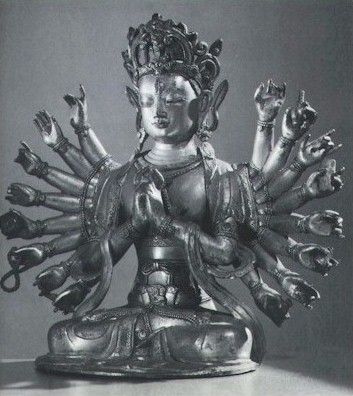
Gary Snyder, Smokey the Bear, Avalokitesvara and other Bodhisattvas

In Jack Kerouac's novel Dharma Bums the protagonist, alter-ego of Kerouac, named Ray Smith, encounters 'the number one Dharma Bum of them all', Japhy Ryder, who instantly decides that Ray is a great Buddhist sage, possibly a reincarnation of Avalokitesvara, the Great Compassion Bodhisattva (more likely, though, a reincarnation of Goat or Mudface, Ryder teases Smith later on), and when they enter a San Francisco bar together and their friends inquire where they have met, Ryder gleefully announces: "I always meet my Bodhisattvas in the street!"

This sets the tone for the whole novel, which is perhaps even more celebratory of its culture hero than On the Road was in its beatification of Neal Cassady, alias Dean Moriarty. The two protagonists share a relationship of mutual respect and growth - again with Smith as the more passive learner and Ryder as the master woodsman, wilderness survivor, mountain climber, haiku improviser, Zen riddler and seducer of young women into the practice of yabyum (Tantric sex...)

Ryder's real life model was of course Gary Snyder, the great Zen practitioner among the Beats - a poet who was also a student and scholar of oriental languages and texts, and later among the first poets instrumental in writing from a non-anthropocentric point of view, expressing a deep-ecology ethos and an eco-critical practise. Snyder has often warned that people should not take everything in Dharma Bums as complete truth, but he does acknowledge that Kerouac's description of his lifestyle is correct in most respects.

In the course of the novel Kerouac paints a very sympathetic portrait of Ryder, and unlike Moriarty in On the Road, this new Buddhist culture hero does not end up betraying the protagonist. Rather it is the Ray Smith figure who at the end abstains from following the hard path to enlightenment that Ryder has helped him embark on, and he decides to literally come down from the pinnacles after a season as a fire lookout on Mount Sourdough's Desolation Peak and once more rejoin the human community with all its temptations of the flesh. Still Smith misses Ryder who has gone off to Japan to live in a monastery and realizes what a strong, serious scholar Ryder will become.

Again, there are clear parallels between the novel and the real life of Gary Snyder. Snyder was born in San Francisco, but his family moved to the Pacific Northwest, where Snyder's father began working in the logging industry. Snyder developed a love of the land from an early age on, and acquired forest and mountain craft through interacting with his environment. He studied anthropology in Portland at Reed College and left there with a BA in 1951. Later he pursued graduate studies at Berkeley, switching from anthropology to Oriental languages, to further his understanding of both Oriental poetry and Buddhist scriptures. Snyder has written a mini-autobiography for Modern Haiku and in there he begins:

I was from a proud, somewhat educated farming and working family. After finishing college I went back to work. I went into the National Forests to be an isolated fire lookout living in a tiny cabin on the top of a peak. I worked as a summertime firefighter and wilderness ranger, and then spent winters in San Francisco to be closer to a community of writers.

This mixture of manual and intellectual pursuits came to mark Snyder's outlook in profound ways and is also one of the reasons behind the frequent comparison with Henry David Thoreau:

"If Ginsberg is the Beat movement's Walt Whitman, Gary Snyder is the Henry David Thoreau. "-- Bruce Cook

This and Snyder's riposte to the Thoreau comparison, along with a great number of other Snyder quotes can be found here. Whereas Thoreau had his Walden Pond, Snyder had his Pacific Northwest - an altogether more rugged and demanding terrain. Already from Snyder's first collection of poetry, the sense of place was one of the most striking features of his poems. His programmatic meta-poem "Riprap" (the title poem of that collection) perfectly illustrates the fusion of poetical practice and hard manual labour. The poem can be found in its entirety on-line here and here. The speaker's absolute certainty of the equal value of building a path up a mountain and composing a poem never ceases to amaze me: each stone and each word matters equally, and the "Solidity of bark, leaf or wall/riprap of things" leads straight out onto the "Cobble of milky way/straying planets" putting us in our place in the Cosmos (this line echoes with Ginsberg's "ancient heavenly connection to the starry dynamo [...] of night", but has no urban angst built into it). Snyder then draws us inward: "In the thin loam, each rock a word/a creek-washed stone/Granite: ingrained/with torment of fire and weight/Crystal and sediment linked hot/all change, in thoughts,/As well as things" - reminding us of the connection between thought and matter and the fiery origins of both. Fire is, in fact, Snyder's favourite element of change, signalling as much rebirth and life as destruction.

The other half of the first Snyder collection was made up of his translations of the Cold Mountain poems by Han Shan, a 9th century Chinese hermit poet, who took his name after the place in which he lived. Snyder's congenial translations indicate the strong identification between the young aspiring poet and the old master. Here is Snyder's translation of "Clambering up the Cold Mountain Path". The poem ends with a question reminiscent of a koan, or Zen riddle: "Who can leap the world's ties/And sit with me among the white clouds?" No doubt this reflects what Snyder desired to do...


Cover image from Riprap & Cold Mountain Poems

Snyder describes his years in Japan in the following terms:

I first arrived in Japan in May of 1956. Exposure to Buddhist scholars and translators soon brought me to the Zenrinkushû, that remarkable anthology of bits and pieces of Chinese poetry plus a number of folk proverbs as they became used within the Zen world as part of the training dialog. If one was looking at the possibilities of “short poems” the Zenrinkushû practice of breaking up Chinese poems would certainly have to be included. R.H. Blyth famously said “The Zenrinkushû is Chinese poetry on its way to becoming haiku.” Maybe it is that somebody — one of the old Zen monk editors — realized that practically all poems are too long and that they’d be better if they were cut up. So he cut up hundreds of Chinese poems and came out with new, shorter poems! I now know I was extremely fortunate to have been exposed to the elegant “Zen culture” aspects of Kyoto. But as I traveled around Japan I came to thoroughly appreciate popular culture, ordinary people’s lives, and the brave irreverent progressive vitality of postwar Japanese life. I realized that the spirit of haiku comes as much from that daily-life spirit as it does from “high culture” — and still, haiku is totally refined.

The practice of haiku was already introduced to the American readers by scholarly translations of Basho and other masters of the form, but a much more efficient boost of cultural transfer was performed by the characters of Dharma Bums who trade off spontaneous haikus during a climb of Mount Matterhorn in California like a couple of jazz-men trading riffs and licks. Smith teaches Japhy to be spontaneous, Japhy teaches Ray the discipline of mind required for the haiku to have an enlightening effect. Kerouac has published many of these so-called western haikus (they don't conform to the syllable structure (3 lines of 5-7-5 syllables, respectively) that Japanese haiku poetry always follows) in books such as Pomes All Sizes, Scattered Poems and Some of the Dharma. Read more about Kerouac's western haiku practice on this page.

Before going to Japan, Snyder had also been hitchhiking extensively up and down the West Coast, sometimes accompanied by Ginsberg, who had become friends with him after both men had participated in the legendary Six Gallery reading in late 1955. Here is a recent interview where Snyder recalls their reading at Reed College - a tape of which, containing the earliest known reading of "Howl", has just surfaced.

Snyder had also spent several summers working as a fire lookout for the Forest Service. He recommended Kerouac for the job, and the summer of Snyder's leaving for Japan, Kerouac manned the small look-out cabin on Sourdough Mountain in the North Cascades. An excellent volume commemorating the stays of Snyder, Kerouac and Philip Whalen on Sourdough has been produced by the very same person who unearthed the "Howl"-tape, John Suiter. His Poets on the Peaks site has sublime photography showing us the things these young men may have seen in the 1950s summers they spent up there in splendid and sometimes terrifying isolation. Kerouac wrote about this experience in two novels, Dharma Bums (somewhat romanticized) and Desolation Angels (with more of an emphasis on the terrors of the void)...

I think Snyder's work as a fire lookout was directly instrumental in his choosing Smokey the Bear as yet another avatar of the Great Sun Buddha. In what is the funniest Snyder poem I have ever read, "Smokey the Bear Sutra", the friendly figure known to every child in America becomes both holy, sublime and hilarious in the best "Zen Lunatic" tradition. You can read the poem here (although Snyder graciously allows us all to "reproduce it free forever", it is a bit long to quote in full here...)

Suffice it to say that Snyder lets his readers participate in a hitherto unheard of non-human centered audience given as "a Discourse to all the assembled elements and energies: to the standing beings, the walking beings, the flying beings, and the sitting beings -- even grasses, to the number of thirteen billion, each one born from a seed, assembled there." This message is about the Future of Turtle Island (perhaps better known to the white man as America), where trouble is brewing: "The human race in that era will get into troubles all over its head, and practically wreck everything in spite of its own strong intelligent Buddha-nature..." Only the figure of Smokey will emerge to put out the uncontrollable wildfires and other destructions that mankind has unleashed on the earth:

With a halo of smoke and flame behind, the forest fires of the kali-yuga, fires caused by the stupidity of those who think things can be gained and lost whereas in truth all is contained vast and free in the Blue Sky and Green Earth of One Mind; Round-bellied to show his kind nature and that the great earth has food enough for everyone who loves her and trusts her; Trampling underfoot wasteful freeways and needless suburbs; smashing the worms of capitalism and totalitarianism; Indicating the Task: his followers, becoming free of cars, houses, canned foods, universities, and shoes; master the Three Mysteries of their own Body, Speech, and Mind; and fearlessly chop down the rotten trees and prune out the sick limbs of this country America and then burn the leftover trash.

This figure of trust and ancient wisdom - but also the bearer of a cleansing fire - will herald a new age for "Those who love woods and rivers, Gods and animals, hobos and madmen, prisoners and sick people, musicians, playful women, and hopeful children", who, chanting Smokey's mantra: "DROWN THEIR BUTTS - CRUSH THEIR BUTTS", will make the world safe, so we will all have "ripe blackberries to eat and a sunny spot under a pine tree to sit at. AND IN THE END WILL WIN HIGHEST PERFECT ENLIGHTENMENT." Amen!

With this radical turn into eco-critical poetry the mature Snyder tone is established. In my session this week I spoke about Snyder's poetics and its heritage from Transcendentalism and the American Romantic age, esp. in its belief in a chain of beings and a transmission of the divine through all beings, the poet being but a conduit. You can learn more from my agenda for analysis for Snyder which suggests his techniques, themes and some contexts for his work.

In my session I also suggested that Snyder was a catalyst for the meeting of East Coast Beats and West Coast poets (often discussed as the San Francisco Renaissance), but more than that he helped seed the central Beat figures with a more Orientalist outlook, turning them on to Buddhist beliefs and ancient poetry of the East, and furthermore I see him as setting Ginsberg on the course that made him a lynch-pin between the Beat Generation and the 1960s multifaceted Counterculture - a movement Snyder also enthusiastically joined upon returning to the US in the late 60s.

I want to close with a clip from one of the few documentary films on Snyder. It can be found in four instalments on YouTube. Here I embed the first bit and after that you'll see links to the other three...


Episodes 2, 3, and 4

Here is the Gary Snyder Reader: Prose, Poetry and Translations 1952 - 1998 which will give you 600 pages of poetry, essays, interviews etc. to peruse... It contains good selections of poetry from Regarding Wave, Turtle Island, Axe Handles, and Mountains and Rivers Without End, as well as prose from Earth House Hold, A Place in Space, The Real Work and The Practice of the Wild.

Snyder is also well represented in the Buddhist Beat reader, Big Sky Mind: Buddhism and the Beat Generation, ed. by Carole Tonkinson (out of print, but available second-hand)

Here is a more recent picture of Gary Snyder:


Minnesota Public Radio has audio files featuring Snyder...

Snyder is very much still with us, dwelling among the species that surround us. His most recent book of essays came out in paperback a month ago: Back on the Fire. Most recent poetry collection was Danger on Peaks (2004).

Long may he remind us of our place in space!


Photo: Anne Braaten
View of Hozomeen Peak from Desolation

Tuesday, February 26, 2008

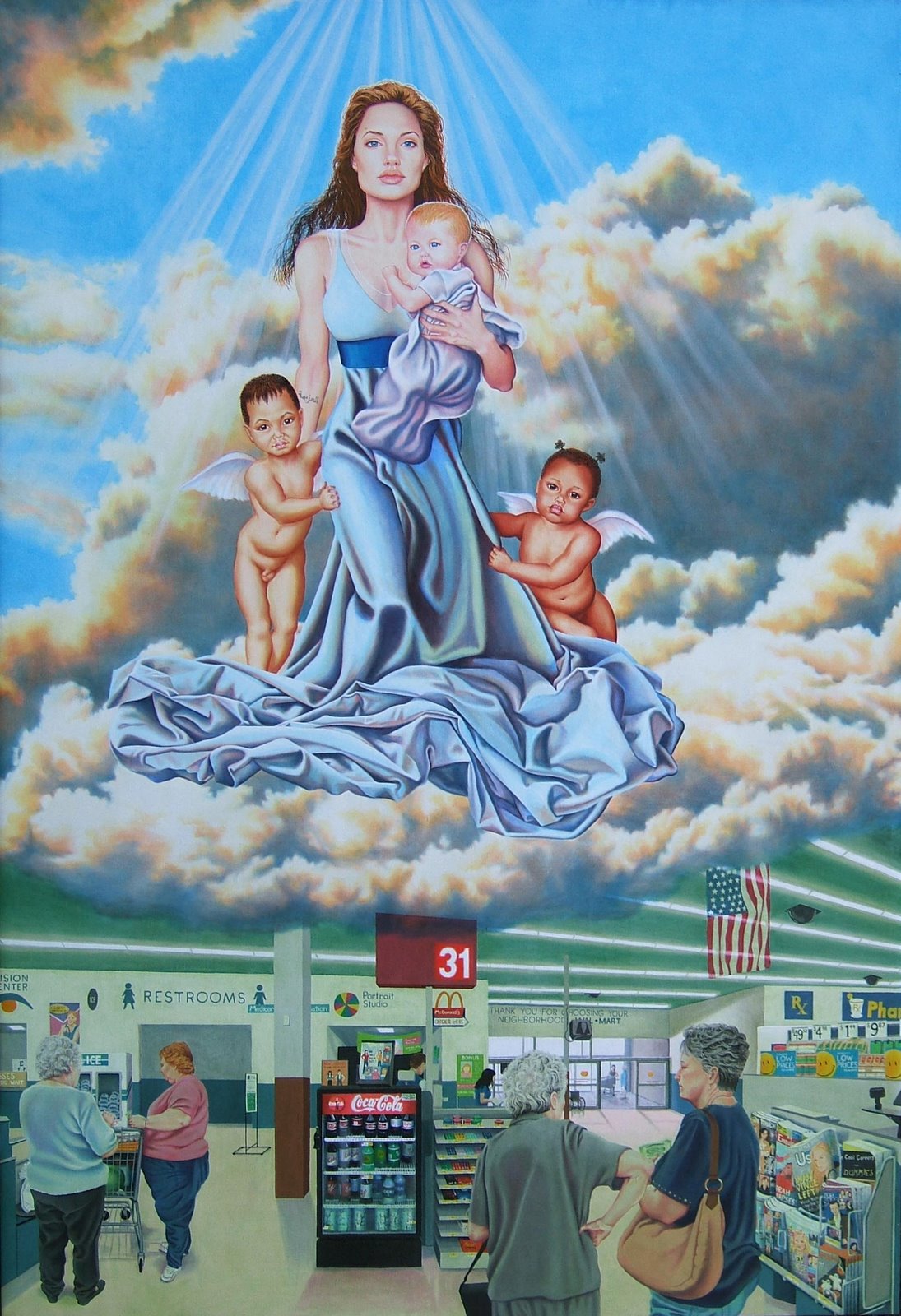
Celebrity Pastiche

Recently, no less than three glossy magazines published photo serials which reenact earlier high points of visual culture:

(Please note, that the last two links contain nudity.)

While the timing may be coincidental, it is surely symptomatic of celebrity culture today. As Amy Henderson points out, celebrity culture has always been part of a culture's self-definition ("Media and the Rise of Celebrity Culture"). By this logic, celebrity culture seems to be looking backwards as much as being interested in the current celebrities. With George Clooney on the cover of TIME Magazine with the caption "The Last Movie Star", there definitely seems to be some sort of eschatology at work in these photo shoots.

The religious connotations of eschatology are not coincidental, as celebrities generate a distinct cultish aspect through their relationship with the fans. Many celebrities, if not all, function as idols worthy of worship, and the films they star in, the music they produce, the clothes they wear, all have a distinct aura which is desireable for the followers. Yet, for many of the newer celebrities such as Lindsay Lohan and Jessica Alba, they have little in the way of proper cultural production to enforce their celebrity status. Whatever one might feel about Herbie or Flipper as cultural entertainment products, these are not exactly productions that build long-lasting acting careers.

These new celebrities end up in a particular relation with their followers; they become celebrities based on a certain shared experience for some of them - they became stars when they were young, and in productions aimed at people their same age. Therefore, a kinship can be said to exist between teen celebrity and teen follower, since they have been part of each others lives for a long time.

Also, they become celebrities in the newer sense of the word that Joseph Epstein traces to Daniel Boorstin in his book The Image: Or What Happened to the American Dream ("The Culture of Celebrity"): "a person who is well-known for his well-knownness". Lohan and Alba are famous because they have always been famous, and part of their followers' lives. The same goes for a number of other celebrities, who are still too young to be considered true stars, in the original sense of having proven themselves somehow "worthy" of worship.

This is where the past enters the stage, for what can be more worthy of worship than classic Hollywood culture? Hitchcock and Monroe can serve as master-icons, lending their glamour to the new, upcoming celebrities, thus creating a strange feedback, where the old icons are revived because new celebrities reenact their original iconic status, while the new celebrities can obtain more celebrity status by serving at the alter of the old masters (male and female).

It is this relationship between the old and new celebrity icons which is interesting. There is no parodic thrust to any of these shoots, but rather a desire to recreate, perhaps even channel or ressurect, the old icons. Margaret Rose refers to pastiche as reviving things from the past, without parody's incongruous structure or comic effect (Rose, Parody). This seems to be a perfect description of these shoots, which also overlaps with Gerard Genette's understanding of pastiche as imitative (Genette, Palimpsests).

Working from Genette's definition, Linda Hutcheon points to the fact that pastiche functions as the desire for similarity rather than difference. (Hutcheon, A Theory of Parody). This is perfectly clear in the different shoots, as their main purpose is to draw a parallel between the new celebrity and the old, establishing a connection meant to increase the celebrity capital of the new icon.

This desire is most obvious in the case of Lindsay Lohan's recreation of Monroe's "Last Sitting". Monroe's shoot for the Look Magazine has been called "The Last Sitting" because it was her last photo shoot. Already here, the religious connotations are clear, the name echoing "The Last Supper of Christ". In the case of Monroe, the parallel to Christ seems to come from the sacrifice that happened to them both; Monroe's death has always been seen as tragic and as a response to the surrounding pressure of her life. Connecting her death to that of Christ also shows that not only is celebrity partly defined as cultish, but also that celebrity status is always bound up in some form of referral to an earlier icon.

Lohan's pastiche of Monroe is as full as possible, recreating both hair, make-up and poses. The intention is clear: Lohan is the Monroe of our time and these photos establish that. From a critical point of view, the situation is somewhat different: Lohan wants to be the Monroe of our time, and so imitates one of the most famous photo sessions Monroe ever did. Through this recreation, Lohan hopes to gain celebrity capital by attempting to reproduce a similarity with Monroe, rather than a difference.

Many of Lohan's followers might not be aware of the original which is being imitated here, but the poses remain a significant part of American culture, and it is likely that they are known by people who do not know who Marilyn Monroe was. The iconocity of her poses extends beyond the historical knowledge of Monroe. Lohan's photos would still strike a familiar note and provide her with a degree of validity and celebrity capital.

The case of Vanity Fair's Hitchcock tribute is slightly different. There is no particular reason for why Vanity Fair would do these Hitchcock stills now, other than the fact that this is the Oscar season and all forms of film and film history are more interesting right now. This is further emphasized by the fact that many of the actors used are nominated this year (Julie Christie, Javier Bardem, Marion Cotillard) or have won in the past (Jodie Foster, Renée Zellwegger). Most others have made significant and artistic films, rather than simply popular films.

In other words, there is less a desire for borrowing celebrity capital from Hitchcock and his classic films. Instead, I would argue, the point is to establish that these celebrities are worthy of recreating such classic moments. They have proved their worth in the Hollywood industry and can be permitted to take on the old master. Rather than an attempt to increase their celebrity capital, it is matter of the celebrity culture industry - of which Vanity Fair is certainly one of the leading producers - "knighting" these celebrities, by allowing them to imitate Hitchcock.

Here it is the industry itself which stands to gain from this imitation. By using currently popular icons to recreate classics, they establish that current celebrity culture is just as vibrant, significant and accomplished as old celebrity culture - nothing has been lost. While there is nostalgia at work in these photos, it is a double-coded nostalgia meant to reinforce current culture as much as past culture. The imitation is thus still used to emphasize similarity over difference.

Which only leaves Jessica Alba's recreations, which is an interesting case of similarity. Alba's photos come from Latina Magazine which obviously caters to the Latino population in USA. Alba is a Latino star, because she has gained celebrity status in spite of this Latino heritage. Allowing her to recreate classic film moments, is thus to emphasize her status in Hollywood and celebrate that her difference has not inhibited her career. However, there is a certain irony in the choice of films.

All of the films Alba imitates star white females: Scream, Psycho, The Birds, Rosemary's Baby and The Ring (this is assuming that we are talking about the Hollywood remake of The Ring rather than the Japanese original, something I consider a safe bet). In other words, Alba can only obtain celebrity status by imitating white female icons. We end up being back at similarity rather than difference. Alba is not a celebrity because she is a Latino, she is a celebrity because she can imitate being white. I'm sure there are Latinos that will disagree with me, in fact I hope so, but this does not change the fact that the stars Alba imitates are all white. White is the original celebrity icon, and this has not yet changed, unfortunately.

The final point to be made here, is about celebrity culture as a whole. It seems to me that celebrity culture is turning into a pastiche itself. As Tom Mole points out, the classic understanding of celebrity culture is "structuring the production, distribution and reception of texts around the mystique of a particularly fascinating individual" (Mole, "Hypertrophic Celebrity"). As these photo shoots show us, there is also a new emergent behavior where production, distribution and reception is not structured around the mystique of a fascinating individual, but rather the mystique of the history of celebrity culture itself. Celebrity culture no longer has icons, but imitations of older icons.

As I briefly mentioned in relation to Marilyn Monroe, this has always been the case, but the difference now is that the feedback loop between historical celebrity culture and contemporary celebrity culture is ever decreasing. The Ring was (re)made in 2002 but is already a classic in the vein of Psycho and The Birds. The production of celebrity culture is now as much the imitation of the production of celebrity culture.

References
Epstein, Joseph. "The Culture of Celebrity". The Weekly Standard, volume 11, issue 5.
Genette, Gerard. Palimpsests.
Henderson, Amy. "Media and the Rise of Celebrity Culture". OAH Magazine of History
6 (Spring 1992).
Hutcheon, Linda. A Theory of Parody
Mole, Tom. "Hypertrophic Celebrity." M/C Journal 7.5 (2004). 25 Feb. 2008 .
Rose, Margaret A. Parody: Ancient, Modern, and Post-Modern.
Stein, Joel. "Guess Who Came to Dinner?", TIME Magazine, vol 171, no. 9, March 2008.

Monday, January 21, 2008

Wood S Lot

The exquisitely designed culture/theory/aesthetics portal, Wood S Lot, has been showing us some 'blog love' over the last couple of days - for which we thank them, and reciprocate...

I am always very inspired by their photography finds - check out this wintry image, for instance. There is always something to look at and think about on the 'Lot', and before you know it you find yourself delving into images from Wisconsin history, or contemplating the circular wisdom of quotes like this one:

Beware of thinkers whose minds function only when they are fueled by a quotation.
- E.M. Cioran


Best not think too much about that one...!

Friday, January 18, 2008

Going to the Chapel?


Those of you who can read Danish might be interested in visiting Kulturkapellet, a new Aalborg based portal featuring reviews of all things cultural. It covers film, literature, theatre, music, games and the arts. Also featured are occasional essays - slightly longer and more 'academic' pieces on cultural and philosophical issues. There are also reviews of non-fiction - and one piece for instance is of clear Am. Studies interest: Steen Christiansen's piece on Apokalypsens Amerika. More are sure to follow... The 'Chapel' welcomes guest reviewers if anyone cares to sign up - check the contact page for details.

Saturday, December 29, 2007

Peace on Earth?

As Stuart said in his latest post, things have been quiet here in the Atlantic Community, if not in the world at large... So, I thought I would disturb the peace ever so slightly by drawing your attention to this image by Kate Kretz which seems to carry its own message about peace on Earth, good will to Man (and women and children). Hope the last of your holiday meals won't go down the wrong way...

PS: My interest in this image is not entirely frivolous, as I am currently writing a book on American Icons - Transgression and Commodification.

Tuesday, December 18, 2007

“They Say They Put a Man on the Moon”: Fallen Astronaut – Violence, Bodies, and Moon Art

I have graciously been invited by Stuart Noble to occasionally contribute a blog entry here at The Atlantic Community. As for topics and themes, I am a literature/culture studies guy. I don't do politics, history, society - except through their manifestations as/in texts... This of course doesn't mean that I as a person am a-political, quite the contrary. However, I prefer to leave writing about strictly socio-political topics to others. My main 'thing' research-wise is the Beat Generation and attendant stuff, including the 1960s, counterculture, music, lyrics, film etc. All things off-beat and oppositional interest me, regardless of period and genre. I usually sum the above credo up in the phrase 'I do cultural text studies' - that's my field and my life (such as it is).

– Bent Sorensen, Aalborg University

I debut with the below piece on a little known aspect of the Space Race of the 1960s and 70s...

“They Say They Put a Man on the Moon”: Fallen Astronaut – Violence, Bodies, and Moon Art

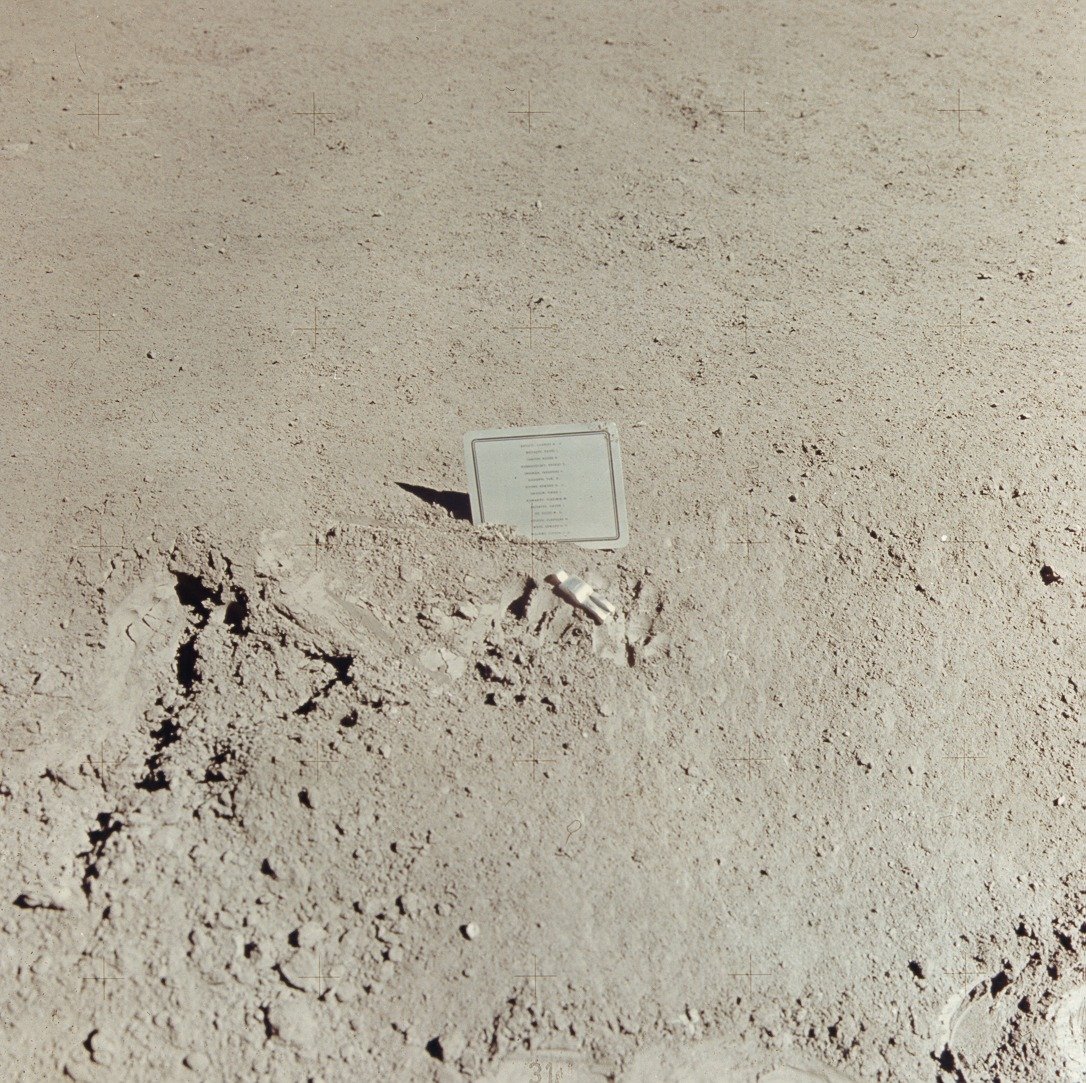
“The only piece of art on the moon is a 3”-tall aluminium sculpture titled Fallen Astronaut. It was created by Belgian artist Paul Van Hoeydonck and installed by Apollo 15 astronaut David Scott, along with a plaque bearing the names of the 14 astronauts and cosmonauts who died in the service of space exploration prior to 1971.” This startling message on a website called The Proceedings of the Athanasius Kircher Society captured my imagination, as the art piece in question seemed to raise a number of interesting aesthetic and political issues and questions.

See photo of Fallen Astronaut here


First of all, it is striking that the only art-work on the Moon is commemorative in nature (as indeed much American art honouring the heroic dead is), whereas in the public imagination of the 60s and 70s the Moon was often associated with the future (promise of expansion), rather than the past.
Secondly, the role of the astronaut in ‘installing’ the art-work raises interesting issues about the production of art and agency vis-à-vis an individual piece. And when did astronauts become artists?
Third, the role of the spectator or audience for this work seems particularly problematic – after all the piece is on the Moon and has never been revisited, seen or documented since its original installation, or to be even more precise, may very likely no longer be intact, given the extreme temperature spectrum of the environment it was placed in and the lack of a protective atmosphere up there. The moon, in other words, seems a particularly violent and destructive milieu for a work of art to be in.
Fourth, taking into consideration that the piece itself is not on public display and known to us exclusively through its mediated forms, i.e. photos kept in NASA’s archives and reproduced in various ways on web sites and in other mass media, and replicas of the sculpture found at the Smithsonian Institution in Washington, we are forced to reflect on wherein the piece really consists: Hoeydonck’s preparation of the figurine (apparently not documented) and the astronauts’ construction of the plaque (not documented), the original gesture of installation performed by Scott when he dropped the figurine into the moon dust in 1971 (not preserved in images and ‘covered’ by inane communication with Ground Control on the audio tape), the act of documenting the piece with a camera, performed by Scott immediately after the installation, or the act of publicizing the performance which the astronauts carried out at their press conference after returning to Earth – or all of the above.
Fifth, the apparently simple homage to heroism embedded in the installation seems to be problematized by the peculiar contract between Van Hoeydonck and the Apollo 15 crew not to make money off the event, the piece or replicas thereof – and not least the fact that this contract was apparently broken by Van Hoeydonck in 1972 when he took steps to sell 950 signed replicas of the piece at 750$ a pop. There is thus a tension between publicizing the piece, which the astronauts clearly desired to do, and making money off the piece, which could potentially be used to support the families of the fallen, but which at least in the official story was anathema to the astronauts.
Sixth, and finally, the fact that the names on the memorial plaque are those of both American astronauts and Russian cosmonauts points to a surprisingly political gesture on the part of the Apollo 15 crew: in the midst of the Cold War space race this reminder of the shared respect for the profession of space traveler and fellow soldier harks back to traditions from other wars where soldiers from the warring sides found a common ground and respect, before proceeding again to attempt to slaughter one another. Thus, rather than a gesture of detente, the inclusion of Russian names in an American memorial is a nostalgic gesture backward to ‘good’ wars of the past where enemies were also fellow human beings – an innocence the loss of which was marked by WW II (Holocaust and Hiroshima) and proved gone for good by the horrors of Vietnam.

The representation of the fallen body (both fallen in the sense of literally dropped from a height, and of course fallen in the metaphorical sense of killed in the line of duty) in the piece also seems problematic in interesting ways. One thing is that the figurine seems to consist of torso, legs and head only, which has prompted wits on the web to comment: ‘Great, now the aliens will think that we humans have no arms or hands’, but perhaps more strangely the figure bears very little resemblance to a man in an actual astronaut/cosmonaut suit. Rather the figure resembles a toy a child might want to play with, and very much looks its actual petite size of all of three inches, making this piece one of the smallest works of memorial art in existence… It is understandable that the figure had to be small to be carried concealed to the moon (like the stamped envelopes the astronauts wanted to flog to philatelists around the globe, the pieces of the art work were not declared among the astronauts’ personal belongings upon embarking on the mission), but the minuscule figure seems to be the antithesis of the usually larger than life human figures customarily used in memorial art. The entire scale of the piece, including the plaque, is in stark contrast to the monumental size used in most memorials, for instance the Space Mirror Memorial which was placed at the Kennedy Space Center in Florida in 1991 and which features a 42 ½ foot high by 50-foot wide black granite surface, listing the names of 24 fallen American astronauts. Thus the Earth-based memorial appropriately signals considerably more gravitas than the Moon-based miniature does.

Apollo 15 was the 4th successful moon landing mission carried out by NASA. Since Neil Armstrong’s ‘one small step for a man’ in 1969, 5 other astronauts had set foot on the lunar surface, prior to David Scott and James B. Irwin’s visit in July and August of 1971. Apollo 15 was the first moon mission to bring a vehicle, the Falcon Lunar Rover, to the surface of the Moon, and
one celebrated photo of the astronauts and their Corvettes together with the Lunar Rover indicates the link between American car culture and the conquest and desired Americanization of the Moon. Unbeknownst to NASA the astronauts of Apollo 15 seem to have carefully planned a secondary agenda to their Moon mission. Each astronaut was allowed to carry a so-called PPK (Pilot’s Preference Kit) containing personal items and other objects destined to become memorabilia after the flight. It was customary for NASA to allow each astronaut a great deal of discretion regarding the nature of these personal items. The Apollo 15 crew was unusual in at least two perspectives in their choice of PPK content. First, they carried with them a great many stamps and envelopes which they intended to sell to philatelists and the profits from which they intended to use for trust funds for their children’s education. In this sense the astronauts were good Americans in the way they showed entrepreneurial instincts and understood the intricate links between fortune and fame. Second, and more uniquely, the astronauts had decided that, in the face of the near fatality of the Apollo 13 mission and the June 1971 deaths of the entire Soviet Soyuz 11 crew, the time was overdue to honour the numerous heroes who had died in the course of the history of the two competing space programs.

For that purpose the astronauts had a plaque manufactured listing the names of all known dead astronauts and cosmonauts, plus they contracted with a semi-obscure Belgian artist, Paul Van Hoeydonck, to create a figurine representing the body of a fallen astronaut, leaving out all identifying signs of nationality, gender and race of the figure. Because of NASA’s strong insistence on the non-commercial nature of space (something that did not bother the astronauts in their stamp enterprise) Van Hoeydonck had to agree to anonymity and to refrain from later trying to capitalize on the art piece. After the stamp scandal was revealed by NASA’s post-mission audit, it is hardly surprising that Van Hoeydonck no longer felt duty-bound by his agreement with the crew.

NASA keeps very meticulous and voluminous documentations of all their missions, not least of the Apollo era flights. A sound log, a TV, film and photo image log, as well as transcripts of these logs are available from
NASA’s web site. From the audio transcript it is clear that Scott and Irwin who were on the lunar surface deliberately kept ground control in the dark as to their intent to install the Fallen Astronaut memorial on the lunar surface. The installation took place shortly before the crew was scheduled to depart the Moon. Among the last activities prior to lift-off was Scott going to park the Lunar Rover in its final resting place and to position the TV camera to shoot footage of the lift-off. In the meantime Irwin was loading moon-rock specimens into the lunar landing module. When asked by ground control, who were puzzled by long pauses in Scott’s communication with them, to account for his “present activity”, Scott fibs: “Oh, just cleaning up the back of the Rover, here, a little, Joe.” In reality he was setting up the art piece and taking high quality photos of the scene. There are 2 photos of the plaque showing behind the Lunar Rover and 2 close-up photos of the piece itself. Scott has commented on the transcripts of the sound log, published in the Apollo 15 Lunar Surface Journal: “We made a plaque for all the astronauts and cosmonauts that had been killed. And a little figurine, a Fallen Astronaut, and we put it right by the Rover. You can see it in the picture. That was just a little memorial, in alphabetical order. In relative terms, we had both [meaning the Russians and the Americans] lost a lot and, interestingly enough, we didn't lose any more after that until Challenger. That’s what I was doing when I said I was cleaning up behind the Rover. Jim knew what I was doing. We just thought we’d recognize the guys that made the ultimate contribution.”

Another aspect of the memorial activities performed by Scott in this connection must be discussed. This is not mentioned in the sound log, nor is it referred to in the commentary cited above, and apparently therefore never hitherto been considered as an extension of the installation of the Fallen Astronaut. However, from several of the astronaut memoirs available and from letters written by Irwin, it is known that Scott also placed a small copy of the Bible, bound in a red cover, on the Lunar Rover. In
enlargements of the final Lunar Rover photographs the Bible can be spotted propped up against the drive control handle. Thus the memorial service for the fallen is completed with the presence of scripture as is fit for such a ceremony. As Scott commented above, Irwin knew about Scott’s activities, and I am confident that he also knew about the presence of the Bible, and perhaps supplied the book himself. It is well known that Irwin was a practicing Christian and several of his books testify to this fact (at least one is published by The Baptist Sunday School Board), and he has stated, without specifying the nature of these objects, that he also left several objects on the lunar surface near the Landing Module. One might speculate that these objects also testify to the Christian faith of the astronauts, supplementing the nationalist sentiment of the American flags routinely planted and left behind on the Apollo missions. Of course, the presence of the Bible as part of the installation changes the tenor of the piece as a work of art, rendering it far more conventional and ceremonial than what has previously been noticed by the relatively few commentators who have written about the event, and who have tended to inscribe the Fallen Astronaut in a more avant-garde push toward conquering a new frontier for art, rather than seeing the piece as having a commemorative and votive function. However, Scott’s comment that “interestingly enough, we didn’t lose any more after that until Challenger” indicates clearly that the performance of the Fallen Astronaut was also intended to ward off future evil, and therefore is best regarded as a religious ceremony.

The astronauts were thus seemingly caught between desiring an intensely private communion with their maker and their dead mates on the one hand, and the obvious need to publicize the ceremony on the other, since a) the news would clearly come out (at least within NASA) once the photos were brought back to Earth and developed and b) the effect of the installation presupposed that it had an actual audience. The covert activities thus needed uncovering, and the astronauts decided to use the first occasion they would have to address the public to break the news of the Fallen Astronaut. The first post splash-down press conference was an obvious choice of venue, since the astronauts would not yet have been debriefed by NASA and censorship was therefore out of the question. NASA was consequently faced with a de facto admission which needed careful spin. The policy decided upon was apparently to, on the one hand, condone the seeming gesture of reconciliation between Cold War foes (the press conference footage was included in the official
NASA mission video), but on the other hand to make sure that neither Scott nor Irwin would fly space missions again. The stamp scandal became the convenient means through which the latter objective could be attained. In a carefully worded press statement, released by NASA in September of 1972, the compromise is laid out fairly plainly:
“In a post-mission press conference, the crew reported the memorial ceremony and, in keeping with their understanding, did not reveal the sculptor’s name. In November 1971 the Smithsonian Institution indicated a desire to display a replica of the memorial statue and plaque; the Apollo 15 crew agreed under the conditions that the display be in good taste and without publicity. Scott undertook to get the replicas for the museum. In March 1972, Scott forwarded replicas of the plaque to the museum. In April, responding to Scott’s request, Van Hoeydonck presented the museum with a replica of the statuette. The replicas are currently on display there. In May 1972, Scott learned that further replicas of the statuette might be offered for sale. He wrote Van Hoeydonck asking him to check on this rumor. In his response, Van Hoeydonck confirmed that replicas were intended for sale and indicated that he felt no constraints or restrictions in this matter. The Apollo 15 crew strongly disagree with this position, feeling that their solemn understanding with Van Hoeydonck prohibits any such commercialization.”

The astronauts were forced to refrain from access to the monies accrued them via the sales of stamps, and the astronauts were also mandated to distance themselves from Hoeydonck’s plans to sell replicas of the Fallen Astronaut. Such plans were also to be preempted by the Smithsonian’s decision to commission their own replicas of the installation, which of course in a quid-pro-quo granted the astronauts' actions an element of official consecration. This compromise was however a dear price to pay for the astronauts, esp. Scott who had flown both Gemini and earlier Apollo missions and reasonably could have expected a John Glenn-like further career within NASA. He retired from active service in December 1975, and his
official NASA bio, dated from that month, reads rather more like an obituary. The three replica plaques are still in the Smithsonian collection, but it is unclear whether they are at present on display, just as there are no photos in the on-line archive of any figurine, rendering it uncertain what has happened to the specimen Van Hoeydonck delivered to the Smithsonian, according to NASA.

NASA’s own idea of the proper way to honour the American fallen Astronauts is reflected in the Reagan/Bush-era monument I referred to earlier,
The Space Mirror Memorial. Its grand scale and use of high technology to ensure that the granite slab is constantly tilted to be backlit by sun rays (or artificial light during night and occasional cloudy Florida days) is more in tune with a Star Wars epoch in American foreign policy. Gone are all traces of Russian cosmonaut names, and gone are also all traces of an overt Christian symbolism. Instead, according to the Astronauts Memorial Foundation’s website describing the monument (The text is in fact borrowed from CCT, the tech supplier's description): “The sun’s rays are projected through the names of the astronauts, which are engraved through the granite. The letter spaces are filled with crystal clear acrylic, minutely jagged on the front side to diffuse the light.” This rather kitschy light show is clearly designed to draw spectators to the site, who then are expected to be duly impressed with the monument's “unique blend of art and science”. The Granite slabs currently feature 24 names, but have great potential for extension as the number of space industry casuals grows (Space shuttle disasters mean an additional 7 names every time).

The biggest controversy, however, has ironically been in connection with the omission of one of the early casualties of the space race, Major Robert H. Lawrence, the first black man selected to participate in the space program and to enter astronaut training (in the so-called MOL program, then not under NASA auspices). He was tragically killed in training before he could participate in any space mission, flying an F-104 jet when it was destroyed in an accident in December 1967. 4 other astronauts have died in T-38 training plane accidents and one has been killed flying an X-15 test plane, all of them having been selected as astronauts, but none of them making it into space. All these deaths occurred in the time span from 1964 to 1967, and these 5 astronauts were included in the original 1991 roster of names on the Space Mirror Monument. Still, Lawrence was not added to the roster until 1997, 30 years to the day after he, as his
official obituary at the Space Mirror site now reads: “made the ultimate sacrifice and lost his life in service to the nation and the space program on December 8, 1967 at 32 years of age”. It took pressure from African-American interest groups to gain him this posthumous recognition. Lawrence still has no official NASA biography. His name also did not feature on the Fallen Astronaut plaque in 1971.

What seemed to have been a rather curious and innocuous event which unfolded relatively quietly on the lunar surface in 1971, actually turns out to have interesting and far-reaching repercussions in the political, historical and cultural realm today. There are signs that the Fallen Astronaut is cusped to enter into the pop-cultural iconosphere of this decade, not least because art is searching for its final frontier and many artists, art critics and art historians are searching for inroads into developing a form of space art of relevance to our continued life on a small troubled planet. They therefore need precursor texts to construct such a history of art in space, as for instance is shown by Arthur Woods’ piece “A Brief History of Space Art” which really is a vehicle for attempted fundraising for his own space art projects, such as “Cosmic Dancer” and other sculptures to be sent into space. Woods even goes as far as to include a possibly apocryphal piece of space art, which if indeed it turns out to be real, would be the first piece of art on the moon. I am referring here to what I believe is an urban legend, the story of a ceramic tile about half the size of a postage stamp, which purportedly was affixed to the lunar landing module of Apollo 12, and featured the work of six very high profile American artists etched into the tile: “Robert Rauschenberg drew a straight line; Andy Warhol drew a penis; Claus Oldenburg drew the image of Mickey Mouse; and John Chamberlain, Forrest Myers and David Novros all drew geometric designs”. This piece, supposedly titled The Moon Museum, must, however, necessarily remain the topic of another, future American Studies Space Criticism paper.

Monday, December 10, 2007

Groove Music: Technology, Race, and the Cultural Politics of Turntablism

This new project by Rayvon Fouche looks fascinating.

David Nye introduced Rayvon Fouche's work to me via a great article, "Say it Loud, I'm Black and I'm Proud." His concept of "Black Vernacular Technological Creativity" and his analysis of "Black Technological Agency" as; "redeployment, reconception, and re-creation" provides an interesting framework for any analysis of social constructions of technology. Granted, Fouche explores the unique cultural productions within African American communities. Fouche suggested, for example, that had Blacks invented the typewriter it would have been far more percussionist in design, reflecting African drum culture. I look forward to Fouche's analysis of turntablism as "Black Vernacular Technological Creativity" which he only briefly develops in the above mentioned article. I see further possibilities for exploring turntablism as postmodern cultural production. Technological agency aside, "mixing, scratching and re-mixing" are distinctly postmodern modes of mentally filtering data. Early Hip-Hop culture was well ahead of what would later become mainstream modes of comprehending music and information with the advent of personal computing and the internet.

Abstract

The phonograph was never intended to be a musical instrument. Yet this technology is now at the center of a thriving, global performance art known as turntablism. This proposal requests funding to support research examining the cultural and technological transformation of the phonograph into a vehicle for musical expression within hip hop culture. This transformation, which began in New York City's African American community in the late 1970s, is unique since a marginalized community reappropriated and redefined an existing and popular technology according to its own distinctive cultural aesthetics. This project will document how turntables as technological artifacts of hip hop have produced musical genres with loyal devotees, mediated multiple cultural relationships, and contributed to the global dissemination of black cultural aesthetics. Given the transformation of the turntable, this project will examine: how national, cultural, ethnic, and racial politics of identity influence technological design, choice, and use. The PIs will seek to understand how ideas of race, ethnicity, and culture have influenced the technological design of turntables and associated turntablist equipment, and to understand the influence of developing turntablist technology on musical originality. It will entail comparative work examining how turntablist communities in the United States and Japan contribute to the production of a hybrid global technological movement by defining, appropriating, and reconstituting the racial, cultural, and technological aesthetics of turntablism. It will produce a study that will move beyond turntables and provide insights into technological transitions from analog to digital affect a variety of cultural communities. Intellectual Merit: This project will contribute to work on music in STS and on technology within musicology, and produce new ways to think about the race in relation to technology. This comparative study will augment the understanding of race and technology. The study will also consider the effects that the larger transition from analog to digital technologies will have on our society. Broader Impacts: This research will show the connections between music, race, and technology. It will show that music can be an important avenue for marginalized peoples to engage technology in a proactive way. This project will facilitate the coalescing of faculty members and students interested in investigating how music, race, and technology interact.

Sunday, September 02, 2007

American Dreamer


American Dreamer
by Paul Goldberger September 2007

If Lauren's vision of America was invented out of whole cloth—no pun intended—that hardly matters. Today, his odes to American style are American style to the rest of the world. Polo Ralph Lauren is the one American brand that has a significant international presence, on a par with Prada, Gucci, Chanel, and Louis Vuitton. The only American name that comes close to Lauren as a global luxury icon is Tiffany, and it doesn't make clothes. Ralph Lauren makes pretty much everything, and you can buy his products as easily on New Bond Street, in London, and in the Ginza, in Tokyo, as in Chicago and Dallas. Lauren's stores in Jidda, Riyadh, Kuwait City, Dubai, and Tel Aviv—not to mention Munich, Athens, and Shanghai—are the best advertisements for America that you could ask for. Ralph Lauren should get an award from the State Department, since he has done more for this country's image than the Voice of America. When you walk into the Polo Ralph Lauren shop on Place de la Madeleine, in Paris, you don't think of the United States as the country that invaded Iraq. You think of it as the country that made it possible for everyone to be rich, or at least to have some of the trappings of the good life.

Tuesday, March 13, 2007

Hip-Hop Pioneer Inducted in the R&R Hall of Fame


It’s official: Hip-hop is rock ’n’ roll.

At least according to the title of the New York Times article. Grand Master Flash and The Furious Five were inducted into the Rock and Roll Hall of Fame, the first ever hip-hop band to receive induction.

"Dont push me, cause Im close to the edge
Im trying not to loose my head
Its like a jungle sometimes, it makes me wonder
How I keep from goin under"
For me, Hip-hop was so cutting edge in that it was a pre-curser (Jamaican Dub being the first) to the eventual post-modern musical expressions of digital sampling and remixing. These guys (and gals) were creating juxtapositions of music, film, TV, and street culture into a deeply expressive art form which would later be adopted by virtually every genre of contemporary popular music, including country. 

Some scholars have argued that hip-hop is fundamentally American, as American as Jazz, Blues, and Rock and Roll. However, America can no longer claim hip-hop as its own, as it has exploded as an art form on 6 Continents and in too many languages to mention.

Today’s digital decedents of Jazz, (they were shunned early on as nothing more than musical pirates) continue to explore combinations and layers of music and sounds, expressing a quintessentially "post-modern experience".

NPR’s All Things Considered has a nice piece here.

Tuesday, February 27, 2007

A Merry Prankster and Environmental ‘Heresies’


Since we just finished one “Merry Prankster” I thought you would appreciate this article about another. It’s getting spooky how everything is all coming together. Just what the heck was Janice Radway getting at anyways?

"He divides environmentalists into romantics and scientists, the two cultures he’s been straddling and blending since the 1960s. He was with the Merry Pranksters and the Grateful Dead at their famous Trips Festival in San Francisco"

Thursday, February 15, 2007

Guest DJ John Waters

This is a fantastic conversation NPR's "All Songs Considered" with underground filmmaker John Waters, including some unbelievable music samplings of his favorite songs. He's got some great stories about growing up in Baltimore in the early 50's and his early musical influences. HIGHLY RECOMMENDED!

"I liked Tina better when she was with Ike, she didn't but the music..."
Btw, Ike will be performing in Odense this April.