Showing posts with label The 70s. Show all posts

Wednesday, May 14, 2008

Icons of Transgression

My paper for the EAAS conference in Oslo last week dealt with icons and icon work, continuing a line of research I began about 5 years ago when I participated in a conference in Austria with the theme of US Icons. The convener of both the AAAS event in 2003 and of the Oslo workshop was Klaus Rieser of Graz, Austria whose tireless work is beginning to make an emergent interdisciplinary field out of Icon Studies.


Here is an excerpt of my presentation focusing on my two case studies of transgressive American icons, Charles Manson and Patty Hearst...

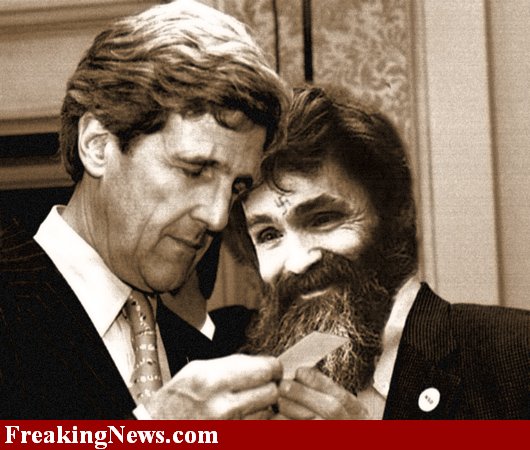
It is the elderly Manson who fuels the imagination of icon workers that use him in a politicized discourse, as witnessed first by a right wing manipulation of Manson’s image, photo-shopped into a photo of former Democrat candidate for President, John Kerry, who was the victim of a vicious slander campaign due to his past as an anti-Vietnam War activist. Here a grinning Manson in a suit modelled on Kerry’s (as is Manson’s hair style) shows the Senator a piece of paper or a photograph (perhaps a snapshot of the original Manson victims), and they appear to share a moment of confidence, although Kerry’s closed eyes might indicate that the image Manson shows him is a bit too much to take in. Note the Swastika on Manson’s forehead (he had used a knife to scrawl an 'X' on his forehead during his trial, and this 'X' later turned into a Swastika in popular legend), as well as the Kerry campaign button on his lapel.

In a parallel image, this time used to satirize Kerry’s defeater, George W. Bush, Manson’s photograph (the raw image is the same, and here the hair and attire are not airbrushed or photo-shopped) is used for a different type of collaborative icon work, this time more oppositional in nature. It is accompanied by an amusing text calling for the approval by the Senate of Manson as ambassador to the Klingon Empire (referencing the Star Trek universe). In this narrative Manson works for the Republicans as (crudely) indicated by the replacement of the Swastika on his forehead, which is substituted with a GOP Elephant, the symbol of the Republican Party. Bush and Condoleeza Rice are both ‘quoted’ as supporting Manson’s speedy appointment, saying for instance that “questions about Manson’s management style shouldn’t be part of the confirmation process”.


These two instances will be perceived as collaborative only from a politically partisan view. Both authors use Manson’s monstrosity to satirize the party he or she does not belong to. They are both hegemonically inscribed in a party political system, although not officially sanctioned by either party. The main iconic image I have selected for analysis is however a true homage to Manson.
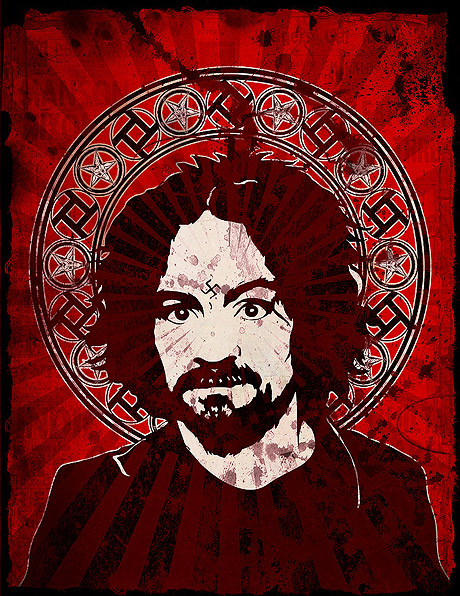

Here Manson is a saint and a martyr, signalled as in classical religious iconography via a representation of his stigmata. Here we note again the Swastika on Manson’s forehead, echoed in even more stylized form in his halo along with pentagrams that associate Manson with Satanism. His other stigmata consist of the blood stains on his face and neck and the strange umbilical chord of blood stretching from the back of his skull into the background of the icon. The photograph used as template for the icon is one depicting Manson in a particularly wild-eyed moment, taken shortly after his arrest, but prior to the X’ing incident. The choice of red, black and purple colours for Manson’s halo and the background (the traditional rays of light signalling the subject’s holiness in religious icons is here turned negative and black) contrast sharply with his pale skin. Taken together with the Swastika this composition and colour scheme serve to underscore Manson’s racial programme which the creator of the icon obviously condones. On the website I originally located the image there is a click through link to a further shrine for Satanism and Alistair Crowley which opens when Manson’s image is clicked.

Manson’s afterlife as an icon is thus prolonged by oppositional, collaborative icon work, falling within at least three spheres (which are not as separate as they perhaps should be): political, religious and pop-culture discourses all feed off his image...

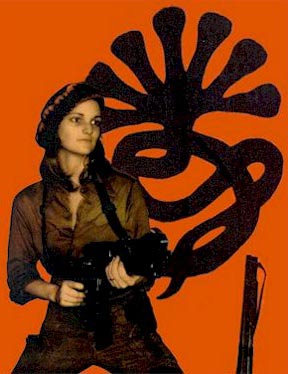
Turning now to Patty Hearst, we encounter a story much intertwined in the same counterculture background as the Manson legend. Heiress Hearst was the victim of an extremely high profile kidnapping in 1974, at the tail end of the armed struggle that militant splinter groups originating in the counter-culture and its anti-capitalist agenda was waging in America. The kidnappers, the bizarrely named Symbionese Liberation Army, carried out urban guerrilla warfare inspired by South American left-wing groups. Their agenda further included an attempt to free African-American inmates from the US prison system which their rhetoric compared to concentration camps and apartheid regime oppression a la South Africa. The SLA saw itself as spearheading a Black revolution in America and took as its symbol a seven-headed cobra snake – each head representing a Kwanzaa principle, such as unity, creativity and faith. After kidnapping Hearst and demanding various types of ransom payment (in kind, to be distributed among the poor), Hearst apparently willingly switched sides and joined the SLA in a bank robbery, generating one of the more iconic images of Patty (now known as Tania) wielding a sub-machine gun.

The SLA was eventually hunted down by the police and in an extremely violent shoot-out which resulted in a fire, most of the SLA members were killed. Hearst and a few SLA members escaped the siege and shootout, but were arrested soon after. During the trial, Hearst again switched persona and claimed that her participation in the robbery was coerced and that she had been sexually abused and brainwashed during her captivity by the SLA. She was sentenced to a fairly mild stretch in jail, her sentence was reduced by President Carter and eventually she was fully pardoned by President Clinton. A number of iconic cultural texts have been generated by this sequence of events.

The best known icon of Hearst is the image of her in front of the SLA cobra on a bright orange background. ‘Tania’ stares aggressively at ‘the Man’, ready to fire her Thompson gun – another weapon is ready in the background. This is revolutionary iconography 101, down to the army fatigues, the beret, the weapon and the surprising amount of cleavage shown. The phallic cobra offers a potent reminder of Tania’s taming, but also boosts her new-found revolutionary clout. As an ironic paean to this image Warren Zevon has put Patty Hearst into the lyrics of his tall-tale of mercenaries, post-colonial African liberation wars, upright, well-meaning Norwegian boys displaying bravery, sinister Danish power brokers, and CIA engineered betrayal followed by posthumous just deserts in the form of a headless ghost’s revenge: “Roland, the Headless Thompson Gunner”. The song ends on a didactic note:

The eternal Thompson gunner
Still wand'ring through the night
Now it's ten years later, but he still keeps up the fight
In Ireland, in Lebanon, in Palestine and Berkeley
Patty Hearst heard the burst
Of Roland's Thompson gun and bought it…

What exactly the meaning of the closing phrase “and bought it” means is an interesting point of debate. To buy something, of course means to acquire it for money, but also to buy into a story hook, line and sinker. The court case against Hearst revolved exactly around this point: did she buy the rhetoric of the SLA, or was she coerced or seduced, becoming a case of Stockholm Syndrome? My take on Zevon, who has many songs about masculine exploits gone horribly wrong (“Send lawyers, guns and money – the shit has hit the fan” is a line that springs to mind), is that he is warning us all against being taken in by revolutionary bravado and romanticism. To him Hearst is the naïve, protected, socialite teen who temporarily falls for the seduction of revolutionary ardour (a sentiment I would guess many of us can recognize).

Here is Zevon performing his song on Letterman:


More images of Hearst and Manson available here...

Read the rest of my paper in due course when it appears in print or as part of my book on Icons of Transgression...
Tuesday, April 01, 2008

The Rebbe Sues

It seems ethnicity and commercials is a hot topic these days. Waves are still high over LeBron James allegedly being cast as 'King Kong' in Annie Leibovitz' April 2008 Vogue cover (see my recent post on this), and now the wires report that Woody Allen has decided to sue American Apparel over their allegedly unauthorized use of his likeness on commercial billboards in New York and L.A. in May 2007. What is particularly interesting about this, not in itself very unusual instance of an American celebrity engaging in the US national pastime of litigation, is that the billboards in question show Allen in costume from a scene in Annie Hall, his celebrated 1977 film, playing a Hasidic rabbi, complete with hat, full beard and ringlet tresses.

This scene from the movie is set at an Easter dinner which Woody's character is sharing with the Hall family (Here is the complete dialogue). Granny Hall's penetrating gaze 'others' Allen's character and the Hasidic stereotype is his character as seen by her "classic Jew hater"-eyes. Woody does all he can to adapt, even complementing Granny's cooking: "It's dynamite ham." Annie Hall is often considered Allen's best and wittiest film, full as it is of his trade-mark self-deprecating humour which often plays on the audience's stereotypical expectations of expressions of Jewishness.

What, then, might have possessed American Apparel, and their CEO, Dov Charney (a self-professed "Jewish hustler" - incisively profiled in this NYT piece) to use the stereotypically disguised Allen character on their billboards, complete with Yiddish writing in Hebrew letters: "Der Heilicker Rebbe" (The Holy Rabbi/Teacher)? Bloggers were intrigued already last year when the billboards made their first appearance - first in N.Y (on Allen St. of all places, indicating perhaps the jokey quality of the image!), then in a Latino quarter of L.A. - esp. when the commercials then rapidly disappeared again.

Dakota speculated on Curbed LA:

Also, founder Dov Charney is Jewish. Is it some Jewish-only hipster call? What a mystery. But better than pimply-faced teens, oops, legal-age models. Nice job, American Apparel. We hope Woody-as-a-rabbi helps you sell a lot of tube socks.


American Apparel founder Dov Charney is notorious for ads featuring scantily clad young women modeling his company’s clothes while striking provocative poses. Now, it appears, he’s found religion — or at least he’s found the appropriate rebbe: Woody Allen. Responding to an inquiry from the Forward, Alex Spunt of American Apparel explained, “Woody Allen is our spiritual leader.” But the feeling may not have been mutual. Within a week, both billboards were gone. American Apparel did not respond to a second request for comment, but the speculation in the blogosphere is that the clothing company didn’t secure permission to use the Woody Allen image. How it must sting when a rebbe spurns his Hasidim!

On BeliefNet Esther had a nifty analysis of the image on the billboard and its cultural narrative:

AA's target customers are probably too young to really know Woody Allen. But in New York, where everyone's a film expert and a vaguely Jewish neurosis seems to permeate daily life, Woody Allen may in fact be a spiritual leader of sorts. He elevates New York City as some sort of cinematic heaven, illuminating the life in different neighborhoods (most notably the Upper East Side). He shocks us with comedic human truths in his films and with scandalous behavior in his personal life. And even if we're appalled, we accept it because that's his particular genius. He's our Woody, and we laugh even if we wince, because we love him even if we hate him. By invoking the Woodman, AA's message may be that it doesn't matter how other people see you. Just be who you are.

Gawker responds to the news of the suit with horrible Woody images photoshopped into American Apparel underwear products.

The New York Post has this report on the suit in inimitable tabloid style, its headline reading: "Oh, No Jew Don't" - which goes to show that there are both kosher puns and distinctly hammy ones out there...

From my perspective the commercial is interesting as it constitutes a borderline case between collaborative and adversarial icon-work. Its indeterminable layers of irony become entangled in the interpretation the viewer reads into the image. Esther, for instance, sees it as cool and a clear homage to Allen who indeed to her is an intellectual leader in his capacity as an often imitated jester figure, constantly reminding the gentile-dominated, liberal intelligentsia of their 'others'.

Since the film where the still is taken from shows the power of the gentile gaze to 'other' even a liberal ham-eating Jew into an old-school stereotype, the billboard in a way forces us to see Allen-as-Rebbe as the Jew-haters do. This could be read as a sophisticated manipulation of the viewer into a dangerous situation where we are also prone to be Jew-haters by proxy (esp. if we do not immediately recognize Woody behind the beard)... Yet, this undercover subversion is still collaborative icon-work offering homage to Woody's powers.

Why then was Allen so upset that he sued? It is amusing to note that Allen has filed what is known as a 'trademark suit' - this at least seems to indicate that Woody has no doubts that viewers will recognize his brand (i.e. face) beneath the beard and hat. Woody has a history of suing, so maybe he is just in it for the money, as some newspapers have suggested (again treading perilously close to another cultural stereotype about Jews). Apparently AA had 'forgotten' to clear the property rights to Allen's image before posting the billboards...


Reached for comment, American Apparel spokeswoman Alexandra Spunt stated “Woody Allen is our spiritual leader and that’s the only statement the company will make on that issue.” I definitely heard snickering in the background. The same billboard also appears on the corner of Sunset and Alvarado in Los Angeles (right next to Burrito King). There’s no telling what the mostly Latino residents of the neighborhood are expected to make of the ad.

A Canadian site, Urbanphoto, has an outsider's cooler view, analysing the ad accurately as kitsch, in effect transcending the adversarial/collaborative dichotomy:

On American Apparel’s website, the company declares its devotion to “people, places and things that surround us” with photos of everyday streetlife in Hong Kong, signs in Montreal and mid-century architecture like Habitat ‘67. (Sound familiar?) This is a company with a heightened awareness of kitsch, and a passion for kitsch is what is driving a large part of our current urban culture. That might explain why, even though many people seem repulsed by American Apparel, even more are attracted to it.

This view implicitly points to kitsch, or camp as Susan Sontag labelled this transgressive cultural strategy, being a postmodern strategy using the post-ironic, flat form of pastiche, or blank parody, as pointed social commentary.

It's a twofer: it sells underwear - and the customer laughs at the in-joke while swiping his credit card.

Tuesday, December 18, 2007

“They Say They Put a Man on the Moon”: Fallen Astronaut – Violence, Bodies, and Moon Art

I have graciously been invited by Stuart Noble to occasionally contribute a blog entry here at The Atlantic Community. As for topics and themes, I am a literature/culture studies guy. I don't do politics, history, society - except through their manifestations as/in texts... This of course doesn't mean that I as a person am a-political, quite the contrary. However, I prefer to leave writing about strictly socio-political topics to others. My main 'thing' research-wise is the Beat Generation and attendant stuff, including the 1960s, counterculture, music, lyrics, film etc. All things off-beat and oppositional interest me, regardless of period and genre. I usually sum the above credo up in the phrase 'I do cultural text studies' - that's my field and my life (such as it is).

– Bent Sorensen, Aalborg University

I debut with the below piece on a little known aspect of the Space Race of the 1960s and 70s...

“They Say They Put a Man on the Moon”: Fallen Astronaut – Violence, Bodies, and Moon Art

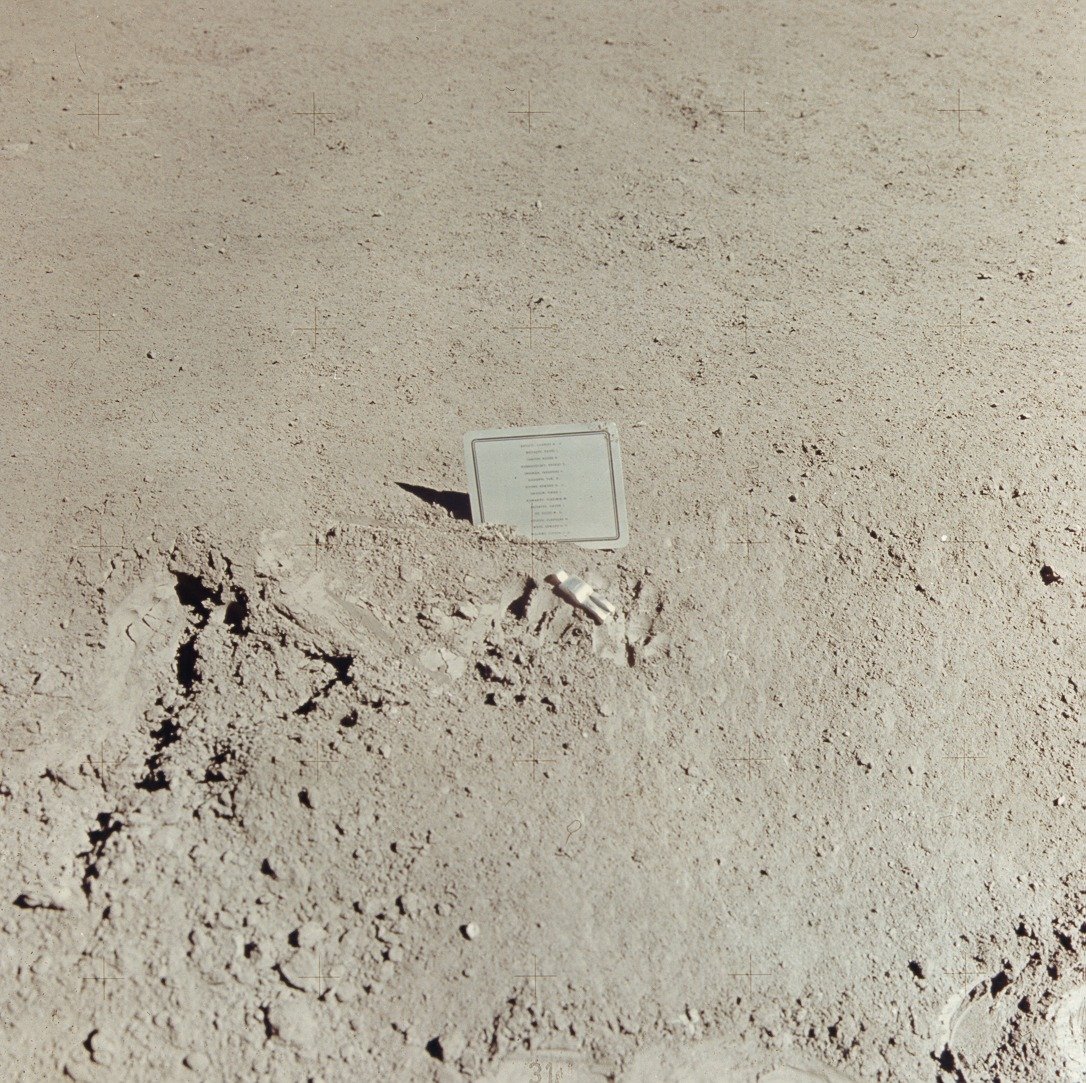
“The only piece of art on the moon is a 3”-tall aluminium sculpture titled Fallen Astronaut. It was created by Belgian artist Paul Van Hoeydonck and installed by Apollo 15 astronaut David Scott, along with a plaque bearing the names of the 14 astronauts and cosmonauts who died in the service of space exploration prior to 1971.” This startling message on a website called The Proceedings of the Athanasius Kircher Society captured my imagination, as the art piece in question seemed to raise a number of interesting aesthetic and political issues and questions.

See photo of Fallen Astronaut here


First of all, it is striking that the only art-work on the Moon is commemorative in nature (as indeed much American art honouring the heroic dead is), whereas in the public imagination of the 60s and 70s the Moon was often associated with the future (promise of expansion), rather than the past.
Secondly, the role of the astronaut in ‘installing’ the art-work raises interesting issues about the production of art and agency vis-à-vis an individual piece. And when did astronauts become artists?
Third, the role of the spectator or audience for this work seems particularly problematic – after all the piece is on the Moon and has never been revisited, seen or documented since its original installation, or to be even more precise, may very likely no longer be intact, given the extreme temperature spectrum of the environment it was placed in and the lack of a protective atmosphere up there. The moon, in other words, seems a particularly violent and destructive milieu for a work of art to be in.
Fourth, taking into consideration that the piece itself is not on public display and known to us exclusively through its mediated forms, i.e. photos kept in NASA’s archives and reproduced in various ways on web sites and in other mass media, and replicas of the sculpture found at the Smithsonian Institution in Washington, we are forced to reflect on wherein the piece really consists: Hoeydonck’s preparation of the figurine (apparently not documented) and the astronauts’ construction of the plaque (not documented), the original gesture of installation performed by Scott when he dropped the figurine into the moon dust in 1971 (not preserved in images and ‘covered’ by inane communication with Ground Control on the audio tape), the act of documenting the piece with a camera, performed by Scott immediately after the installation, or the act of publicizing the performance which the astronauts carried out at their press conference after returning to Earth – or all of the above.
Fifth, the apparently simple homage to heroism embedded in the installation seems to be problematized by the peculiar contract between Van Hoeydonck and the Apollo 15 crew not to make money off the event, the piece or replicas thereof – and not least the fact that this contract was apparently broken by Van Hoeydonck in 1972 when he took steps to sell 950 signed replicas of the piece at 750$ a pop. There is thus a tension between publicizing the piece, which the astronauts clearly desired to do, and making money off the piece, which could potentially be used to support the families of the fallen, but which at least in the official story was anathema to the astronauts.
Sixth, and finally, the fact that the names on the memorial plaque are those of both American astronauts and Russian cosmonauts points to a surprisingly political gesture on the part of the Apollo 15 crew: in the midst of the Cold War space race this reminder of the shared respect for the profession of space traveler and fellow soldier harks back to traditions from other wars where soldiers from the warring sides found a common ground and respect, before proceeding again to attempt to slaughter one another. Thus, rather than a gesture of detente, the inclusion of Russian names in an American memorial is a nostalgic gesture backward to ‘good’ wars of the past where enemies were also fellow human beings – an innocence the loss of which was marked by WW II (Holocaust and Hiroshima) and proved gone for good by the horrors of Vietnam.

The representation of the fallen body (both fallen in the sense of literally dropped from a height, and of course fallen in the metaphorical sense of killed in the line of duty) in the piece also seems problematic in interesting ways. One thing is that the figurine seems to consist of torso, legs and head only, which has prompted wits on the web to comment: ‘Great, now the aliens will think that we humans have no arms or hands’, but perhaps more strangely the figure bears very little resemblance to a man in an actual astronaut/cosmonaut suit. Rather the figure resembles a toy a child might want to play with, and very much looks its actual petite size of all of three inches, making this piece one of the smallest works of memorial art in existence… It is understandable that the figure had to be small to be carried concealed to the moon (like the stamped envelopes the astronauts wanted to flog to philatelists around the globe, the pieces of the art work were not declared among the astronauts’ personal belongings upon embarking on the mission), but the minuscule figure seems to be the antithesis of the usually larger than life human figures customarily used in memorial art. The entire scale of the piece, including the plaque, is in stark contrast to the monumental size used in most memorials, for instance the Space Mirror Memorial which was placed at the Kennedy Space Center in Florida in 1991 and which features a 42 ½ foot high by 50-foot wide black granite surface, listing the names of 24 fallen American astronauts. Thus the Earth-based memorial appropriately signals considerably more gravitas than the Moon-based miniature does.

Apollo 15 was the 4th successful moon landing mission carried out by NASA. Since Neil Armstrong’s ‘one small step for a man’ in 1969, 5 other astronauts had set foot on the lunar surface, prior to David Scott and James B. Irwin’s visit in July and August of 1971. Apollo 15 was the first moon mission to bring a vehicle, the Falcon Lunar Rover, to the surface of the Moon, and
one celebrated photo of the astronauts and their Corvettes together with the Lunar Rover indicates the link between American car culture and the conquest and desired Americanization of the Moon. Unbeknownst to NASA the astronauts of Apollo 15 seem to have carefully planned a secondary agenda to their Moon mission. Each astronaut was allowed to carry a so-called PPK (Pilot’s Preference Kit) containing personal items and other objects destined to become memorabilia after the flight. It was customary for NASA to allow each astronaut a great deal of discretion regarding the nature of these personal items. The Apollo 15 crew was unusual in at least two perspectives in their choice of PPK content. First, they carried with them a great many stamps and envelopes which they intended to sell to philatelists and the profits from which they intended to use for trust funds for their children’s education. In this sense the astronauts were good Americans in the way they showed entrepreneurial instincts and understood the intricate links between fortune and fame. Second, and more uniquely, the astronauts had decided that, in the face of the near fatality of the Apollo 13 mission and the June 1971 deaths of the entire Soviet Soyuz 11 crew, the time was overdue to honour the numerous heroes who had died in the course of the history of the two competing space programs.

For that purpose the astronauts had a plaque manufactured listing the names of all known dead astronauts and cosmonauts, plus they contracted with a semi-obscure Belgian artist, Paul Van Hoeydonck, to create a figurine representing the body of a fallen astronaut, leaving out all identifying signs of nationality, gender and race of the figure. Because of NASA’s strong insistence on the non-commercial nature of space (something that did not bother the astronauts in their stamp enterprise) Van Hoeydonck had to agree to anonymity and to refrain from later trying to capitalize on the art piece. After the stamp scandal was revealed by NASA’s post-mission audit, it is hardly surprising that Van Hoeydonck no longer felt duty-bound by his agreement with the crew.

NASA keeps very meticulous and voluminous documentations of all their missions, not least of the Apollo era flights. A sound log, a TV, film and photo image log, as well as transcripts of these logs are available from
NASA’s web site. From the audio transcript it is clear that Scott and Irwin who were on the lunar surface deliberately kept ground control in the dark as to their intent to install the Fallen Astronaut memorial on the lunar surface. The installation took place shortly before the crew was scheduled to depart the Moon. Among the last activities prior to lift-off was Scott going to park the Lunar Rover in its final resting place and to position the TV camera to shoot footage of the lift-off. In the meantime Irwin was loading moon-rock specimens into the lunar landing module. When asked by ground control, who were puzzled by long pauses in Scott’s communication with them, to account for his “present activity”, Scott fibs: “Oh, just cleaning up the back of the Rover, here, a little, Joe.” In reality he was setting up the art piece and taking high quality photos of the scene. There are 2 photos of the plaque showing behind the Lunar Rover and 2 close-up photos of the piece itself. Scott has commented on the transcripts of the sound log, published in the Apollo 15 Lunar Surface Journal: “We made a plaque for all the astronauts and cosmonauts that had been killed. And a little figurine, a Fallen Astronaut, and we put it right by the Rover. You can see it in the picture. That was just a little memorial, in alphabetical order. In relative terms, we had both [meaning the Russians and the Americans] lost a lot and, interestingly enough, we didn't lose any more after that until Challenger. That’s what I was doing when I said I was cleaning up behind the Rover. Jim knew what I was doing. We just thought we’d recognize the guys that made the ultimate contribution.”

Another aspect of the memorial activities performed by Scott in this connection must be discussed. This is not mentioned in the sound log, nor is it referred to in the commentary cited above, and apparently therefore never hitherto been considered as an extension of the installation of the Fallen Astronaut. However, from several of the astronaut memoirs available and from letters written by Irwin, it is known that Scott also placed a small copy of the Bible, bound in a red cover, on the Lunar Rover. In
enlargements of the final Lunar Rover photographs the Bible can be spotted propped up against the drive control handle. Thus the memorial service for the fallen is completed with the presence of scripture as is fit for such a ceremony. As Scott commented above, Irwin knew about Scott’s activities, and I am confident that he also knew about the presence of the Bible, and perhaps supplied the book himself. It is well known that Irwin was a practicing Christian and several of his books testify to this fact (at least one is published by The Baptist Sunday School Board), and he has stated, without specifying the nature of these objects, that he also left several objects on the lunar surface near the Landing Module. One might speculate that these objects also testify to the Christian faith of the astronauts, supplementing the nationalist sentiment of the American flags routinely planted and left behind on the Apollo missions. Of course, the presence of the Bible as part of the installation changes the tenor of the piece as a work of art, rendering it far more conventional and ceremonial than what has previously been noticed by the relatively few commentators who have written about the event, and who have tended to inscribe the Fallen Astronaut in a more avant-garde push toward conquering a new frontier for art, rather than seeing the piece as having a commemorative and votive function. However, Scott’s comment that “interestingly enough, we didn’t lose any more after that until Challenger” indicates clearly that the performance of the Fallen Astronaut was also intended to ward off future evil, and therefore is best regarded as a religious ceremony.

The astronauts were thus seemingly caught between desiring an intensely private communion with their maker and their dead mates on the one hand, and the obvious need to publicize the ceremony on the other, since a) the news would clearly come out (at least within NASA) once the photos were brought back to Earth and developed and b) the effect of the installation presupposed that it had an actual audience. The covert activities thus needed uncovering, and the astronauts decided to use the first occasion they would have to address the public to break the news of the Fallen Astronaut. The first post splash-down press conference was an obvious choice of venue, since the astronauts would not yet have been debriefed by NASA and censorship was therefore out of the question. NASA was consequently faced with a de facto admission which needed careful spin. The policy decided upon was apparently to, on the one hand, condone the seeming gesture of reconciliation between Cold War foes (the press conference footage was included in the official
NASA mission video), but on the other hand to make sure that neither Scott nor Irwin would fly space missions again. The stamp scandal became the convenient means through which the latter objective could be attained. In a carefully worded press statement, released by NASA in September of 1972, the compromise is laid out fairly plainly:
“In a post-mission press conference, the crew reported the memorial ceremony and, in keeping with their understanding, did not reveal the sculptor’s name. In November 1971 the Smithsonian Institution indicated a desire to display a replica of the memorial statue and plaque; the Apollo 15 crew agreed under the conditions that the display be in good taste and without publicity. Scott undertook to get the replicas for the museum. In March 1972, Scott forwarded replicas of the plaque to the museum. In April, responding to Scott’s request, Van Hoeydonck presented the museum with a replica of the statuette. The replicas are currently on display there. In May 1972, Scott learned that further replicas of the statuette might be offered for sale. He wrote Van Hoeydonck asking him to check on this rumor. In his response, Van Hoeydonck confirmed that replicas were intended for sale and indicated that he felt no constraints or restrictions in this matter. The Apollo 15 crew strongly disagree with this position, feeling that their solemn understanding with Van Hoeydonck prohibits any such commercialization.”

The astronauts were forced to refrain from access to the monies accrued them via the sales of stamps, and the astronauts were also mandated to distance themselves from Hoeydonck’s plans to sell replicas of the Fallen Astronaut. Such plans were also to be preempted by the Smithsonian’s decision to commission their own replicas of the installation, which of course in a quid-pro-quo granted the astronauts' actions an element of official consecration. This compromise was however a dear price to pay for the astronauts, esp. Scott who had flown both Gemini and earlier Apollo missions and reasonably could have expected a John Glenn-like further career within NASA. He retired from active service in December 1975, and his
official NASA bio, dated from that month, reads rather more like an obituary. The three replica plaques are still in the Smithsonian collection, but it is unclear whether they are at present on display, just as there are no photos in the on-line archive of any figurine, rendering it uncertain what has happened to the specimen Van Hoeydonck delivered to the Smithsonian, according to NASA.

NASA’s own idea of the proper way to honour the American fallen Astronauts is reflected in the Reagan/Bush-era monument I referred to earlier,
The Space Mirror Memorial. Its grand scale and use of high technology to ensure that the granite slab is constantly tilted to be backlit by sun rays (or artificial light during night and occasional cloudy Florida days) is more in tune with a Star Wars epoch in American foreign policy. Gone are all traces of Russian cosmonaut names, and gone are also all traces of an overt Christian symbolism. Instead, according to the Astronauts Memorial Foundation’s website describing the monument (The text is in fact borrowed from CCT, the tech supplier's description): “The sun’s rays are projected through the names of the astronauts, which are engraved through the granite. The letter spaces are filled with crystal clear acrylic, minutely jagged on the front side to diffuse the light.” This rather kitschy light show is clearly designed to draw spectators to the site, who then are expected to be duly impressed with the monument's “unique blend of art and science”. The Granite slabs currently feature 24 names, but have great potential for extension as the number of space industry casuals grows (Space shuttle disasters mean an additional 7 names every time).

The biggest controversy, however, has ironically been in connection with the omission of one of the early casualties of the space race, Major Robert H. Lawrence, the first black man selected to participate in the space program and to enter astronaut training (in the so-called MOL program, then not under NASA auspices). He was tragically killed in training before he could participate in any space mission, flying an F-104 jet when it was destroyed in an accident in December 1967. 4 other astronauts have died in T-38 training plane accidents and one has been killed flying an X-15 test plane, all of them having been selected as astronauts, but none of them making it into space. All these deaths occurred in the time span from 1964 to 1967, and these 5 astronauts were included in the original 1991 roster of names on the Space Mirror Monument. Still, Lawrence was not added to the roster until 1997, 30 years to the day after he, as his
official obituary at the Space Mirror site now reads: “made the ultimate sacrifice and lost his life in service to the nation and the space program on December 8, 1967 at 32 years of age”. It took pressure from African-American interest groups to gain him this posthumous recognition. Lawrence still has no official NASA biography. His name also did not feature on the Fallen Astronaut plaque in 1971.

What seemed to have been a rather curious and innocuous event which unfolded relatively quietly on the lunar surface in 1971, actually turns out to have interesting and far-reaching repercussions in the political, historical and cultural realm today. There are signs that the Fallen Astronaut is cusped to enter into the pop-cultural iconosphere of this decade, not least because art is searching for its final frontier and many artists, art critics and art historians are searching for inroads into developing a form of space art of relevance to our continued life on a small troubled planet. They therefore need precursor texts to construct such a history of art in space, as for instance is shown by Arthur Woods’ piece “A Brief History of Space Art” which really is a vehicle for attempted fundraising for his own space art projects, such as “Cosmic Dancer” and other sculptures to be sent into space. Woods even goes as far as to include a possibly apocryphal piece of space art, which if indeed it turns out to be real, would be the first piece of art on the moon. I am referring here to what I believe is an urban legend, the story of a ceramic tile about half the size of a postage stamp, which purportedly was affixed to the lunar landing module of Apollo 12, and featured the work of six very high profile American artists etched into the tile: “Robert Rauschenberg drew a straight line; Andy Warhol drew a penis; Claus Oldenburg drew the image of Mickey Mouse; and John Chamberlain, Forrest Myers and David Novros all drew geometric designs”. This piece, supposedly titled The Moon Museum, must, however, necessarily remain the topic of another, future American Studies Space Criticism paper.