Showing posts with label Poetry. Show all posts

Tuesday, March 18, 2008

Hard-core Divas Hit the Stone: Sharon, Gertrude, Lynn


I have recently attended a conference in Reims on the interesting topic The Cultural Kernel. On popular demand, for those that can't wait for the paper to come out in Imaginaires, here's a preview. This pre-publication is also in response to Stuart Noble's call for papers dealing with American women writers.

My essay takes its point of departure in contemporary poet Lynn Emanuel’s work. Emanuel’s poetry is engaged in making cultural statements which are often based on a link between portrayal and ideas – character portrayal, object portrayal, and depictions of places and personalities from Gertrude Stein to Sharon Stone. I argue that Emanuel’s poems establish themselves as cultural texts, and as such, as discourses that address several levels of reality: 1) in order for the poems to work communicatively, they have to put into operation and activate the author’s and reader’s cultural awareness; 2) in order for the poems to make themselves intelligible, relevant, and aesthetic, (a tall order for any text) they have to be involved in a deliberate reworking of cultural elements. We never experience culture as something complete or at a distance. The cultural kernel is not just an object that is in the poems, but can be thought of as more of a process of collaboration between the author, poems, and the reader. These levels show the extent to which the author’s intent of pulling the reader into her world can be said to change the reader’s perspectives which in turn rework the interpretations of the poems.

By means of illustrating what culture does in terms of the collaborative, I begin here with a consideration of the title of the conference: The Cultural Kernel. When the call for papers came, I looked at the keywords and I could see that the ones I liked were the ones that hit me in my own poetic gut. Thus, my first question to myself for a potential paper was this: will there be any stones in it? I stumbled over Lynn Emanuel’s poem "Homage to Sharon Stone" from her 1999 collection Then Suddenly, and decided that it was no small pebble. In it there were definitely stones. I was ready to dig. I reproduce the poem here:

It's early morning. This is the "before,"
the world hanging around in its wrapper,
blowzy, frumpy, doing nothing: my
neighbors, hitching themselves to the roles
of the unhappily married, trundle their three
mastiffs down the street. I am writing this
book of poems. My name is Lynn Emanuel.
I am wearing a bathrobe and curlers; from
my lips, a Marlboro drips ash on the text.
It is the third of September nineteen**.
And as I am writing this in my trifocals
and slippers, across the street, Sharon Stone,
her head swollen with curlers, her mouth
red and narrow as a dancing slipper,
is rushed into a black limo. And because
these limos snake up and down my street,
this book will be full of sleek cars nosing
through the shadowy ocean of these words.
Every morning, Sharon Stone, her head
in a helmet of hairdo, wearing a visor
of sunglasses, is engulfed by a limo
the size of a Pullman, and whole fleets
of these wind their way up and down
the street, day after day, giving to the street
(Liberty Avenue in Pittsburgh, PA)
and the book I am writing, an aspect
that is both glamorous and funereal.
My name is Lynn Emanuel, and in this
book I play the part of someone writing
a book, and I take the role seriously,
just as Sharon Stone takes seriously
the role of the diva. I watch the dark
cars disappear her and in my poem
another Pontiac erupts like a big animal
at the cool trough of a shady curb. So,
when you see this black car, do not think
it is a Symbol For Something. It is just
Sharon Stone driving past the house
of Lynn Emanuel who is, at the time,
trying to write a book of poems.

Or you could think of the black car as
Lynn Emanuel, because, really, as an author,
I have always wanted to be a car, even
though most of the time I have to be
the "I," or the woman hanging wash;
I am a woman, one minute, then I am a man,
I am a carnival of Lynn Emanuels:
Lynn in the red dress; Lynn sulking
behind the big nose of my erection;
then I am the train pulling into the station
when what I would really love to be is
Gertrude Stein spying on Sharon Stone
at six in the morning. But enough about
that, back to the interior decorating:
On the page, the town looks bald
and dim so I turn up the amps on
the radioactive glances of bad boys.
In a kitchen, I stack pans sleek with
grease, and on a counter there is a roast
beef red as a face in a tantrum. Amid all
this bland strangeness is Sharon Stone,
who, like an engraved invitation, is asking
me, Won't you, too, play a role? I do not
choose the black limo rolling down the street
with the golden stare of my limo headlights
bringing with me the sun, the moon, and
Sharon Stone. It is nearly dawn; the sun
is a fox chewing her foot from the trap;
every bite is a wound and every wound
is a red window, a red door, a red road.
My name is Lynn Emanuel. I am the writer
trying to unwrite the world that is all around her. (53-54)

Emanuel’s poem here is an example of how the cultural kernel as that which resists us can be overcome by observing domestic practices. While we may not always understand another culture and thus be able to crack its literary productions due to missing implicit referents and indigent symbolizations, daily routine is something that most of us can relate to. We all have bad hair days. Not only does Emanuel establish a close proximity between herself and her reader, by bringing her reader into her house, but she also collaborates with the reader towards understanding the workings of collective cultural competence. If the kernel resists us, or creates a gap, we go for the nearest association. We will understand something, if it must be through misreading. In considering Sharon Stone, the reader who may not know the famous actress, may be prompted to think of the infamous 70s hit song by Smokie: “Who the fuck is Alice?” (Sharon, Gertrude, Lynn):1

Sally called when she got the word,
She said: "I suppose you've heard -
About Alice".
Well I rushed to the window,
And I looked outside,
But I could hardly believe my eyes -
As a big limousine rolled up
Into Alice's drive...

Oh, I don't know why she's leaving,
Or where she's gonna go,
I guess she's got her reasons,
But I just
don't want to know,
'Cos for twenty-four years
I've been living next
door to Alice.
Alice, who the fuck is Alice?

If we don’t stumble over stones in this song, we certainly get hit by a car. A big car. A limo, to be more precise. Is Emanuel thinking of Alice, when she sees Sharon, one would like to ask? Lynn Emanuel, the speaker of Emanuel’s poem definitely wants to know what Sharon is up to. And she clearly knows who Sharon is. But Sharon is taken out of her context, which makes the act of observing even more significant, particularly as it relates to consolidating the condition of all cultural understanding and subject constitution: look first, imitate, and understand later. So Lynn does what any good amateur anthropologist should: observe what’s going on. In this poem it begins with her taking a seat: by the window, by the door, by the desk. She positions herself strategically in relation to the objects and people that surround her. The aim is to put something on paper. Encircle. What she notices is that the neighbors are also engaged in their routine, namely, playing the role of unhappily married.

The poem shifts quickly between observations that depict cultural manifestations as they happen and their aesthetic translation into text. Characters in their roles, while taking their roles for granted or accepting them as part of societal constraints, are also in a position to pass judgment on their culture’s relentless emphasis on creating sameness. The poem thus suggests that even though we all do the same things, culture itself is a generator of difference. The poem concludes with a desire to “unwrite the world that is all around her,” Sharon Stone, and presumably Lynn Emanuel alike, but not before the reader gets to witness “the carnival of Lynn Emanuels” as a composite of another character embodiment expressed in the wish to be “Gertrude Stein spying on Sharon Stone at six in the morning” (53). What this example demonstrates is that we never experience culture as something ineffectual. The assumption is that we learn to distinguish between the internal and external origins of inspiration by standing in close proximity to “actuality”, or the very thing that happens while it happens.2

As Emanuel’s poem writes itself through the metaphors of cracking the kernel and smashing the core-stone, the style that emerges from the collaboration between the poet, her subject, the poem, and the reader, also demonstrates that the act of portraying establishes a close relationship between the verbal and the visual. While the depiction of Sharon Stone relies on creating an image-world for the reader, which goes beyond language, the fact that the images conjured up are all context-based and anchored in cultural competence points to the significance of how language works in use and the consequences of its being self-referential. What we are dealing with here is a poem which expresses not just ideas (as poems often do primarily) but also a conscious awareness of the workings of language in and through time. While we can easily see Sharon Stone diva’ing about in a limo in 1999, we do not in the same breath associate the idea of a diva with the 50s tradition.

Emanuel portrays herself as a 50s housewife, mocking the last decade of glamour, and contrasts herself here with another ‘housewife’ of the new millennium for whom even the chore of curling the hair involves external agency (as Sharon Stone probably has somebody else attending to her hairdo). The 50s housewife is thus recast in the passive role of watching, observing, and ultimately identifying, yet not with the character under scrutiny, but the character’s role. The irony is that the 50s housewife is endowed with double agency: on the one hand, she has to make sure that the status quo is maintained, (she stays a product of her culture: she is a housewife, before she is a writer), and on the other hand, she has the potential to become someone else, precisely because this potential is activated by the writer within the housewife.

The subtle point that the poem expresses is that while Emanuel may not be a confessional writer who writes in the same vein as Sylvia Plath, Anne Sexton, Robert Lowell, Allen Ginsberg, and Frank O’Hara, at the same time she both acknowledges and subverts the long tradition of articulating mundane situations in highly crafted poetic constructions. She brings in literary figures such as Gertrude Stein, whom the reader familiar with either her writings or photos of her will instantly recognize as being situated in the opposite direction of glamour: not thin, no curls, no housewife. The fact that Stein, who was also concerned with craft and composition, and wrote in a most ordinary language, is here taken as a barometer – as Emanuel would like to hear Stein’s confessions about Stone – indicates a performative gesture on Emanuel’s part which consists of pulling the reader into the image world of ‘stone on stone’, and ultimately letting her carve her own inscriptions.

This example points to the way in which language works as a cultural construct, and how it configures the human condition according to a specific aesthetics. Emanuel’s poem with its concatenation of language awareness and cultural images is ultimately a poem on portraits, a portrait of a poem, a portrait of a (self)portrait and a poem about itself. In other words, a narrative in verse that is not only a manifestation of, but also a gesture towards cultural understanding.

One of the other implicit messages in the poem that we can extrapolate an understanding from is that where culture is concerned events come and go. What remains are portraits, photographs, descriptions of people in other media. What connects us to events either current or the ones that remain distant in the past and thus only have significance for people who have experienced them first hand is that they remind us of something else. In Emanuel’s poem, language itself traverses with and through these events and is shown to adapt itself easily to new modes of representation. We thus go from the event of writing, in which something must be recorded, to activating a memory about a film with Sharon Stone, or a picture that Gertrude Stein portrayed with words. Thus, what Emanuel suggests is that pictures collaborate to inspire writing, and that writing in turn ‘reminds’ us of fleeting visual moments.

All these alternative modes or representations that are the result of cultural manifestations following a dominant in a certain time and age – writing, film, music, painting – are furthermore shown to collaborate towards the process of de-mystifying seemingly strange relations. We take seriously Emanuel’s advice, not to think of big, black cars as symbols for something, but a quick glance at the way in which her writing shapes itself on the page, shows that her “Symbol for Something” is spelled in capital letters which makes us think that Emanuel’s writing betrays her at the very moment its graphical representation takes place. Where this reader is concerned, I can’t stop thinking about the mob driving mysteriously in their black Cadillacs in the 50s. The depiction of Sharon invites that very association insofar as she is portrayed as being a bit mysterious and distant. Any diva with respect for herself will know how to play the mystery part. Roles are thus played seriously. Actors are generous. Directors are merciless. And bit-players take it all in, and then they write about it.

In Emanuel’s poem, the smart move from the trivial associations that we get from linking picture to picture – film to film, song to song, writing to writing – to overcoming the state of ‘this merely reminds me of something’ is done through bringing in a master who knows a thing or two about strange relations. In her famous book, The Making of Americans, written in 1909 and published in 1925, Gertrude Stein repeatedly insists that she writes for herself and strangers. What can culture do in the face of such enunciations, or questions, one is tempted to ask? Or what is the textual cultural practice that enables or conditions the articulation of such enunciations, or questions? What can strangers do for one’s writing, and what can one’s writing do for them? This reminds me of my own writing practice these days when I find it difficult to get out of the essayistic mode, especially when attempting to be most scholarly. More than ever technology has enabled what Stein has prophesied: I blog to myself and strangers. So we associate. But there is nothing new in that. So we associate incongruous events. Nothing new in that either. Perhaps it’s more interesting. So we associate symbolic events. While the situation of ‘nothing new’ presents itself again, we can at least claim self-authorial legitimacy for this or that interpretation.

The knack to dealing with the cultural kernel is not in the cracking, but in the playing of parts. Lynn Emanuel finds Sharon’s question: “Won’t you, too, play a role?” attractive. She is a bit-player, like the rest of us. What is suggested in the line immediately before this question: “amid all this bland strangeness is Sharon Stone” is that in the face of remaining speechless in our encounter with the strange, especially the bland kind, or strangers, especially the blond ones, we can start singing our own praises. The picture that Lynn Emanuel depicts of the other Lynn in the poem, the one who is engaged in a very similar writing practice to our nowadays blogging, is suggestive of the kind of impersonations we are capable of in the face of performing. We assign roles to one another and play the parts too by taking turns at being the other.

But what about the third of September? Is that Sharon’s birthday? Or Gertrude’s? Or Lynn’s? Or is it really about the 15th of November when T.S. Eliot went to see Gertrude in Paris, which made Gertrude write that portrait poem that has wool and silk in it? Lynn says Sharon’s head is swollen, and Gertrude says Eliot’s mouth is woolen. Speech impediment. Or is it about me, having to skip a meeting on the 12th of March, because I have to bash my brain and write on the writers of dates for this gathering here? I collaborate too. I let my friend and colleague, a polyglot punster and professor of German, Hartmut Haberland, know that I’m on my way to France – no pilgrimage on stones – but by flight through air, and this is what he gives me: “Gertrude Stein was born on February 3 as so many other good people. (Joyce was one day early, which must have been a mistake. Groundhog day! Who would eat a ground hog? Well, I better mince my words ...) I was always wondering if Alice B. Toklas was a real name or a pun. I hope your topic doesn’t leave you speechless. ‘Talkless in Reims’ sounds like a take-off on ‘Speechless in Seattle’ (You have my permission to use it.)” And so I do, here, now, to our collective stunning astonishment.

We step around the cultural kernel by looking at the alphabet. Grammar of the stepping-stone. It’s all in there: in the stoning of the text. Gertrude says in her To Do: Book of Alphabets and Birthdays: “alphabets and names make games and everybody has a name and all the same they have in a way to have a birthday” (Stein, 2001: 5). Groundhog day is here to stay. Baptism day.

P.S. The story doesn’t end here. There was a mail from my colleague, one day after he had sent me the above, in which he says: “of course I meant ‘Sleepless in Seattle’. Maybe you thought it was intended (and since we are talking about open texts here), who gives a fuck for my intention?”

It goes to show that if the cultural kernel resists us, we have a couple of choices we can make, at least where authors’ intentions are concerned. The tongue won’t know the difference, if it sleeps, slips, or remains speechless.


~~~

[1] In the original version played by Smokie, there is no reference to the f-word. However, whenever they often played the song in Ireland, the audience would shout "Who the fuck is Alice?" when the main line was sung, "I've been living next door to Alice". The band then decided to do a spoof of their own song and insert the line in their subsequent recording of it. They collaborated for this with the foul-mouthed Roy Chubby Brown, a stand-up comedian.

[2] Russell Edson wrote a collection of prose poems, The Very Thing that Happens (1964) which influenced a number of poets interested in the relationship between readers, writers and the materiality of power in language.

The Cultural Kernel and the Transnational Subject: Meena Alexander

A while back Stuart and I agreed that celebrating Women's History Month needn't be a purely American thing, nor a thing reserved purely for historians, so I thought I would post a bit about some recent work I've been doing on American, transnational poet, Meena Alexander:


My interest in her work is quite recent, so I am definitely not an expert on her poetry or scholarly practice yet, but I am currently reading as much as I can of her and on her work. The whole thing started, as it often does, with three apparently unrelated incidents.

First off, the launch of the excellent journal on poetry, Studio - which featured Meena Alexander in their very first issue. They reprint a lot of good selections from her 2004 collection, Raw Silk, as well as supplementary material in the form of a very rich talk on those poems and their writing which Alexander gave at Shippensberg U., and later at Dartmouth - titled "Fragile Places: A Poet’s Notebook".

Second, I was asked to be the external examiner for a superb MA-thesis on Indian, transnational poetry in English. The student had done a beautiful job in presenting his findings, had a good grasp of theory and of close reading, so we of course gave him the top grade available. One of his subjects was the poetry of Meena Alexander, which he read as an example of what Homi Bhabha calls unhomely texts.

Third (and according to Freud, the uncanny part of repetition is when things repeat themselves not once, but twice), I received a call for papers from a friend of mine who regularly puts on great conferences with themes such as 'Chaos and Order', or 'Pluralities of Interpretation'. This time Daniel in Reims wanted papers on what he proposed to call the 'Cultural Kernel', asking/stating provocatively: “The question is: how can we determine when our understanding of a literary work stops? There always seems to be a gap that cannot be bridged, a kernel that will always resist us.” For me it seemed a short leap to start thinking of Alexander as a producer of texts that ought to, for me at least, have a number of culturally specific elements that might be investigated as 'kernels' resisting interpretation. Thus, I was all set to propose a paper on her work, and I was accepted and in fact presented my work last week in France...

Even a cursory glance at Alexander's bio will peak your interest in her: She was born in Allahabad in 1951 to Syrian Christian parents, raised in the Sudan, educated in English-speaking contexts there (BA in English and French from Khartoum University) and in Nottingham, England (PhD in English), returned to India for a number of years, married another Indian academic, and is now residing in the USA, where she is a Distinguished Professor at Hunter College and CUNY in NYC. Her linguistic history is, if possible even more fascinating: Mother tongue: Malayalam, with a knowledge of Hindi on the side - in Khartoum, exposure to Arabic and French - after return to India, exposure to other Indian languages - throughout a tendency to exploit English as lingua franca, but not stopping at that: developing an acute poetic ability in that language too...

I knew that in Alexander I had found a subject that was extremely different from my own background as a male, white, European academic and that, given my reading protocol with its foundation in those identity positions and difference discourses, I might well hit a few interpretative bumps in my reading of her texts. As it turned out I was to be positively surprised...

Alexander is a very political individual and poet. Her work speaks out for the weak and marginal groups and individuals. She is also extremely conscious of her native country's troubled history and political conflicts. Raw Silk is written in the aftermath of the violence of two Septembers: Her adopted country, the USA's 9/11 trauma, and her native province, Gujarat's ethnic unrest in September 2002. The result is erudite, compassionate poetry about the effect of violence on victims and poets alike, and the poems weave an intricate intertextual web with precursor poets, politicians and philosophers from India: Rabindranath Tagore (Nobel Laureate, 1913), Mahatma Ghandi, and Sankara, the 8th C. Vedantic philosopher and religious teacher...

The poem I mainly analyze is "Fragile Places" which closes the Raw Silk collection. I cannot share my entire paper with you before its eventual publication, but here is an excerpt from the analytical part, where I endeavour to give a 'classically founded interpretation' of this particular poem and the collection as a whole:

The key poem in the collection is “Fragile Places”, which is set partly in Gujarat where Mahatma Gandhi lived and partly in Kerala where the 8th century Vedantic philosopher Sankara was born. These two figures, both associated with intense religious and pacifist feelings and ideas, function to structure the poem. Sankara, whose desire was to revitalize Hinduism and point to the identity between self and the whole, figured as the highest (and ultimately only) deity Brahman, is addressed at the poem’s beginning and end, so that the poet speaker’s desire to hear the words of Sankara comes to frame the whole poem. The effect is heightened by the use of a quote by Sankara, “The world is a forest on fire,” as the poem’s motto. The reading protocol an experienced reader of poetry will invoke here is to expect that the motto will set the tone of the poem, as is quickly borne out by the poem’s insistence on violent images involving fire, culminating with the references to the burning child in the second to last group of couplets. Similarly the custom of addressing an absent interlocutor, akin to invoking a distant deity will be familiar from much Romantic poetry and the whole set of conventions concerning the ode. Therefore one experiences little difficulty in encountering the beginning exhortations of the poet speaker addressed to Sankara, pleading for shelter, refuge, protection: “carry me through the house of silt/ the low slung bone,/ wind me in raw silk” – and ultimately insight: “Who dares to burn/ with the stamp of love?/ Words glimmer/ then the slow/ march to sentences./ Sankara speak to me.”

The role of Gandhi in the poem is less clear as he is not referred to explicitly. Only the place of the poem’s setting indicates his role in the poem and the culturally competent reader will associate the location of Gandhi’s ashram in Gujarat with the site of the ethnic unrest the poem describes. The ashram would historically be just such a place of refuge as the poet speaker calls for, but in other poems in the collection with the give-away title “Letters to Gandhi”, the nation’s father is gently chastised for not having influenced his inheritors sufficiently, and the shame of his old ashram barring the doors for Muslims seeking shelter from violence, rape and murder is pointed out. Gandhi’s grandson is also mentioned in the notes to these poems, as well as in Alexander’s talk on the poems.

Yet another figure ghosts the poem “Fragile Places”, this time through a more conventional intertextuality, as his poetry is quoted in the Alexander poem. This figure is Rabindranath Tagore, the 1913 Nobel Laureate, who is remembered and revered in India along the same lines as the philosopher and the politician discussed above. The biography of Tagore at the Nobel Prize Organization’s website emphasizes some similarities between Sankara and Tagore’s origins, mentioning his father’s sect which “attempted a revival of the ultimate monistic basis of Hinduism as laid down in the Upanishads.” It is well-known that Tagore and Gandhi were close friends, and we thus have a closely linked trinity of men from the past history of India, all representing similar ideals of unity, peace and non-sectarian beliefs, all present in the poem. The quote from Tagore is: “I lay with you at the water’s edge/ a red rose blossomed in my breast.” The complex symbol of the red rose blossoming is decodable as feelings of erotic love (“I lay with you”), or as agape (love for one’s fellow man), or as the blood of the heart running out of a dying man’s body after a stabbing or shooting, or as yet another image of the fires that otherwise crowd the poem. These readings are all fairly conventional, and intertextual precursors including at least Dante, Shakespeare and T.S. Eliot could be invoked here. Again, while the symbol cannot be decoded in an entirely unitary way, the gap presented by the text is not unbridgeable – rather there are almost too many bridges crossing this particular gap, which then hardly constitutes an uncrackable kernel.

If one now turns to the presence of difference discourses in the poem, one is surely not disappointed, nor particularly surprised to find an implicit dichotomy between the three great men, who are ultimately all portrayed as powerless to influence the course of history in a non-violent direction (the two Septembers’ violence was perpetrated regardless of their lasting presence on Indian soil, and Tagore’s words displayed on giant posters in Kolkata have little effect), and the female poet speaker and her references to her matriarchal lineage back to her grandmother whose house the speaker inherits (grandmother’s birthplace is the same as Sankara’s). Another important figure in the poem is the woman who responds to the burning of the child by stopping in her washing of the rice in her kitchen and turning to write instead. This mirror image of the poet is more of an insider to the region, and her donning the writer’s mantle is a sign of hope and her inscriptions a guarantee of the lasting memory of the events: “Words glimmer/ then the slow/ march to sentences.” It is therefore clear that we have a case of the gender difference discourse playing out in a form of reversal in Alexander’s poem. Nothing new or challenging here.

Likewise her figuration of the transnational self is a variation over the in-group/out-group dichotomy that is typical of the national difference discourse. The poet speaker has a foot in each camp: she is rooted in India, yet has left the country only to return and mourn its state. Her presence is problematized as not entirely authentic. While she claims: “I have come to ground/ in my own country,/ by the Pamba’s edge” and her grandmother’s house is her inheritance, there is still a doubt spurred on by her role as an interloper. The poem’s words on identity illustrate this dilemma: “Unable to reconcile those that are scattered/ with those bound in fragile places/ we turn to where alms/ are collected for the poor,/ identity pulled apart/ on the tongs of war.” Scattered, yet bound as the migrant figures are, it is the unpleasant tool of war that creates the identity split in the poet speaker’s tenuous ‘we’.

As you can begin to see, I was not finding the uncrackable cultural kernels I had been expecting in Meena Alexander's work. I read her memoirs, Fault Lines, where she reflects on her multicultural background, tells stories of her grandparents whose house she has inhereted, and who received Ghandi as a visitor. I read her poetry and reflections in The Shock of Arrival: Reflections on Postcolonial Experience where her academic analysis enriches her poetic practice. I read more of her poems, including her most recent collection, Quickly Changing River, from 2008. I still feel that I understand her very well...

I look at some of the many good resources online for Alexander: This interview, this overview of her work, another blog interview, Ruth Maxey's Kenyon Review interview... All this reading adds more to my understanding of her.

At the conference my colleagues did not disagree with my interpretation of her poem, nor with my observation that her knowledge of and mastery of Western poetry in all its forms, conventions and intertextualities helped us all to engage with her work. On the question of how I felt as a white, male, not-quite-dead European after having interpreted her work so 'fully', I had to answer that such an experience inevitably makes you feel like God in some 'omnipotent' way. Of course, in that context, we must always remember that God is a black, lesbian woman....

Saturday, March 08, 2008

Beat 'Others', 2 - Racial Othering

Picking up on the following remark from vol. 1 of this post, I want to focus on the role (or lack thereof) of African-Americans in the Beat movement:

Representations of the racial Other in the Beat 'canon' also are problematic. Kerouac notoriously idolized the racial Other as a Fellaheen primitive, who was more in touch with the land and with the immediacy of human needs and urges, and whose creativity was somehow primordial, and usually pre-linguistic. Thus the great jazz-men of On the Road blow tremendously, but rarely speak - in fact it is their animalistic qualities that are always singled out as their distinguishing marks. The most acute analysis of this figuration of the racial other as the sociopathic, orgasm-directed figure, prowling the subconscious of white disaffected youths, of course remains Norman Mailer's influential essay "The White Negro" which can now be read on-line at Dissent Magazine's website. I recommend that one also reads Frantz Fanon as a counterpoint to Mailer's discourse to get a perspective on what it feels like to wear a white mask over black skin...

Of all the fellow travellers with the Beat Generation group, the one African-American writer of distinction is Amiri Baraka. Most of the other black figures associated with the Beat phenomenon are relegated to supporting or minor roles as 'inspiration', or at best 'forerunners'. Such figures as the hipsters with the ability to talk 'the jive', or the be-bop musicians with their improvisatory skills - almost exclusively black - were major influences on Kerouac's aesthetic ideals, and with him put their stamp on the diction and tonality of much Beat writing. Some would argue that both hipsters and jazz-men were performers, and that the public and theatrical element of the Beat writing and life-style comes straight from there. The history of the 1940s hipster subculture is not yet something I have personally researched, but the current Wikipedia entry on the subject seems above average for the site, so it may safely be consulted...

Obviously, African-American culture has its own, much deeper roots, and Baraka has always kept a consciousness of this multifaceted heritage at the forefront of his literary and political practice. His participation in the Black Arts Movement from the late 50s onward, including setting up the Harlem based theatre company The Black Arts Repertory Theatre, is a case in point. The link above will take you to one of several resources on the history of the movement, and this is another. Baraka's several political and aesthetic mutations are detailed quite comprehensively in the Literary Kicks' web-page on Baraka. His activities with his publishing house, Totem Press, from 1958 onwards were significant to the Beats, but more so his journal Yugen, and later the newsletter The Floating Bear, which he edited together with Diane di Prima. This site reproduces a bunch of issues of the Bear. As Jed Birmingham points out: "It seems like he had his hands in every major magazine coming out of New York City in the late 1950s and early 1960s. Jones published Michael McClure, Allen Ginsberg, Jack Kerouac, Frank O’Hara, Charles Olson, Gary Snyder, Philip Whalen, Ed Dorn, Diane Di Prima, and Paul Blackburn."

Several sites are dedicated to the work and thinking of Baraka: Poetry.org from The Academy of American Poets has a comprehensive page w. bibliography, and a direct link to Amazon.com for the LeRoi Jones/Amiri Baraka Reader and other Baraka titles.

The Modern American Poetry site, as always, features selected excerpts from critical works on individual Baraka texts, as well as some resources situating him in literary and cultural history.

A Finnish site on Books and Writers has a capsule personal biography plus bibliographies of Baraka's work and selected criticism.

The best portal for Baraka resources, however, remains his own web site, which features a gallery of photos, a short bio, links to and covers from selected books, and - most valuably - links to a wealth of on-line Baraka texts and critical resources.

Of the many YouTube clips available I recommend the following three:

A brief soundbite on the link between performance poetry, rap, and street poetry...

Here is a longish interview from the Blackademics.org site, featuring both Amiri and his second wife Amina Baraka. Note how Amiri liked to hold his head and shake it a bit when he is asked a question that perhaps he finds a bit naive (all of them). Pay particular heed to what he thinks the price is for not being a revolutionary poet...


Finally, my favourite clip is Baraka in performance from 2007. He treats us to what he calls Lowkus, a bawdy form that shouts back in a trickster vein, but very politically so, at the sometimes pale aestheticism of the Haiku. So Lowku, which also puns on 'loco', the Spanish word for crazy, and also hints at the whole locomotion Baraka would like to get started against, say Bush, is a wholly original performance genre... Enjoy Baraka scatting and riffing (this is Bud Powell, he tells us) in between the little slogans and joking digs his lyrics consist of...


Baraka has perhaps never been so intensely scrutinised in the public eye as after the poem he wrote about the 9/11 events - a poem that cost him his post as Poet Laureate of New Jersey, and generally has been very controversial. Why don't you read it for yourselves and judge?

"Minor Characters"? Beat 'Others' 1

After introducing 4 male authors, all white (although not all generically white-bread American), and approximately half of them more or less straight - it is high time to ask whether there were no women Beat writers, and no Beat writers of colour...

The immediate answer is that of course there were some, but none who have gained as much interest (neither publicly, nor academically) as the big four (Kerouac, Ginsberg, Burroughs and Snyder), nor even as much as the next echelon of writers, which would count Gregory Corso, Michael McClure, Lawrence Ferlinghetti, and perhaps Whalen, Lamantia and Welch (all male). Nor are the main non-writing Beat culture heroes female or black: Cassady, Huncke, Carr - you name 'em - white males...

Thus the sharp irony with which Joyce Johnson titles her memoir of life as a female member of the Beat circle, Minor Characters, is terribly apt. In fact, this irony of marking alterity, simultaneously with hedged belonging, runs through several of the titles which the Beat women who have published about their own lives, as well as the lives of their famous men or fathers, have chosen: Carolyn Cassady's Off the Road and Jan Kerouac's Baby Driver both play off Kerouac's On the Road title and road persona. Two other Beat women's memoirs tell stories of identity crises and formation: Hettie Cohen Jones' How I Became Hettie Jones, and Bonnie Bremser's Troia: Mexican Memoirs (apparently Troia is a Mexican slang term for prostitute) both deal with the sometimes shocking sacrifices these wives made for their husbands, LeRoi Jones (later Amiri Baraka) and Roy Bremser, respectively...

However, I have chosen to focus today's blog on two figures who are both excellent poets and have stood up for their identities without subordination and apology. Diane di Prima is a fine, bold poet who has commented on sexual identity and gender inequality through her work (sometimes in a direct writing back to more established male figures), and Amiri Baraka has long since transcended his initial affiliation with the Beats and with his insistence on Black roots and belongings has contributed greatly to political art in the US for at least the last 50 years.

Before discussing these two figures, I do want to point out that the representations of the sexual and racial Other in the Beat 'canon' also are problematic. Kerouac notoriously idolized the racial Other as a Fellaheen primitive, who was more in touch with the land and with the immediacy of human needs and urges, and whose creativity was somehow primordial, and usually pre-linguistic. Thus the great jazz-men of On the Road blow tremendously, but rarely speak - in fact it is their animalistic qualities that are always singled out as their distinguishing marks. The most acute analysis of this figuration of the racial other as the sociopathic, orgasm-directed figure, prowling the subconscious of white disaffected youths, of course remains Norman Mailer's influential essay "The White Negro" which can now be read on-line at Dissent Magazine's website. I recommend that one also reads Frantz Fanon as a companion to Mailer's discourse to get another perspective on what it feels like to wear a white mask over black skin...

The alterity representations get even more striking when the racial and the sexual Other melt into one in Kerouac's prose. Sometimes an unholy marriage of antisemitism and homophobia is found in descriptions of 'fags' and 'queers', and such epithets regularly spilled over into Kerouac's own real-life love-hate relation with Ginsberg (no doubt sometimes spurred on by Kerouac's mother's rather unmitigated racism and bigotry) and his paranoid belief in a Jewish intellectual mafia trying to discredit him and his work.

On other occasions (as in the notorious description of Mardou Fox, the black protagonist of The Subterraneans, whose genitals are seen by the male Kerouac alter ego as oversized and supplemented by monstrous, non-human attributes) it is the depiction of women of colour as promiscuous beings, usually prostitutes - who are on the one hand hotly desired for their primordial sweetness and immediacy (which translates into availability), but on the other always objects of either contempt (when they give in too easily) or fear, as in the case of Terry, the Mexican girl Sal Paradise seduces in On the Road, whom he then instantly decides must be a whore, whose pimp is waiting at the bus station to steal Paradise's money. Although she retaliates by accusing him of being the pimp, and they subsequently make up and Sal spends a bucolic fortnight as a Fellaheen farm worker with her Mexican brothers, he ends up summarily dumping her and moving on when the pressures of her love become too insistent for him to handle...

Not just Kerouac had problems seeing women as equals, as Rebecca Metzger points out in her now apparently defunct blog Beat Generation Women, in which she for instance refers to Ginsberg's less than feminist atitudes towards Elise Cowen, who in addition to being his on-and-off girlfriend during the years Ginsberg experimented with going straight, also served as his typist and would-be friendly critic. Even a quite highly developed consciousness of eco-sensitivity did not stop Gary Snyder from penning a condescending and essentialist poem such as "Praise for Sick Women" (their only apparent sickness being their menstrual cycle), which notoriously begins with these lines:


The female is fertile, and discipline
(contra naturam) only
confuses her
Who has, head held sideways
Arm out softly, touching,
A difficult dance to do, but not in mind.

This reduction of the female to a birdlike simplicity (can dance, but cannot think) is however fortunately not left unchallenged, as Diane di Prima mockingly writes back to him in "The Practice of Magical Evocation":

i am a woman and my poems
are woman's: easy to say
this. the female is ductile
and
(stroke after stroke)
built for masochistic
calm. The deadened nerve
is part of it:
awakened sex, dead retina
fish eyes; at hair's root
minimal feeling

Di Prima rather indelicately reminds the male poet that the vagina has more qualities than he seems to realize: not merely fertile but 'ductile' - pliable both for the penis going 'stroke after stroke' but ultimately also ductile for the event of childbirth. Females are always objectified by other-labelings: as women poets, writing woman's poems; as passive receptacles 'built for masochistic calm', as ultimately fishlike beings of 'minimal feeling'... Note how even the form and graphic lay-out of di Prima's poem, which btw. borrows Snyder's beginning for its epigraph, parodies his structure and mannerisms, such as the show-off'y parenthesis.

Di Prima's other poems in collections such as This Kind of Bird Flies Backwards, Dinners and Nightmares, and Revolutionary Letters, plus her prose in Memoirs of a Beatnik, are all marked by a surefooted sense if independence and self-esteem, while never shying away from controversy and explicit sexuality. Unlike much other confessional literature di Prima's texts regardless of genre are strongly anecdotal and funny in their revelations and observations of the follies of others as well as the poet herself with regards to lifestyle and subcultural choices. In this light it is a bit ironic that di Prima's own official website features a somewhat condescending quote by Ginsberg as its front-page caption, labelling and subtly diminishing her with these words: "A great woman poet in second half of American century, she broke barriers of race-class identity, delivered a major body of verse brilliant in its particularity." Why 'woman' poet, why brilliant 'in its particularity'?

Among the several good online resources for di Prima, I recommend Levity.com's page on her, captioned with a typically ironic "No Problem Party Poem" by her; and, as always with Beat related matters, Literary Kicks has a fine (but too brief) page on her. Why she should be absent from both Poets.org and the Modern American Poetry site is beyond me. Her major later work, such as the poetry cycle Loba has drawn much praise from fellow female poets (Muriel Rukeyser, Adrienne Rich, Marge Piercy), but the testimonials di Prima herself has gathered on her Reviews page come mainly from male colleagues. Her recent memoirs volume, Recollections of My Life as a Woman, has been well received, too, as a chronicle of the Counterculture heyday:

"Because it is so unashamedly personal and true, it will disturb all those who lived that passionate time when theatre and poetry, love and revolution seemed at last conjoined." - Judith Malina

Listen to her read a poem for her grandfather:


The other women writers associated with the Beats have latterly experienced somewhat of a renaissance, involving getting anthologized more as well as having their work re-issued or published anew in better editions. Among these publications I want to mention 3 memoirs: First, Carolyn Cassady's now classic Off the Road, which she discusses among other places at this website which is the official site of the Cassady estate. Carolyn earlier on published a shorter book on the same topic, her menage a trois with Neal and Jack, titled Heart Beat, which was actually turned into a Hollywood movie, starring Nick Nolte.

Secondly, Hettie Jones, who HAS made it into the Academy of American Poets and has a page at their site, despite only debuting with a poetry collection as late as in 1997, and her very detailed account in How I Became Hettie Jones of life with LeRoi Jones and being his partner in running (out of their apartment in the Village) a publishing house, a newsletter and a journal of experimental poetry, Yugen, which was almost unique in bringing together on its pages the various dissident poetry groups and coteries such as the Black Mountain poets, the New York School of Poetry and the Beats. Jed Birmingham has the following to say about Hettie's role:

Much of the work of constructing Yugen was done by Jones’ wife, Hettie Cohen. Cohen worked as an editor at Partisan Review which gave her invaluable experience in putting together a magazine. She performed many editorial tasks as well as designing the layout. Like with many magazines of the period, the construction process, such as collating, folding, mailing, and stapling, provided a center for the literary community. Collating parties became literary events. Hettie Cohen’s How I Became Hettie Jones is mandatory reading on the literary community in New York City in the late 1950s, early 1960s, as is Diane Di Prima’s Recollections of My Life as a Woman. Both books provide detailed accounts of the day-to-day process of running a literary magazine. I highly recommend them.

And finally, Bonnie Bremser, who paid a dearer price than most for following Ray Bremser into refuge from the law in Mexico. There is a very good write-up of Troia: Mexican Memoirs at Bookforum.com by Ronna Johnson. Here is her evaluation of how Bonnie Bremser manages to transcend the conventional victim position that seems scripted for her through her forced life in prostitution:

Both protagonist and narrator, Bremser is a sexual adventuress partaking in the descriptive gusto usually reserved in Beat writing for freewheeling masculinity; her confessed inner states provide the text’s gritty, visceral discourse. Merging memoir with road narrative, domesticity with adventure, Troia inscribes a revisionist, hybrid female protagonist. In this, Frazer [Bremser's birth name] converts “beat”—the subcultural ethos that rejected traditional values and inhibitions for nonconformity,
self-determination, and existential improvisations—to her own specifically gendered ends.

Returning to Joyce Johnson, she is one of several so-called Beat 'muses' or almost-wives who has written about their life with one or several of the Beat luminaries. Her memoir Minor Characters and subsequent other beat related works, such as Door Wide Open: A Beat Love Affair in Letters, are special in the sense that they also emphasize the role of herself and other women in the circle of friends and writers, and the real work they did to help the better-known writers to become just that: writers. Interviews with Johnson and Hettie Jones from 1999 (carried out by Nancy Grace) have appeared at the Artful Dodge site, giving also a nice historical frame for the Beats:

Much of my research over the last several years has focused on an attempt to expand the definition of Beat by turning the critical lens toward the women. And there were indeed women involved who were much more than girlfriends, wives, or muses. They were writers themselves--poets, novelists, playwrights, editors--individuals who have thought quite seriously about what it meant, and means, to be Beat.

Closing the book for now on the women Beats, I just want to mention the two readers that have appeared: Brenda Knight's anthology Women of the Beat Generation (2000), and Richard Peabody's A Different Beat: Writings by Women of the Beat Generation (1997). Of the two, Knight offers the slightly better selection (she includes precursors and a few artists) and more volume. Both volumes have their stars, mostly writers I have already mentioned. Both also deservedly feature Elise Cowen who committed suicide in 1962, but left poignant poems behind showing similarities to some of Sylvia Plath's work. One volume of critical essays on women Beat writers complements the two readers particularly well: Girls Who Wore Black: Women Writing the Beat Generation - ed. by Ronna Johnson and Nancy Grace.

Peabody's book is, strangely enough, the only Beat reader to have been edited by a man - Charters, Waldman and Tonkinson who have compiled the three main Beat readers are all women. So it seems there may still be remnants of a gendered division of labour now transposed to the critical field: the men create, the women compile, archive and comment...

The second part of this post will focus on the work of Amiri Baraka and on the racial other in Beat literature.

America

"America I'm putting my queer shoulder to the wheel."

H/T the Literary Outpost.

This is Ginsberg reciting his poem but I don't know why the word order is changed from the original. I'm sure Bent could help us with this.

I think this re-mix is fantastic. I've emailed the creator of the video to ask her/him about the music and video that was chosen. I love how Ginsberg is adopted and recreated as contemporary political and social commentary.

UPDATE: Here's the reply I received from the video's author.

The project had more to do with American history (1932-62) than Ginsberg himself or the Beat movement. It accompanied an essay about how we got from the New Deal to the Communist witch hunts and Cuban Missile Crisis.

The music is from Angelo Badalamenti and the Prague Philharmonic. The reading is from a Library of Congress recording from San Fransisco in 1959. The video is public footage from news reels from the above period and my own archive of family home movies from the Fifties and early Sixties.

I suppose the intention is to project how the population's own divided feelings about the national identity reflect Ginsberg's confused feelings about his own identity as American.

Saturday, March 01, 2008

Gary Snyder, Smokey the Bear, Avalokitesvara and other Bodhisattvas

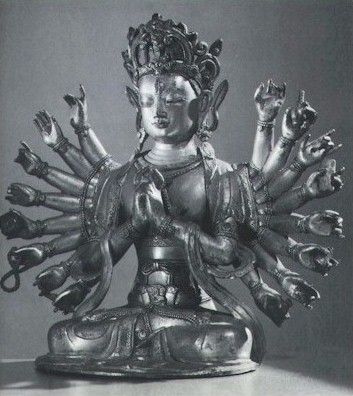
In Jack Kerouac's novel Dharma Bums the protagonist, alter-ego of Kerouac, named Ray Smith, encounters 'the number one Dharma Bum of them all', Japhy Ryder, who instantly decides that Ray is a great Buddhist sage, possibly a reincarnation of Avalokitesvara, the Great Compassion Bodhisattva (more likely, though, a reincarnation of Goat or Mudface, Ryder teases Smith later on), and when they enter a San Francisco bar together and their friends inquire where they have met, Ryder gleefully announces: "I always meet my Bodhisattvas in the street!"

This sets the tone for the whole novel, which is perhaps even more celebratory of its culture hero than On the Road was in its beatification of Neal Cassady, alias Dean Moriarty. The two protagonists share a relationship of mutual respect and growth - again with Smith as the more passive learner and Ryder as the master woodsman, wilderness survivor, mountain climber, haiku improviser, Zen riddler and seducer of young women into the practice of yabyum (Tantric sex...)

Ryder's real life model was of course Gary Snyder, the great Zen practitioner among the Beats - a poet who was also a student and scholar of oriental languages and texts, and later among the first poets instrumental in writing from a non-anthropocentric point of view, expressing a deep-ecology ethos and an eco-critical practise. Snyder has often warned that people should not take everything in Dharma Bums as complete truth, but he does acknowledge that Kerouac's description of his lifestyle is correct in most respects.

In the course of the novel Kerouac paints a very sympathetic portrait of Ryder, and unlike Moriarty in On the Road, this new Buddhist culture hero does not end up betraying the protagonist. Rather it is the Ray Smith figure who at the end abstains from following the hard path to enlightenment that Ryder has helped him embark on, and he decides to literally come down from the pinnacles after a season as a fire lookout on Mount Sourdough's Desolation Peak and once more rejoin the human community with all its temptations of the flesh. Still Smith misses Ryder who has gone off to Japan to live in a monastery and realizes what a strong, serious scholar Ryder will become.

Again, there are clear parallels between the novel and the real life of Gary Snyder. Snyder was born in San Francisco, but his family moved to the Pacific Northwest, where Snyder's father began working in the logging industry. Snyder developed a love of the land from an early age on, and acquired forest and mountain craft through interacting with his environment. He studied anthropology in Portland at Reed College and left there with a BA in 1951. Later he pursued graduate studies at Berkeley, switching from anthropology to Oriental languages, to further his understanding of both Oriental poetry and Buddhist scriptures. Snyder has written a mini-autobiography for Modern Haiku and in there he begins:

I was from a proud, somewhat educated farming and working family. After finishing college I went back to work. I went into the National Forests to be an isolated fire lookout living in a tiny cabin on the top of a peak. I worked as a summertime firefighter and wilderness ranger, and then spent winters in San Francisco to be closer to a community of writers.

This mixture of manual and intellectual pursuits came to mark Snyder's outlook in profound ways and is also one of the reasons behind the frequent comparison with Henry David Thoreau:

"If Ginsberg is the Beat movement's Walt Whitman, Gary Snyder is the Henry David Thoreau. "-- Bruce Cook

This and Snyder's riposte to the Thoreau comparison, along with a great number of other Snyder quotes can be found here. Whereas Thoreau had his Walden Pond, Snyder had his Pacific Northwest - an altogether more rugged and demanding terrain. Already from Snyder's first collection of poetry, the sense of place was one of the most striking features of his poems. His programmatic meta-poem "Riprap" (the title poem of that collection) perfectly illustrates the fusion of poetical practice and hard manual labour. The poem can be found in its entirety on-line here and here. The speaker's absolute certainty of the equal value of building a path up a mountain and composing a poem never ceases to amaze me: each stone and each word matters equally, and the "Solidity of bark, leaf or wall/riprap of things" leads straight out onto the "Cobble of milky way/straying planets" putting us in our place in the Cosmos (this line echoes with Ginsberg's "ancient heavenly connection to the starry dynamo [...] of night", but has no urban angst built into it). Snyder then draws us inward: "In the thin loam, each rock a word/a creek-washed stone/Granite: ingrained/with torment of fire and weight/Crystal and sediment linked hot/all change, in thoughts,/As well as things" - reminding us of the connection between thought and matter and the fiery origins of both. Fire is, in fact, Snyder's favourite element of change, signalling as much rebirth and life as destruction.

The other half of the first Snyder collection was made up of his translations of the Cold Mountain poems by Han Shan, a 9th century Chinese hermit poet, who took his name after the place in which he lived. Snyder's congenial translations indicate the strong identification between the young aspiring poet and the old master. Here is Snyder's translation of "Clambering up the Cold Mountain Path". The poem ends with a question reminiscent of a koan, or Zen riddle: "Who can leap the world's ties/And sit with me among the white clouds?" No doubt this reflects what Snyder desired to do...


Cover image from Riprap & Cold Mountain Poems

Snyder describes his years in Japan in the following terms:

I first arrived in Japan in May of 1956. Exposure to Buddhist scholars and translators soon brought me to the Zenrinkushû, that remarkable anthology of bits and pieces of Chinese poetry plus a number of folk proverbs as they became used within the Zen world as part of the training dialog. If one was looking at the possibilities of “short poems” the Zenrinkushû practice of breaking up Chinese poems would certainly have to be included. R.H. Blyth famously said “The Zenrinkushû is Chinese poetry on its way to becoming haiku.” Maybe it is that somebody — one of the old Zen monk editors — realized that practically all poems are too long and that they’d be better if they were cut up. So he cut up hundreds of Chinese poems and came out with new, shorter poems! I now know I was extremely fortunate to have been exposed to the elegant “Zen culture” aspects of Kyoto. But as I traveled around Japan I came to thoroughly appreciate popular culture, ordinary people’s lives, and the brave irreverent progressive vitality of postwar Japanese life. I realized that the spirit of haiku comes as much from that daily-life spirit as it does from “high culture” — and still, haiku is totally refined.

The practice of haiku was already introduced to the American readers by scholarly translations of Basho and other masters of the form, but a much more efficient boost of cultural transfer was performed by the characters of Dharma Bums who trade off spontaneous haikus during a climb of Mount Matterhorn in California like a couple of jazz-men trading riffs and licks. Smith teaches Japhy to be spontaneous, Japhy teaches Ray the discipline of mind required for the haiku to have an enlightening effect. Kerouac has published many of these so-called western haikus (they don't conform to the syllable structure (3 lines of 5-7-5 syllables, respectively) that Japanese haiku poetry always follows) in books such as Pomes All Sizes, Scattered Poems and Some of the Dharma. Read more about Kerouac's western haiku practice on this page.

Before going to Japan, Snyder had also been hitchhiking extensively up and down the West Coast, sometimes accompanied by Ginsberg, who had become friends with him after both men had participated in the legendary Six Gallery reading in late 1955. Here is a recent interview where Snyder recalls their reading at Reed College - a tape of which, containing the earliest known reading of "Howl", has just surfaced.

Snyder had also spent several summers working as a fire lookout for the Forest Service. He recommended Kerouac for the job, and the summer of Snyder's leaving for Japan, Kerouac manned the small look-out cabin on Sourdough Mountain in the North Cascades. An excellent volume commemorating the stays of Snyder, Kerouac and Philip Whalen on Sourdough has been produced by the very same person who unearthed the "Howl"-tape, John Suiter. His Poets on the Peaks site has sublime photography showing us the things these young men may have seen in the 1950s summers they spent up there in splendid and sometimes terrifying isolation. Kerouac wrote about this experience in two novels, Dharma Bums (somewhat romanticized) and Desolation Angels (with more of an emphasis on the terrors of the void)...

I think Snyder's work as a fire lookout was directly instrumental in his choosing Smokey the Bear as yet another avatar of the Great Sun Buddha. In what is the funniest Snyder poem I have ever read, "Smokey the Bear Sutra", the friendly figure known to every child in America becomes both holy, sublime and hilarious in the best "Zen Lunatic" tradition. You can read the poem here (although Snyder graciously allows us all to "reproduce it free forever", it is a bit long to quote in full here...)

Suffice it to say that Snyder lets his readers participate in a hitherto unheard of non-human centered audience given as "a Discourse to all the assembled elements and energies: to the standing beings, the walking beings, the flying beings, and the sitting beings -- even grasses, to the number of thirteen billion, each one born from a seed, assembled there." This message is about the Future of Turtle Island (perhaps better known to the white man as America), where trouble is brewing: "The human race in that era will get into troubles all over its head, and practically wreck everything in spite of its own strong intelligent Buddha-nature..." Only the figure of Smokey will emerge to put out the uncontrollable wildfires and other destructions that mankind has unleashed on the earth:

With a halo of smoke and flame behind, the forest fires of the kali-yuga, fires caused by the stupidity of those who think things can be gained and lost whereas in truth all is contained vast and free in the Blue Sky and Green Earth of One Mind; Round-bellied to show his kind nature and that the great earth has food enough for everyone who loves her and trusts her; Trampling underfoot wasteful freeways and needless suburbs; smashing the worms of capitalism and totalitarianism; Indicating the Task: his followers, becoming free of cars, houses, canned foods, universities, and shoes; master the Three Mysteries of their own Body, Speech, and Mind; and fearlessly chop down the rotten trees and prune out the sick limbs of this country America and then burn the leftover trash.

This figure of trust and ancient wisdom - but also the bearer of a cleansing fire - will herald a new age for "Those who love woods and rivers, Gods and animals, hobos and madmen, prisoners and sick people, musicians, playful women, and hopeful children", who, chanting Smokey's mantra: "DROWN THEIR BUTTS - CRUSH THEIR BUTTS", will make the world safe, so we will all have "ripe blackberries to eat and a sunny spot under a pine tree to sit at. AND IN THE END WILL WIN HIGHEST PERFECT ENLIGHTENMENT." Amen!

With this radical turn into eco-critical poetry the mature Snyder tone is established. In my session this week I spoke about Snyder's poetics and its heritage from Transcendentalism and the American Romantic age, esp. in its belief in a chain of beings and a transmission of the divine through all beings, the poet being but a conduit. You can learn more from my agenda for analysis for Snyder which suggests his techniques, themes and some contexts for his work.

In my session I also suggested that Snyder was a catalyst for the meeting of East Coast Beats and West Coast poets (often discussed as the San Francisco Renaissance), but more than that he helped seed the central Beat figures with a more Orientalist outlook, turning them on to Buddhist beliefs and ancient poetry of the East, and furthermore I see him as setting Ginsberg on the course that made him a lynch-pin between the Beat Generation and the 1960s multifaceted Counterculture - a movement Snyder also enthusiastically joined upon returning to the US in the late 60s.

I want to close with a clip from one of the few documentary films on Snyder. It can be found in four instalments on YouTube. Here I embed the first bit and after that you'll see links to the other three...


Episodes 2, 3, and 4

Here is the Gary Snyder Reader: Prose, Poetry and Translations 1952 - 1998 which will give you 600 pages of poetry, essays, interviews etc. to peruse... It contains good selections of poetry from Regarding Wave, Turtle Island, Axe Handles, and Mountains and Rivers Without End, as well as prose from Earth House Hold, A Place in Space, The Real Work and The Practice of the Wild.

Snyder is also well represented in the Buddhist Beat reader, Big Sky Mind: Buddhism and the Beat Generation, ed. by Carole Tonkinson (out of print, but available second-hand)

Here is a more recent picture of Gary Snyder:


Minnesota Public Radio has audio files featuring Snyder...

Snyder is very much still with us, dwelling among the species that surround us. His most recent book of essays came out in paperback a month ago: Back on the Fire. Most recent poetry collection was Danger on Peaks (2004).

Long may he remind us of our place in space!


Photo: Anne Braaten
View of Hozomeen Peak from Desolation

Saturday, February 16, 2008

Howl tape unearthed


To follow up on yesterday's post on "The American Scream" - Ginsberg's poem "Howl" - the recently discovered first recording of Ginsberg reading Part I of the poem (the famous 6 Gallery reading in October '55 was not recorded) has now been made available to the general public...

To listen, go to the Reed College - a Portland, OR undergraduate college - Multimedia website. After you hear the readings, look at John Suiter's fascinating account (wonderfully illustrated on 6 HTML-pages)(this link opens the article as a PDF-file if you just want text - but the photos should not be missed) of finding the tape and describing the events in February 1956 when Gary Snyder and Ginsberg came to Reed and gave poetry readings to a small student audience...

Suiter's story begins:

In a plain gray archival box in the basement of Reed’s Hauser Library there lies a single reel of audiotape that captures a moment in the early life of one of the anthemic poems of the 20th century. The aging brown acetate clarifies an author’s voice, hints at a spirit, adds to the myth of two poets, and tells of a part Reed College played in the early days of the Beat Generation—before it was Beat, or yet a generation.

Later in the piece Suiter quotes Ginsberg's introductory remarks before launching into the incomplete version of "Howl":

Ginsberg pauses to briefly prime his listeners for what’s to come. “The line length,” he says. “You’ll notice that they’re all built on bop— You might think of them as built on a bop refrain—chorus after chorus after chorus—the ideal being, say, Lester Young in Kansas City in 1938, blowing 72 choruses of ‘The Man I Love’ ’til everyone in the hall was out of his head—and Young was also...” (This was pure Kerouac, straight from the prefatory note to Mexico City Blues, wherein Kerouac states his notion of the poet as jazz saxophonist, “blowing” his poetic ideas in breath lines “from chorus to chorus.”)

John Suiter has his own interesting website for his "Poets on the Peaks" project...


Thursday, February 14, 2008

Allen Ginsberg and the American Scream

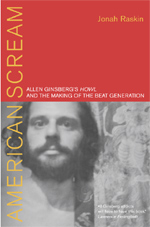
This week's class in The Beat Generation Revisted course was an introduction to the life and works of Allen Ginsberg, whose famous poem "Howl" inspired the title of Jonah Raskin's 2004 book (subtitled "Allen Ginsberg's Howl and the Making of the Beat Generation") and gave me the title of this blog entry. American Scream is an examination of the cultural roots of Ginsberg's great outpouring in poetry of what made his generation unique in its maladaptation to an American conformity. As a communication studies professor Raskin's primary interest is not in "Howl" as a literary work, but more in the effect of the poem on its contemporary society, as well as the personal development Ginsberg underwent before he could gather his ideas in this compendium of anecdotes about life as "angelheaded hipsters burning for the ancient heavenly connection to the starry dynamo in the machinery of night..." Raskin has, as the first scholar ever, had access to some unique background sources, such as psychiatric reports on Ginsberg, interviews with his psychoanalyst and extracts from the poet's journals:


American Scream shows how "Howl" brought Ginsberg and the world out of the closet of a repressive society. It also gives the first full accounting of the literary figures--Eliot, Rimbaud, and Whitman--who influenced "Howl", definitively placing it in the tradition of twentieth-century American poetry for the first time. As he follows the genesis and the evolution of "Howl", Jonah Raskin constructs a vivid picture of a poet and an era. He illuminates the development of Beat poetry in New York and San Francisco in the 1950s--focusing on historic occasions such as the first reading of "Howl" at Six Gallery in San Francisco in 1955 and the obscenity trial over the poem's publication. He looks closely at Ginsberg's life, including his relationships with his parents, friends, and mentors, while he was writing the poem and uses this material to illuminate the themes of madness, nakedness, and secrecy that pervade "Howl".

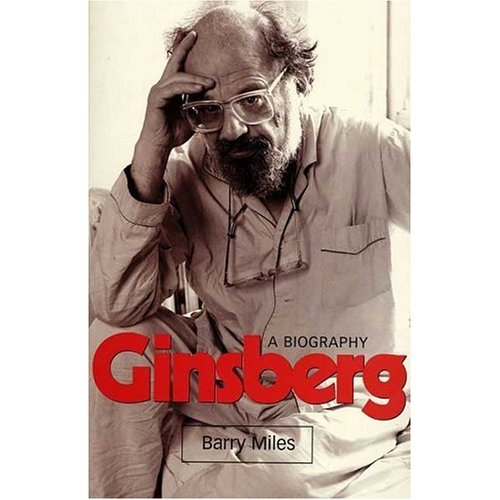
Raskin's book is just one among many books focusing on Ginsberg as the chief poet of the Beat Generation and one of the key focal characters in the nascent counterculture from the mid-fifties and onwards. One can point to Barry Miles exhaustive biography of Ginsberg from 1989, Ginsberg - A Biography:


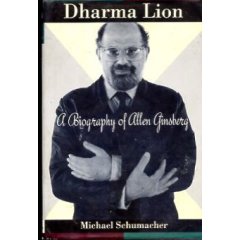
or Michael Schumacher's critical biography from 1992 Dharma Lion: A Critical Biography of Allen Ginsberg which has more focus on analyses of the poems:

Apart from these bios, there is excellent information to be found in the facsimile version of "Howl", edited by Barry Miles, in which one gets a full annotation of the poem by Ginsberg himself as well as background on the "Howl" obscenty trial, Ginsberg's struggle to correct the contemporary image of the poem as a nihilistic protest, instead of a spiritual credo, and much other invaluable material. Of course one must also own a copy of the original black and white covered City Lights Pocket Poets series edition of Howl and Other Poems which is still a cool object to carry in one's jacket or jeans pocket...

As for my lecture today I took my starting point in a clip from Bob Dylan's 1978 film Renaldo and Clara, showing Dylan and Ginsberg together at Kerouac's grave, discussing poetry, gesturing and walking about looking at the various mementi mori at the cemetery:


I thought it only appropriate to link back to last week's talk about Kerouac and his untimely death in 1969 of alcoholism-related causes, but also to point forward to the great connection between the Beats and the counterculture of the 60s with Dylan as one of its less willing figureheads. This connection gave me an occasion to explore the great meetings in 1965 (recently commented on by Todd Haynes' film I'm Not There) between Dylan, Ginsberg and The Beatles in London, where Ginsberg mediated as if he were a diplomat negotiating a peace treaty between two rival superpowers. Miles describes (p. 370) how Ginsberg managed to break the ice between the oversized egos of Lennon and Dylan by clowning around telling stories about William Blake, Jack Kerouac and the other Beats.

The relationship between Dylan and Ginsberg continued to be close, and Dylan helped Ginsberg take a step towards using music in connection with his poetry, teaching him a few chords on the guitar, and in general inspiring Ginsberg to approach other, more traditional forms, such as the blues - a popular form Ginsberg seems to have been unfamiliar with before meeting Dylan. In Don't Look Back, D.A. Pennebaker's well-known documentary of Dylan's tour of England in '65, Ginsberg takes part in what has really become an independent music video of "Subterrenean Homesick Blues" (it was also used as the original trailer for the film). While Dylan holds up and discards cue cards with the song lyrics, ("don't follow leaders, watch pawking metaws") Ginsberg is seen in the background vigorously debating with another individual, waving his arms and a weird shepherd-like walking stick about. The action all takes place in the back alley from the hotel they were staying at. This was only the first of Ginsberg's many cameo appearences with musicians over his career...


I went on to briefly mention some of Ginsberg's other activities in 1965, including the visit to three Communist countries (Cuba, the Soviet Union and Czechoslovachia) and getting thrown out of all of them (although in Prague the students crowned him King of May). I also pointed to Ginsberg's rapidly accumulating FBI-file, which didn't seem to reflect that since Ginsberg was treated as a dissenter and a misfit everywhere he went, it made little sense for the Feds to think he was some sort of Communist infiltrator and spy...

After this excursion into Ginsberg's ushering in of the 60s counterculture and passing the mantle of prophet and critic of America's contradictions on to a new generation, I returned to the main works of the mid-fifties Ginsberg, discussing how Kerouac's list of essentials for the production of spontaneous prose inspired Ginsberg during the writing of "Howl". The other raw material for "Howl" was of course personal experience, both from Ginsberg's childhood where he suffered greatly because of his mother's mental illness and his own troubled sexuality, and the more recent experiences from his circle of friends in New York, both at Columbia and Times Square, and later on in California.

In the facsimile version of "Howl" Ginsberg actually provides a rather elaborate line-by-line key to the anecdotal evidence immortalised in phrases such as: "who were expelled from the academies for crazy & publishing obscene odes on the windows of the skull" - references to Ginsberg writing on his dirty dorm window and getting suspended from Columbia for claiming that (Columbia President) "Butler has no balls". Many other otherwise obscure lines refer to specific incidents involving friends of Ginsberg, such as Philip Lamantia, Herbert Huncke, Joan and William Burroughs, Kerouac, or Neal Cassady (who famously is "N.C. - secret hero of these poems"). There is also a reference to Bill Canastra who was a legendary bohemian on the outskirts of Ginsberg's circle who decapitated himself by leaning out of a subway car while it was leaving the platform...

With regards to the structure of "Howl", Ginsberg insists in a letter to the critic Richard Eberhart that the poem is built "like a brick shithouse". By this he means that there is a solid, predictable construction of each of the 3 main segments and the so-called "Footnote to Howl". Each of the sections of the poem has a "fixed base" and a repetition-fueled structure: The "catalogue" of section I contains the anecdotes I referred to earlier, and they are anchored by the relative pronoun "who" initiating each line. Part II is a condemnation of "Moloch" - Ginsberg's name for the military-industrial complex which in Old Testament fashion demands a burnt offering of each citizen. This section ends with the speaker "abandoning" Moloch. This portion is the katabasis element of the poem, i.e. its descent into Hell. After that, part III features a statement of solidarity and brotherhood, where the direct address to "Carl Solomon!" is followed by the reassurance: "I'm with you in Rockland where...", repeated as the beginning of each line. Finally, in the Footnote (which really is the poem's part IV) we are back out of the mental hospital, and hear a list of all things holy, from the lowliest body part ("The tongue and cock and hand and asshole holy!") to the highest aspiration of a man: "Holy the supernatural extra briliant intelligent kindness of the soul!" This portion opens with 15 times "Holy!" and after that every line opens with the same incantation. This structure can be summarised in terms of language functions: Lament, Curse, Praise, Incantation/Prayer...

(By amazing coincidence, my friend Gray from Washington just sent me a news item that a hitherto unknown tape recording of Ginsberg reading "Howl" has been discovered in a university library at Reed College in Portland, Oregon! The tape will be available from the college website soon...)

After this in-depth survey of "Howl" we briefly discussed and heard some other poems, including "America", the funny tongue-in-cheek politics of which hinge on a parody of media stereotypes of "them bad Russians". In "America" Ginsberg still signs into the American project, putting his "queer shoulder to the wheel". The America outside his poem was less than forthcoming in accepting the help he offered.

We also discussed the role which some poetical predecessors have played as inspiration for Ginsberg. Here I singled out Walt Whitman, as the peripatetic American bard whom Ginsberg offered to follow early on: "Which way does your beard point tonight?" ("A Supermarket in California") (this post discusses Whitman and Ginsberg and the American Dream); Wiliam Blake whose voice Ginsberg heard in a vision, and to whom his "Sunflower Sutra" pays homage; and finally Oriental traditions, both within religious thought and poetic practice (for instance the haiku).

In closing we heard Ginsberg perform his moving "Father Death" (taken from a 90s BBC program) where he plays the harmonium and sings this simple lyric about accepting and embracing the inevitability of death for all. Thus we started the day at Kerouac's grave and ended with a celebration of both life and death. Ginsberg passed away in 1997...


Ginsberg at Academy of American Poets
Ginsberg at Levi Asher's Literary Kicks
Ginsberg at Modern American Poets

Also check out the recent Allen Ginsberg movie...

Friday, February 08, 2008

Basic Hip - Kerouac times, vol. 2

My first class in the "Beat Generation Revisited" course was given in the true Beat spirit of spontaneous improvisation. I went in there to tell a few stories about the origin of the Beat Generation, about some of the key persons involved - then zooming in on Kerouac and his writings, covering his manifestos for spontaneous prose and On the Road. I reminded the students of Kerouac and Ginsberg's belief in "first thought - best thought", and also in Ginsberg's re-enactment of a Dadaist approach to lecturing: if things get too boring feel free to take off your clothes and throw potato salad at the lecturer. Fortunately it didn't come to that, probably because no-one had thought to actually bring potato salad...

To start the lecture off on a proper note I played a track from the Beat Generation CD-box that came out on Rhino Records in 1992: "The Beat Generation" by the pseudonymous band 'Bob McFadden & Dor'. This track was originally the title song to one of several Beat-exploitation flicks of the late fifties and early sixties (this one starring Mamie Van Doren) - the most notorious of which may be the racially purified 1960 film based on Kerouac's novel The Subterreneans, whose black love interest was miraculously turned into a white chick by Hollywood. The publicity for The Beat Generation film is typically stereotypical for the way deviance was sold to a mainstream audience: "The wild, weird, world of the Beatniks! ...Sullen rebels, defiant chicks...searching for a life of their own! The pads...the jazz...the dives... those frantic "way-out" parties... beyond belief!" I made a point out of emphasizing that the course would explore those stereotypes and hopefully dig a bit deeper.

The performer actually hiding behind the faddish name of 'McFadden' is none other than Rod McKuen who went on to become one of the best selling poets of the late 60s and 70s, putting out more than a volume a year for a 20 year period from '67 to '86. In the liner notes to the CD-box he is dubbed the "poet laureate of the Silent Generation", and it is suggested that his training as a "psychological warfare script-writer" for the US army during the Korean War came in handy for his undercover work as a Beatnik... McKuen's poetry is somewhat mushy and lovey-dovey but had and continues to have a wide appeal, as the web-site linked to above indicates. The "Beat Generation" track has actually had an interesting afterlife in a later generation, when Richard Hell and the Voidoids recorded it under the title "Blank Generation" in the punk era of the late 1970s.

I won't try to reproduce my literary history of the Beats, nor the account I gave of the Beats as a social rebellion against post WW II conformity - all that you can read about from my course website - esp. in the chapter from my PhD on the construction of the Beats as a literary generation. But I do want to especially draw your attention to the literary manifesto Kerouac produced when he broke through the publishing barrier he had encountered when trying to get publishers to 'dig' his strange scroll manuscript of On the Road (see previous post for more on the scroll). In the list of 30 pithy tenets titled, "Belief and Technique for Modern Prose" (accessible online from University of Pennsylvania), Kerouac espouses not only a prescriptive ideal for prose writing, but also gives good, concrete advice for living: "3. Try never get drunk outside yr own house", perhaps less good, abstract advice: "6. Be crazy dumbsaint of the mind", and purified Catholic, long-suffering wisdom: "19. Accept loss forever 20. Believe in the holy contour of life". The point I wanted to make was that for Kerouac any distinction between life and the writing of that life was artificial. He desired more than anything to set his life in words, remembering it all: "17. Write in recollection and amazement for yourself", gaining insights and visions ("9. The unspeakable visions of the individual") from the process, creating an uninhibited flow of words, as a jazzman blowing an interminable solo: "7. Blow as deep as you want to blow 8. Write what you want bottomless from bottom of the mind".

That led us to a discussion of the language of Beat writing and later of Beatniks and Hipsters trying to live a Beat life-style. For that purpose I dug out another track from the Beat Generation box-set, namely "Basic Hip" by John Brent and Del Close (which you can access here as an mp3-file from the über-cool website that borrows its title from that very track). The track is a hilarious riff on how lingo and subcultural argot always is slippery and tautological to outsiders, such as the "professor" on the track who tries to get "Geets Romo", the Beatnik, to define the key concept of "dig"...

Del Close as Romo


This gave us a good inroads into the thematic analysis of On the Road, which also draws on a limited set of key terms from the Beat lingo, all circularly defining one another: To 'blow', to 'go', to 'dig' - to be 'hip', to be 'beat', to be 'gone'... All activities that one had to engage in while being on the quest for the mysterious 'IT' that Sal Paradise and Dean Moriarty desire to find throughout the novel. 'IT' is at various times defined as their lost or dead fathers, the original Fellaheen peoples of the Earth, sex, jazz, God ("Don't you know that God is Pooh Bear"), but mostly as all of the above rolled into one.

The controlling metaphor of the quest is the pearl: "Somewhere down the line the pearl would be handed to me", Sal Paradise (Lost) muses at the onset of his life on the road. This pearl is eventually handed, not to him, but to Dean Moriarty, by an innocent Mexican girl on the plateau the questers cross to get to Mexico City. It now takes the form of the purest mountain crystal the size of a berry plucked especially for them by the Mexican child... I pointed out how the reference to the pearl is an oblique reference to the old chestnut "the world is my oyster" (as we all know oysters are mothers of pearl), which of course, as Kerouac well knew, is from Shakespeare's The Merry Wives of Windsor: "Why, then the world's mine oyster, Which I with sword will open. "(2.2.3-4, Pistol to Falstaff)... For anyone who thinks like Truman Capote about On the Road: "That's not writing, that's typing", I recommend that you read the novel with Shakespeare and The Bible as companions because then you will then quickly get smarter than Capote was when he made his famous quip...

I closed the lecture with a few pictures of Kerouac to emphasize the several facets of his personality, which included not just the frenzied, drunken hep-cat of On the Road, but also more contemplative and homely personae. You can see some of those pictures here. BTW, should you have any Kerouac or Beat related collecting/shopping needs try this website...

I'd like to here also give the final word to Kerouac himself, whose distinct voice and diction gives new energy to the words of On the Road. Enjoy Jack riffing on themes from that book and Visions of Cody to Steve Allen's piano accompaniment in the YouTube clip below...