Showing posts with label Semiotics. Show all posts

Thursday, June 26, 2008

No Caption Needed Birthday

Robert Hariman and John Lucaites recently posted the one year anniversary of their fantastic blog, No Caption Needed.

You can read Bent's review of both the blog and their seminal book by the same title here.

They're experiencing some "growing pains", something we are familiar with here.

It’s been a year since we began this blog. We had no idea what we were getting into. The initial idea was to put up an ad for the book. Not a great idea, but then we thought that we could write a few posts to thicken the ad. After all, neither one of us had the time to do this on a regular basis. One thing lead to another, and soon we had created a monster: we loved writing the posts and seeing the audience grow, but we still didn’t have the time, so we told ourselves that we’d do it for a year and then quit. It’s been a year and we don’t want to quit, but we need to make some changes.

I encourage you to stop by and leave your comments or drop them an email, or better yet both. This is one of the little jewels out in the academic blogosphere (and a service to the public at large). Both blog and book have been a source of inspiration for me personally as I have become increasingly drawn into visual culture, semiotics and that emerging niche that Bent refers to as iconicity studies.

Best of luck and continued success with No Caption Needed.

Monday, May 26, 2008

McCain's Memorial Day Political Iconography


Today is Memorial Day in the US. Doubtful there was any "coverage" by our local media here. But given the recent importance we've been placing on visual analysis, iconic studies, and semiotics I thought this image, featured today on the mainpage of John McCain's campaign website, might be interesting to toss around.

I've recently been re-reading Robert Hariman's and John Louis Lucaites' exceptional book, No Caption Needed: Iconic Photographs, Public Culture and Liberal Democracy.

Chapter 4, "Performing Civic Identity," specifically explores the iconic image of the flag raising at Iwo Jima.

Hariman and Lucaites argue that the flag raising image creates three simultaneous civic narratives based on three deeply embedded ideological traditions within America's political and cultural history. I'm pulling this from memory so please correct me if I don't get it exactly right.
1. civic republicanism
2. egalitarianism
3. nationalism

From the photo above, its obvious that the man holding the flag is none other than John McCain. Given that John McCain's campaign has embraced militaristic and nationalistic themes for his campaign an image like this is not unique for McCain on its first read.

However, I couldn't help seeing this image in relation to the iconic Iwo Jima photo. There's McCain, standing atop a barren hilltop amongst an eerily similar barren landscape like that depicted in the Iwo Jima.

What do you think? Is McCain relying on the cultural memory of the Iwo Jima image here?
If so, does the image meet any of the three qualities listed above? For Hariman and Lucaites the Iwo Jima worked and continues to work because it simultaneously embodies all three of those traits which can be read by different and competing identities within the body politic. For me, any expression of egalitarianism or popular liberal democracy is removed from the context in the McCain photo. Its even difficult to read a civic republican virtue into the visual narrative. I'm left with a libertarian ultra-individualistic patriotism as the sole narrative. Perhaps the creators thought a lone McCain would strengthen the "maverick" meme. I don't know, I think this image fails terribly in comparison to the original, if that is what it was based upon.

What do you think?

Friday, May 16, 2008

Lakota Sundance and the American Flag

One of the most captivating presentations at the recent EAAS conference in Oslo was Kay Koppedrayer's narration of the events at a Lakota sundance ceremony on the Pine Ridge reservation where American Flags were flown during the ceremony:

One year, four American flags flew over a Lakota sundance on the Pine Ridge Reservation. Raised on a column of lodge poles dug into the hillside above the eastern gateway of the sundance arbor, the flags were easily visible from every location on the sundance grounds, from where families camped, to where people parked and sat in their cars, to the shade circling the arbor, where the drums and singers sat, to inside the arbor where the sundancers prayed, to the fire and where the sweat lodges were located.

There were varying opinions among the participants concerning the meaning of the iconic flag in such a context. I was particularly struck by this comment cited by Kay:

As one of the Lakota sundancers put it, "that's our flag, too. We captured it. We won that flag, the one that’s flying up there." He was referring to the defeat of Custer at the Battle of the Little Big Horn, in which more than a few American flags were taken by the victors. One estimate is that some fifteen were later brought back to the Lakota and Cheyenne camps.

See for instance the account by Chief Rain-in-the-Face of his role in the battle of Little Big Horn which mentions a flag capture:

I had sung the war song, I had smelt power smoke, my heart was bad--I was like one who had no mind. I rushed in and took their flag; my pony fell dead as I took it. I cut the thong that bound me; I jumped up and brained the sword flag man with my war club, and ran back to our line with the flag. I was mad. I got a fresh pony and rushed back, shooting, cutting and slashing. This pony was shot and I got another. This time I saw Little Hair (Tom Custer)--I remembered my vow. I was crazy; I feared nothing. I knew nothing would hurt me, for I had my white weasel tail on. I don't know how many I killed trying to get at him. He knew me. I laughed at him and yelled at him. I saw his mouth move, but there was so much noise I couldn't hear his voice. He was afraid. When I got near enough I shot him with my revolver. My gun was gone, I didn't know where. I got back on my pony and rode off. I was satisfied and sick of fighting.

The pride in the American flag expressed by one Lakota sundancer in the above quote from Kay's presentation was supplemented by her further account of the respect several veterans of service in the US military expressed for the flag. Historically the US Government has made considerable efforts to establish the role of the flag and has used it as a means of integration of Natives serving in the military. Kay Koppedrayer again:

Veterans returning from the war were welcomed with victory songs, adaptations of earlier songs celebrating victory over other tribes or the US cavalry (Standing in the Light: A Lakota Way of Seeing, Young Bear and Theisz, 1996: 83-84), and flag songs, introduced to the reservations with the citizenship and recruitment campaigns. [...] Flags were flown at these [social] dances as at most other gatherings on the reservation as part of the Americanization process. Veterans, honoured with the flag songs and victory songs, were given the privilege of opening and policing the gatherings. As for the Lakota soldiers who didn’t come back, their deaths were honoured with the display of the flag. A description of a soldier’s burial at Rosebud describes his body being brought home: “Long before we reached the home we could also see Old Glory floating from a tall flagpole that had been set up since the news of his death had reached the reservation” (Department of Interior 1927: 3).

At the end of the sundance described in Kay's presentation the flags were taken down and in an impromptu ceremony presented to a young Marine representing all the veterans there. Kay quotes this young man's account of the event:

He said that when he stood there in front of the people, it was so still, so quiet, he felt as if the ancestors were there, all the veterans were there. He stood there for all the veterans and he can’t put into words how he felt, can’t express it, can’t explain it. He said the look on the faces of the family members who received the flags is something he can’t explain. He said that the experience took him to another place, "it was as if I was up on the hill [the hill surrounding the sundance grounds, but also an expression that is used when one goes fasting (= vision quest), the hill where the flag poles were, the hill where the men had earlier been fasting] watching. I could see myself and I could see everybody and I could see the pride. The pride I felt wasn’t my pride, but it came from the people, it came from them and I felt it through me."

Kay's narration of these events and feelings left us all quite stunned. The somewhat problematic connotations of Old Glory had been re-interpreted for us in a whole new context. I deem the actions of the participants in the Lakota sundance as a performance of an instance of unincorporated, non-hegemonic collaborative icon-work vis-a-vis the US flag...

For an alternative Native view see this document.

Here is a Whitecap Dakota/Sioux flag used in Canada:

Thursday, May 15, 2008

An Uncanny Convention(al) Photo

Yesterday John Edwards endorsed Barack Obama. I know, old news already. But if you haven't seen the video it's worth noting the overwhelming enthusiasm from the Michigan crowd when Obama introduced Edwards. Considering he received 7% of the vote in West Virginia and isn't even running I'd say he's still got some serious mojo with "the people".


Hat tip to the EENR blog for video. EENR is a progressive blog community which began as a partisan grassroots community for John Edwards and has since morphed into an independent progressive/populist advocacy site.

The thing that struck me immediately about the visual of Obama and Edwards together was how much they looked like running mates at a Democratic convention. No doubt many would have read the visual as such which was probably the point. The BAG has a few remarks on this worth checking out, "-- it's hard to believe the true blue O-team wasn't playing for this exact pose."

Bellow is Clinton and Gore at the 92 Democratic convention. The comparison is uncanny.
Even Edwards' and Obama's facial gestures mimic Gore and Clinton in these two photos.
Do you notice anything different between the two photos?


The title of this blog post is a direct play on the BAG's title linked above, "Obama-Edwards: Just A Convention(al) Photo"

Wednesday, May 14, 2008

Icons of Transgression

My paper for the EAAS conference in Oslo last week dealt with icons and icon work, continuing a line of research I began about 5 years ago when I participated in a conference in Austria with the theme of US Icons. The convener of both the AAAS event in 2003 and of the Oslo workshop was Klaus Rieser of Graz, Austria whose tireless work is beginning to make an emergent interdisciplinary field out of Icon Studies.


Here is an excerpt of my presentation focusing on my two case studies of transgressive American icons, Charles Manson and Patty Hearst...

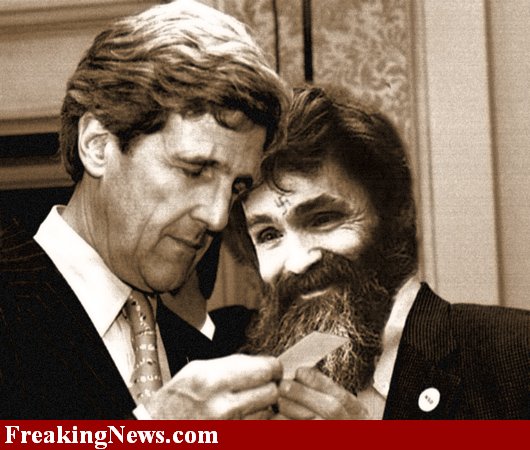
It is the elderly Manson who fuels the imagination of icon workers that use him in a politicized discourse, as witnessed first by a right wing manipulation of Manson’s image, photo-shopped into a photo of former Democrat candidate for President, John Kerry, who was the victim of a vicious slander campaign due to his past as an anti-Vietnam War activist. Here a grinning Manson in a suit modelled on Kerry’s (as is Manson’s hair style) shows the Senator a piece of paper or a photograph (perhaps a snapshot of the original Manson victims), and they appear to share a moment of confidence, although Kerry’s closed eyes might indicate that the image Manson shows him is a bit too much to take in. Note the Swastika on Manson’s forehead (he had used a knife to scrawl an 'X' on his forehead during his trial, and this 'X' later turned into a Swastika in popular legend), as well as the Kerry campaign button on his lapel.


In a parallel image, this time used to satirize Kerry’s defeater, George W. Bush, Manson’s photograph (the raw image is the same, and here the hair and attire are not airbrushed or photo-shopped) is used for a different type of collaborative icon work, this time more oppositional in nature. It is accompanied by an amusing text calling for the approval by the Senate of Manson as ambassador to the Klingon Empire (referencing the Star Trek universe). In this narrative Manson works for the Republicans as (crudely) indicated by the replacement of the Swastika on his forehead, which is substituted with a GOP Elephant, the symbol of the Republican Party. Bush and Condoleeza Rice are both ‘quoted’ as supporting Manson’s speedy appointment, saying for instance that “questions about Manson’s management style shouldn’t be part of the confirmation process”.


These two instances will be perceived as collaborative only from a politically partisan view. Both authors use Manson’s monstrosity to satirize the party he or she does not belong to. They are both hegemonically inscribed in a party political system, although not officially sanctioned by either party. The main iconic image I have selected for analysis is however a true homage to Manson.


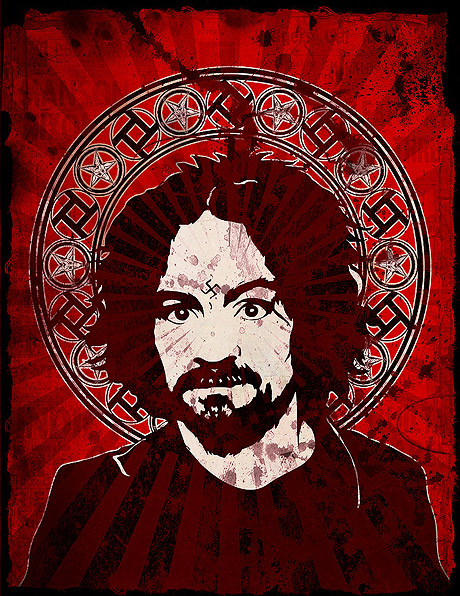
Here Manson is a saint and a martyr, signalled as in classical religious iconography via a representation of his stigmata. Here we note again the Swastika on Manson’s forehead, echoed in even more stylized form in his halo along with pentagrams that associate Manson with Satanism. His other stigmata consist of the blood stains on his face and neck and the strange umbilical chord of blood stretching from the back of his skull into the background of the icon. The photograph used as template for the icon is one depicting Manson in a particularly wild-eyed moment, taken shortly after his arrest, but prior to the X’ing incident. The choice of red, black and purple colours for Manson’s halo and the background (the traditional rays of light signalling the subject’s holiness in religious icons is here turned negative and black) contrast sharply with his pale skin. Taken together with the Swastika this composition and colour scheme serve to underscore Manson’s racial programme which the creator of the icon obviously condones. On the website I originally located the image there is a click through link to a further shrine for Satanism and Alistair Crowley which opens when Manson’s image is clicked.

Manson’s afterlife as an icon is thus prolonged by oppositional, collaborative icon work, falling within at least three spheres (which are not as separate as they perhaps should be): political, religious and pop-culture discourses all feed off his image...

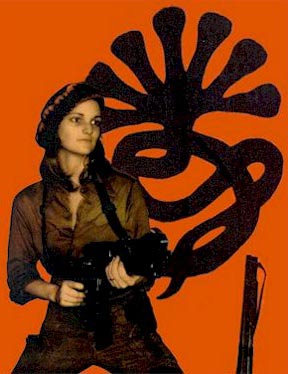
Turning now to Patty Hearst, we encounter a story much intertwined in the same counterculture background as the Manson legend. Heiress Hearst was the victim of an extremely high profile kidnapping in 1974, at the tail end of the armed struggle that militant splinter groups originating in the counter-culture and its anti-capitalist agenda was waging in America. The kidnappers, the bizarrely named Symbionese Liberation Army, carried out urban guerrilla warfare inspired by South American left-wing groups. Their agenda further included an attempt to free African-American inmates from the US prison system which their rhetoric compared to concentration camps and apartheid regime oppression a la South Africa. The SLA saw itself as spearheading a Black revolution in America and took as its symbol a seven-headed cobra snake – each head representing a Kwanzaa principle, such as unity, creativity and faith. After kidnapping Hearst and demanding various types of ransom payment (in kind, to be distributed among the poor), Hearst apparently willingly switched sides and joined the SLA in a bank robbery, generating one of the more iconic images of Patty (now known as Tania) wielding a sub-machine gun.

The SLA was eventually hunted down by the police and in an extremely violent shoot-out which resulted in a fire, most of the SLA members were killed. Hearst and a few SLA members escaped the siege and shootout, but were arrested soon after. During the trial, Hearst again switched persona and claimed that her participation in the robbery was coerced and that she had been sexually abused and brainwashed during her captivity by the SLA. She was sentenced to a fairly mild stretch in jail, her sentence was reduced by President Carter and eventually she was fully pardoned by President Clinton. A number of iconic cultural texts have been generated by this sequence of events.

The best known icon of Hearst is the image of her in front of the SLA cobra on a bright orange background. ‘Tania’ stares aggressively at ‘the Man’, ready to fire her Thompson gun – another weapon is ready in the background. This is revolutionary iconography 101, down to the army fatigues, the beret, the weapon and the surprising amount of cleavage shown. The phallic cobra offers a potent reminder of Tania’s taming, but also boosts her new-found revolutionary clout. As an ironic paean to this image Warren Zevon has put Patty Hearst into the lyrics of his tall-tale of mercenaries, post-colonial African liberation wars, upright, well-meaning Norwegian boys displaying bravery, sinister Danish power brokers, and CIA engineered betrayal followed by posthumous just deserts in the form of a headless ghost’s revenge: “Roland, the Headless Thompson Gunner”. The song ends on a didactic note:

The eternal Thompson gunner
Still wand'ring through the night
Now it's ten years later, but he still keeps up the fight
In Ireland, in Lebanon, in Palestine and Berkeley
Patty Hearst heard the burst
Of Roland's Thompson gun and bought it…

What exactly the meaning of the closing phrase “and bought it” means is an interesting point of debate. To buy something, of course means to acquire it for money, but also to buy into a story hook, line and sinker. The court case against Hearst revolved exactly around this point: did she buy the rhetoric of the SLA, or was she coerced or seduced, becoming a case of Stockholm Syndrome? My take on Zevon, who has many songs about masculine exploits gone horribly wrong (“Send lawyers, guns and money – the shit has hit the fan” is a line that springs to mind), is that he is warning us all against being taken in by revolutionary bravado and romanticism. To him Hearst is the naïve, protected, socialite teen who temporarily falls for the seduction of revolutionary ardour (a sentiment I would guess many of us can recognize).

Here is Zevon performing his song on Letterman:


More images of Hearst and Manson available here...

Read the rest of my paper in due course when it appears in print or as part of my book on Icons of Transgression...

Wednesday, April 30, 2008

Cars and Killers

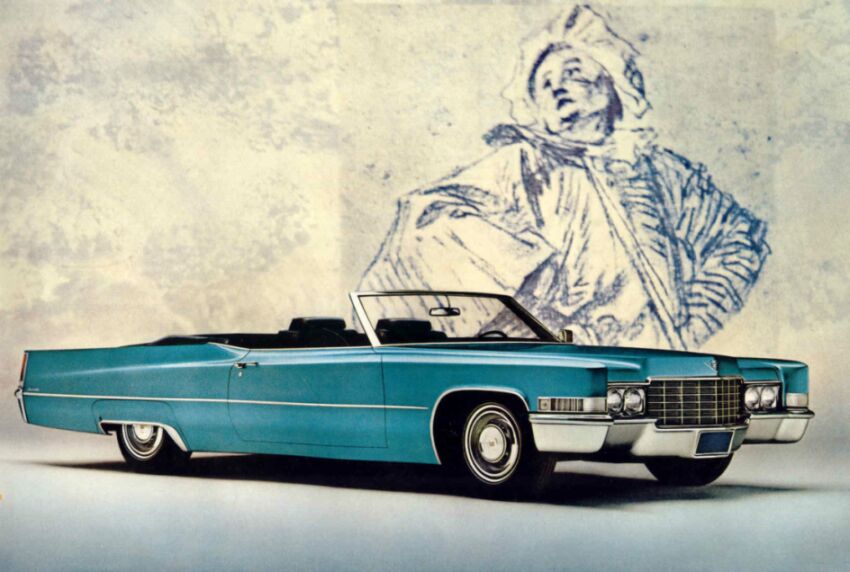
Next week will be a busy academic whirlwind tour of two Nordic capitals for me: Helsinki and Oslo. The two main American Studies events of the year are crammed together as Consecutive conferences: The Renvall Institute's Helsinki do, The Maple Leaf and Eagle Conference, has reached instalment no. 12 in its fine run (it will be my third time around as a participant). The theme is always broad and this year is no exception: "North America - Relations and relationships". My contribution is about the cultural importance of one specific, iconic brand of car: The Cadillac...


I approach this broad topic from a cultural text studies point of view, analysing film, photos, novels and songs - investigating how the cars are represented as markers of specific identity positions within specific difference hierarchies:

The Cadillac car has long featured in the American imagination as a signifier of cool masculinity, mastery of the road, financial surplus and a predilection for luxury and comfort (cf. the lyrics to ‘Cadillac Man’, quoted below). I propose to analyze a number of cultural texts that construct, establish and eventually subvert these connotations. I am particularly interested in constructions of race and sexual orientation utilizing the vehicle of the Cadillac. Texts to be analyzed include Jack Kerouac’s “fag Cadillac” in On the Road, rock singer and performer Mink DeVille, the persona of James ‘Thunder’ Early (played by Eddie Murphy) in the 2006 movie Dreamgirls, and various rock ‘n’ roll lyrics featuring comparisons of Fords and Caddies…


Well I’m the king of the road
Ain’t got no place to go, no place I call home
Seen the world from behind this old wheel
Driving away from those feelings I feel
- Cadillac Man
After a few days in Finland we'll relocate to Norway for the big European American Studies event under the auspices of the EAAS. Here my presentation is in connection with my on-going project on American Icons, more specifically some icons of transgression, associated with the 1960s. I'll give a paper on two celeb-criminals, two very different cultural texts, Patty Hearst and Charles Manson:

All iconic representations of actual persons (living or dead) are caught in a dichotomy between elements of normality/familiarity and elements of transgression. Manipulation of representations of celebrities or famous persons into hero- or other-images can either constitute adversarial or collaborative icon work. In adherence with the conference theme of “E Pluribus Unum or E Pluribus Plura” it would be interesting to examine iconic images that are meant to be particularly transgressive of normality and challenge stereotypical images of American wholesomeness. I propose to look at specific collaborative, yet provocative representations of two 1960s icons of transgression: Charles Manson and Patty Hearst, and to analyze how these particular images simultaneously stylize and sacralize these counterculture (anti)heroes, turning the viewer of the icons from passive consumers into ardent worshippers, consumers or cultural agnostics, all according to our ideas regarding the subjects and symbols in question. The images are reproduced below:


Thursday, April 24, 2008

Out of the Bag again and behind the curtain

After last week's ABC Democratic primary debate, the Bag posted a great series of TV frames as a visual recap to the debate. In my earlier post I wrote;

This is by far the most succinct summary of last night’s debacle of a debate TV show hosted produced by ABC News Disney Entertainment. This captures the essence of what is, “the postmodern condition” of US politics.

I selected this image as the most telling frame of the set.

Tuesday was Earth Day btw, but most wouldn't have known if not for Google's always clever way of "holiday theming" their logo. Al Gore has recently launched a $300 million environmental ad campaign to increase awareness and apply political pressure. Likewise, some of the other major environmental organizations have also launched public advocacy campaigns like the Sierra Club's Power 2 Change. The environment is one of the top issues among Democratic voters but it wasn't discussed during the debate or in any meaningful way since.

But Tuesday was also Pennsylvania Primary Day, which dominated the news cycle. So fitting the severity and importance of the major issues at hand, the three remaining presidential candidates recorded statements on Monday, not to address global warming, poverty, the war in Iraq, or the economy but addressed fans of the WWE (World Wrestling Entertainment) for the popular program, "Monday Night Raw."

McCain, I would presume, won the verbal "smack down", with a subtle mispronunciation of Obama's first name and a not so subtle gender bias, "If you wanna be the man, you have to beat the man." Remember Bush Sr. used to deliberately mispronounce Sadam Hussein's first name in a similar fashion leading up to the first Gulf War. The right wing has repeatedly injected Obama's middle name, Hussein, at every turn.

Jeez, when will Democrats learn to stop playing in territory which give Republicans distinct advantages? Clinton as "Hill-Rod" was more on cue than Obama's inauthentic, "do you smell what Barack is cookin'?" Did the campaigns provide their own scripts or were the candidates scripted by the WWE? I initially associated "cookin" with "soul food" and the wrestling character who played Obama in the ring that night was fitted with grossly exaggerated "ape like" ears. But the cooking line could also just be a reference to one of wrestling's biggest stars, The Rock.

McCain's,"...and whatcha gonna do when John McCain and all his McCainiacs run wild on you?" was just disturbing. McCain with his own private paramilitary special force of brown shirt goons comes to mind. Obamabots and Hillbots seem to be the most common derogatory slang for their respective supporters. In 2004, Howard Dean's partisans were referred to as deaniancs. But coming from McCain's mouth, who's running a distinctly militarized campaign the personal "run wild on you" feels all the more threating. Of course, this is all just entertainment right? Corporate sponsored entertainment, which is what the Bag so aptly crystallized.

So here's where this post comes out of the Bag again and looks behind the curtain. President Bush, who now has the lowest approval rating of any president since Taft, appeared on the NBC game show program, Deal or No Deal to address one the contestants, a three tour Iraqi War veteran. See the video here.

There are far too many points to address here in this blog post. Many important ones have been raised at the Bag, not the least of which is the Bush administration's use of soldiers as political props. But I was most interested in how these three utterly bizarre media episodes might relate to each other.

During the last decade, TV programming has become notably dominated by "reality TV." For me, these three episodes; the debate, the WWE, and Deal or No Deal, all occurring within a week, signify a continued media commodification of the political public sphere into a realm which ceases to even attempt to recreate or reproduce reality. In it's place the entertainment industry creates "hyper-real TV" in essential Baudrillardian fashion.

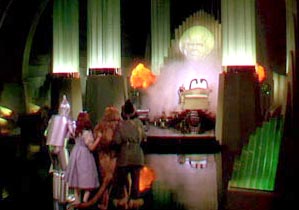
My initial reaction to the Bush megatron appearance was not Orwell's 1984, which came next, but the Wizard of Oz.

It's become commonplace today to compare America's stumbling economy and increasingly economically stratified society to the Gilded Age. This was afterall the backdrop of L. Frank Baum's The Wonderful Wizard of Oz, which was first published in 1900.

While many scholars have read the Wizard of Oz as, "a parable of the Populists", does the story have any narrative power as an allegory today?[1] Annie Leibovitz's (stunning) December 2005 "Oz" inspired photo shoot for Vogue may be instructive. Like the first image in this post suggests, who is wagging the dog behind the curtain?


[1] Henry Littlefield was probably the first to critically analyze the Wizard of Oz as an economic parable in his 1964 essay which was published in American Quarterly, "The Wizard of Oz: Parable on Populism". (subscription required)


Wednesday, April 16, 2008

Hillary Clinton as Annie Oakley?

As often happens here on this blog, because we don't have a formal editorial process, different writers post articles related to the same or similar material, albeit from often different perspectives. See Bent’s article bellow, Barack Mean to Bubba, which also deals with the topic of this blogpost. Although we have approached the subject from different perspectives these two articles should be seen as complimentary.

One of the many interesting aspects of American politics are the ways popular cultural narratives are manifested, especially as deliberate campaign constructions.

This post explores the current brouhaha over Barack Obama's alleged "elitist" remarks through the lens of the cowboy cultural narrative, both as campaign rhetoric and visual media representation.

In The American Adam: Innocence, Tragedy and Tradition in the Nineteenth Century, R.W.B. Lewis coined the term “American Adam” in reference to the cowboy and noted, “It is the birth of an archetypal, still finely individualized character, which [D.H.] Lawrence identifies as ‘the essential American soul…an isolate, almost selfless, stoic, enduring man’” (104). Lewis claimed that the archetype – the American Adam – was “birth[ed] on American soil” and in the American imagination the late nineteenth/turn of the century cowboy came to be perceived as a uniquely American creation. Hence, the mythological construction of the cowboy, built on the foundation of the medieval English knight, was a crucial element in the creation of nationalist sentiment in post-Civil War America. (Moskowitz, 2006)

I've been attracted to the Obama campaign however precisely because it challenges many of the narratives which have been so dominant in recent years, often turning conventional wisdom on its head. His speech on race serves as a great example, tackling head on what would have been considered political suicide. Two earlier posts, The Politics of Gotham and Postmodern Presidential Branding, also demonstrate that his “brand of change” represent a break from the clichéd narratives dominant in politics since "the Cowboy" came to power in 1980.

When Obama’s recent remarks at a San Francisco fundraiser became political fodder, he once again responded by undercutting a popular or dominant cultural narrative. But first, here's the statement which the press, and both the McCain and Clinton campaigns had seized upon;

“You go into some of these small towns in Pennsylvania, and like a lot of small towns in the Midwest, the jobs have been gone now for 25 years and nothing's replaced them. And it's not surprising then they get bitter, they cling to guns or religion or antipathy to people who aren't like them or anti-immigrant sentiment or anti-trade sentiment as a way to explain their frustrations.”

photo: Alex Brandon / AP in Time MagazineAri Kelman has an interesting analysis and further background of the incident here. Obama's statement has been attacked first and foremost as elitist. The image here which accompanies this Time Magazine article adds a perfect visual of Obama's alleged elitism. While the posture and facial expression captured relate "aloofness" the subtext reads that "change" is phony as Obama's body position blocks out the letters. The Bag has deconstructed a similar image here. Within the politicized cowboy narrative, the "Eastern Elite" represents the antithesis to the "American Adam." By portraying Obama as such he is vilified, as an enemy not only against the "common man" but as a corruption of America's frontier ethos. While the Turner thesis is mostly appreciated today in academia within its historical context, it continues to serve as political gospel within much of the DC political class.

Update: The photo above was online yesterday but has since been replaced with another, less explicit portrayal. It's curious as to why the replacement was introduced today.

Camp Clinton, has repeatedly demonstrated a strategy that embraces Republican and media talking points. In a very odd, but increasingly typical Clinton move she even affirmed a common Republican talking point stating that both Gore and Kerry lost in 2000 and 2004 respectively because they were perceived as elitist.

But it gets more interesting. She builds the case against Obama's elitism even further by claiming he's anti-2nd Amendment, and portrays herself as part of America’s rich gun-loving cultural heritage.
“You know, my dad took me out behind the cottage that my grandfather built on a little lake called Lake Winola outside of Scranton and taught me how to shoot when I was a little girl," You know, some people now continue to teach their children and their grandchildren. It's part of culture. It's part of a way of life. People enjoy hunting and shooting because it's an important part of who they are. Not because they are bitter."

There are of course many Americans who hunt and fish, who have an affinity to the "outdoors sportsman's ethos." The hunting trips with my grandfather our some of my fondest memories. In America, cowboys are still heroes and the modern hunter plays into this image. But the image of Clinton as a hunter just feels completely inauthentic and unbelievable.

Obama has continually proven adapt at political jujitsu, turning one's opponent's perceived strengths against them. Take this stump speech at a union gathering in Pennsylvania for example. Rather than defend his comments, Obama counters and refocuses his campaign message. He first takes up the elitist charge from the McCain campaign, turning it back against them.
"here's a guy who wants to perpetuate the Bush tax cuts for the wealthiest Americans while ordinary folks are struggling to pay the gas bill, and light bill, and gas at the pump, and he's saying I'm out of touch? Do you think I'm out of touch or do you think he's out of touch!?"

Then he narrows in on Clinton, saying, "she knows better, shame on her" which is also a reference to her own words she used against him when talking about health care a few months back. The most artful and powerful part of Obama's talk was followed with his reference to Hillary Clinton as Annie Oakley, the famous cowgirl of Buffalo Bill's Wild West Shows.
"She's running around talking about how this is an insult to sportsmen, how she values the 2nd Amendment. She's talking like she's Annie Oakley. Hillary Clinton's out there like you know she's out in a duck blind every Sunday. She's packin' a six shooter! Come on, she knows better."
Hillary's portrayal of herself was meant to ingratiate herself within a cultural tradition. However, Obama takes that narrative "hunters and fishers" and traces it back to its cowboy myth origins by invoking Annie Oakley, ‘the essential American soul…an isolate, almost selfless, stoic, enduring [man]’” Oakley, though not an "authentic cowgirl" herself is mythologized as such and by comparing Clinton to Oakley, the narrative becomes absurd.

That's not to say that contemporary female politicians can't convincingly portray the cowboy myth. Anne Richard's, the Governor of Texas who was defeated (outcowboyed by Rove, some would argue) by George Bush comes to mind. When Obama cleverly says about Clinton, "I want to see that picture of her out there in the duck blind" he knows one doesn't exist. Anne Richards on the other hand was authentic and believable. (Notice the yellow rose on her lapel). Here's an image of Richards, presumably in South Texas, on an actual (non PR produced) bird hunt. But it's this legendary photo from the cover of Texas Monthly that will always stand out for me. Before her defeat to Bush, she was even rumored to be a potential presidential candidate. Here the motorcycle replaces the horse, and Richard's looks as comfortable in the saddle of a Harley Davidson as Annie Oakley was in the saddle of a horse. Could anyone conceivably picture Clinton on that hog?

While I contend that Obama has very cleverly exploited the cowboy narrative against Clinton, Clinton herself seems to have made a gross misjudgment by attaching herself to it. Rather than vilify Obama, who could never convincingly be a credible cowboy, Hillary seems to have framed McCain as the vastly superior candidate in the race. Remember her remarks that only she and McCain had the experience to answer the 3am phone call? By siding with McCain, she inadvertently poses the question, do you want a "real maverick" or a faux Annie Oakley?
Which brings me to McCain where I end this discussion. Should Obama ask to see a picture of McCain in a duck blind there would be no shortage. Whether McCain's "maverick" image is justified or not is irrelevant to this post. There are certainly no shortages of modern day cowboy anecdotes of McCain in the media. McCain's self-professed political hero is Theordor Roosevelt, who was himself no stranger to publicly portraying the cowboy hero myth. Here's what McCain said about his political hero at a 2002 speech at the University of Southern California;
Theodore Roosevelt is one of my greatest political heroes. The “strenuous life” was T.R.’s definition of Americanism, a celebration of America’s pioneer ethos, the virtues that had won the West and inspired our belief in ourselves as the New Jerusalem, bound by sacred duty to suffer hardship and risk danger to protect the values of our civilization and impart them to humanity. “We cannot sit huddled within our borders,” he warned, “and avow ourselves merely an assemblage of well-to-do hucksters who care nothing for what happens beyond.”

There's no shortage of visual imagery portraying McCain as the "maverick", a modern day "Rough Rider".


1) President Theodore Roosevelt with naturalist John Muir at Yosemite in 1903.
2) John McCain, "Prisoner of Conscience" Vanity Fair, February 2007.

While I don't know how the production details of Vanity Fair shoot came to be, in the photo above, the similarities to the 1903 photograph are recreated to near precision. It's hard to imagine the TR photo wasn't used as a template. McCain's attire, stance and even his stare, all resemble TR's as closely as possible for a 21st century recreation. Even McCain's bird dog, redundant on a fly fishing trip, replaces Muir, facing the same direction with a similar stare into the distance. The dog's long shaggy ears even resemble Muir's long bushy beard.

Several books have recently been released that address the media's role in creating and perpetuating McCain "the maverick", which rely on and reproduce the established mythological cowboy narrative. Despite the attention that these authors will bring to the media's role in perpetuating myths, the majority of Americans will most likely continue to see McCain as he's been constructed, a postmodern TR. For Obama, should he become the Democratic nominee, voters will have a clear choice between two very different but compelling popular cultural narratives. Should Hillary go on to secure the nomination, the vote could come down to two false choices; "the real maverick" or " a faux Annie Oakley?" Given those choices, its not difficult to predict which cowpoke would be singing "happy trails."

Update: David Nye draws a similar conclusion on my point about Clinton's strategy here.

Tuesday, April 15, 2008

Barack Mean to Bubba?

Barack Obama may have committed a major political faux pas last week when he spoke out on the attitudes of some prospective working class voters: "It's not surprising then," he said, "that they get bitter, they cling to guns or religion or antipathy to people who aren't like them or anti-immigrant sentiment or anti-trade sentiment as a way to explain their frustrations." Hillary Clinton quickly saw an opening and worked the spin to the max: “It’s being reported that my opponent said that the people of Pennsylvania who faced hard times are bitter; well, that’s not my experience,” Mrs. Clinton told an audience at Drexel University. “Pennsylvanians don’t need a president who looks down on them; they need a president who stands up for them, who fights for them, who works hard for your futures, your jobs, your families.” Certainly Obama committed a bad move in terms of navigating discourse spheres: by raising the otherwise silent class issue, he opened himself up to all kinds of metaphorical abuse.

What I find interesting about this debacle is how political discourse gets reduced to simple dichotomies, highlighting one or another discursive difference. In this case it's smart vs. dumb, un(der)educated vs. intellectual, country vs. city, and somewhere deep down class and race lurk as subtexts. Take the spin Salon.com put on this case:
Rubes. Rednecks. Low-information voters. Beer-track voters. NASCAR man. Bubba. Retro America. These terms have all been used by well-known progressive writers and thinkers to describe white working-class Americans. This familiar litany of contempt provides the context for the firestorm that erupted Friday, when Sen. Barack Obama's remarks to a closed-door group of rich donors in San Francisco were made public by a blogger for the Huffington Post.

The list of derogatory terms Salon's writer Michael Lind opens his article with is tantalizing... Let's look at them using sophisticated analytical apparatus such as etymology, cultural text studies and semiotics (sorry beer-trackers!):

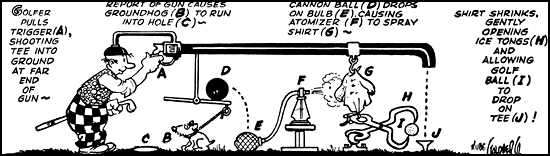
Merriam-Webster tells us that a 'Rube' is 'an awkward, unsophisticated person' and that the etymology is that it it a short, nick-name form of the Christian name 'Reuben'. For more colour, let's go to the OED, where we find late nineteenth century phrases like these: "We could make sandwich money in front of a hootchy-kooch palace, barking at the Rubes" or "They know a Rube when they see him, or a guy, or a crook, or a bonehead." The first users of the term seem to have been carnies, or barkers trying to find easy marks at carnivals and freak-shows. Hmmm... nice tie-in with the political side-show usage in Salon.com! What must also be noted here is the class and ethnic slant built in to the Rube term: country bumpkins and yokels of German, Dutch or Jewish stock (possible shades of anti-semitism here?)... The most famous Rube in popular culture, btw, is Rube Goldberg, whose cartoon inventions of comically complicated machines to perform simple tasks such as teeing up a golf ball make him a perfect schmuck...

'Rednecks' is an old favourite term for Southern, working-class whites - anecdotally related to the red dirt of the region ending up on said farmers' necks. Again from the OED, and that wonderfully colourful, non-pc decade, the 1890s: "a name applied by the better class of people to the poorer inhabitants of the rural districts." Synonyms would include "crackers, tar-heels and other poor white trash." Ouch...

With 'low-information' we are in another realm, that of euphemism and understatement. A franker, non-pc and politically suicidal way of putting it would be 'ignorant'. Ignorance of course doesn't come without a lot of hard work: the work of not going to school, not reading books, not challenging one's mind, not caring to gain 'information'...

With 'Beer-track' things are getting interesting: The Economist already had the low-down on this term and its opposite, 'wine-track', in an article in early March:
A famous political distinction exists between “wine-track” and “beer-track” Democrats. Wine-track Democrats have traditionally supported reform-minded liberals such as Gary Hart and Paul Tsongas. Beer-track Democrats have preferred more practical-minded pols. Walter Mondale famously hammered the nail into Gary Hart's coffin when he stole a line from a hamburger advertisement and asked “Where's the beef?” [...] Obamaworld is a universe of liberal professionals and young people—plus blacks from all economic segments. Hillaryland, by contrast, is a place of working-class voters, particularly working-class women, and the old. These are people who occupy not just different economies but also different cultures. How many white Obama voters eat in Cracker Barrel or Bob Evans? And how many Clinton voters have a taste for sushi?

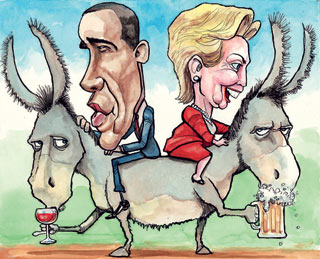
The illustration by Kevin Kallaugher is pretty neat too:

But what is the deal with the beer-track/wine-track dichotomy? It's an obviously displaced class-metaphor similar to other beverage-related nicknamings of a swank neighbourhood, such as the 'whiskey-belt', but a particularly insidious one because it has its open antithesis built into it: beer and wine (unlike whiskey and soda) don't mix - it's one or the other. The cultural connotations appear to ameliorate the harshness of the dichotomy but in reality only exacerbate it. Beer spells underclass, loss of control, drunkenness and loutish behaviour - Animal House. Wine spells sophistication, finesse and distinction - Sideways. The metaphor is related to the mind, and functions as a conduit over into the same 'intellectual - dumb' split as 'Rube' and 'redneck' signify. Virginie Boone spins the lighter side of the dichotomy in this blog...

'NASCAR', of course, refers to the funny kind of American stock car racing where the races are carried out on oval tracks, so that the intelligence of the drivers is not overtaxed by them having to keep a distinction between left and right always ready in their busy little brains - but that of course is just my snotty intellectual preference for types of racing where actual skills behind the wheel has an impact on the result. By inference the audience - 'fans' - of the sport (NASCAR-man and Mrs. NASCAR-man) are also associated with drink, rowdiness, a penchant for crashes and violent death, and low intelligence (actually I would have expected a Republican slant in NASCAR's fan base...) Peter Bainart writes almost with as much bias as I could muster in the above where I was trying to be sarcastic and exaggerate as much as possible:
Let's call him Nascar Man ... Nascar Man is the guy liberals need to win, but usually don't. He loves guns, pickup trucks, chewing tobacco, and church on Sunday. He thinks liberals are high-taxing, culturally libertine, quasi-pacifist wimps. And, once liberals have conjured him up, they no longer say what they really believe -- even to one another ... Nascar Man inhibits intellectual inquiry. He's the bully everyone wants to appease.

There is a funny soul-searching blog on this quote from a guy called Mark Schmitt that I can recommend...

'Bubba' is NASCAR-man's younger brother, second cousin, dad, grandad, next-door neighbour etc. Nuff said... In fact the only Bubba I really need to refer you to is golfer Bubba Watson, the longest hitting man on the PGA tour (No. 1 in driving distance w. 310 yards, but unfortunately only no. 178 in driving accuracy...) Bubba hails from Bagdad - that is Bagdad, Florida, not the Middle Eastern hot-spot we Europeans tend to think of first when hearing that name... He is comfortable with his masculinity, to the degree of using a pink shaft in his big stick (golf slang for the driver...) Bubba is best friends and hunting buddy with another Florida golfer 'Boo' Weekley, another hick from the sticks who recently tried to bring rifle cartridges on a commercial airplane...

Finally, we have the funny appellation 'Retro America', which must refer to the nostalgia among some democrats for the days of vintage consumer USA, as indicated in the blog that wears this label on its sleeve: "travel back to a time of pink kitchens, cars with huge fins, barbeques by the backyard pool". Pre-Kennedy USA, pre-desegregation USA, pre-Women's Lib, pre-Vietnam, pre-Moon landings, pre-oil crisis USA... The days when a man was a man and a woman was a housewife. The days of rock'n'roll, before Betty Friedan, Black Power, hippies and yippies, the youth revolt and the liberal university. Aren't we all just drooling by now...?

These days 'retro' is almost synonymous with 'vintage' - certainly in the fashion business. Again with an analogy across discourse spheres we understand the deep rooted wish for a simpler retro-fitted world in the political sphere as well. A nostalgia for simplicity that is deeply disturbed by the fact that the Democrats contesting this nomination are dreadfully unsimple by dint of their unprecedented distribution in terms of ethnicity and gender: Will NASCAR-man, Bubba and the wifey, prefer a woman or a black man? Whoa, honey - let's turn back the clock on that one...

The list of stereotypes is done, but what remains is that discourse such as Salon's simplifies matters greatly. All Americans can comfortably choose between beer and wine, meat & potatoes and pasta, Daytona and The Metropolitan Museum, swamp blues and string quartets. As Pierre Bourdieu teaches us it is all a matter of distinction... But the real political choice is too important to be reduced to a matter of taste - it's complicated, not least by the differences of gender and race which are carefully avoided by the candidates themselves most of the time, and the political pundits virtually all of the time. They prefer a nice food metaphor or a stock cartoon character any day. The reason this debate came back to smack Obama is that a mostly dormant major difference all of a sudden got vitalised by his remarks: class reared its ugly little head. Good thing pundits could 'culturate' it back in its basket by turning the debate into something else: dumb/smart stereotypes.

Thursday, March 06, 2008

The Politics of Gotham

While researching examples for my last post, Postmodern Presidential Branding, I stumbled across some typesetting blogs discussing the Obama campaign's font, or typeset; Gotham.

So I was naturally interested in the typography as a visual political narrative. What does Obama's choice of Gotham say about his campaign, about his political philosophy? I imagine that Obama had nothing personally to do with choosing the font but his design team saw Gotham perhaps as a reflection of the candidate. Here's what Jonathan Hoefler and Tobias Frere-Jones, the designers of Gotham have to say;

A journalist recently asked what it is about Gotham that we think suits the Obama campaign. We'll defer to designers John Slabyk and Scott Thomas to make that call — they selected the font for Obama for America, we merely provided it — but one thing we can say as type designers is that Gotham isn't pretending to be anything it's not, which makes it an unusual and refreshing choice for a campaign. Political typefaces have a way of being chosen because they underscore (or imagine) some specific aspect of a candidate, working hard to convey "traditional values" or "strength and vigilance," or any number of graspable populist notions. The only thing Gotham works hard at is being Gotham.

Gotham then in some ways represents an American Helvetica, a typeface that, "shouldn’t have a meaning in itself" because "meaning is in the content of the text and not in the typeface." In Obama's case, does Gotham convey the message that the meaning is in the candidate? It does feel fresh, clean, and neutral. Like Obama. Perhaps the candidate, like the text, has no meaning in itself which has allowed his following to project their own meaning into the race.

Gotham, as it turns out, is quintessentially American Modernism. I find this terribly fascinating as Hoefler and Frere-Jones research to create Gotham suggests a contemporary Myth and Symbol American Studies project through the lens of typography.

An American Vernacular

Like most American cities, New York is host to a number of mundane buildings whose facades exhibit a distinctively American form of sans serif... And judging by how often it appears in signs for car parks and liquor stores, this might well be the natural form once followed by neon-lit aluminum channel letters. Although there is nothing to suggest that the makers of these different kinds of signs ever consciously followed the same models, the consistency with which this style of letter appears in the American urban landscape suggests that these forms were once considered in some way elemental... Read more...

Long before the emergence of a profession called “graphic design,” there was signage. Up until the mid-twentieth century, the job of providing architectural lettering often fell to engineers or draftsmen, most of whom worked outside of the typographic tradition. The shape of facade lettering was often determined by the practical business of legibility, rather than any sort of stylistic agenda — although inevitably, even the draftsman’s vision of “basic building lettering” was influenced by the prevailing style of the time.

Here is a short Youtube clip of the two type designers discussing the creation of Gotham, the font "born outside of type design."


The Youtube clip is actually a bonus feature from the DVD release of the documentary, Helvetica. Yes, an entire movie about a typeface. I'll never quite be able to look at typeface the same.

Here is the trailer for the New York release.

Saturday, March 01, 2008

Postmodern Presidential Branding

Something I've been thinking about but just never got around to writing about is the use of visual media in these presidential campaigns. Much has already been written about the explosion of internet based communications this cycle, from blogging to user created video. One of things I had looked at early on were the candidates' front page web presence, especially their logos. Now the field has narrowed to 3 remaining candidates so I missed my chance at a grand comparative visual analysis of all the campaign websites.
C'est la vie.

However, Karrie Jackobs does a wonderful job reading the remaining candidates' logos with this essay at Salon.com, "May the best logo win."

She begins;

Given that branding is our true national pastime -- the swoosh, the golden arches and the mermaid in the green circle are now more ubiquitous, and arguably more potent, than the eagle and the flag -- you would think that a candidate's graphic style would be as strategic as every other piece of his or her message. A strong logo or visual identity should be part of any leading candidate's package.

She then goes on to look at Hillary's logo, which is notably uninspiring and utterly unoriginal. She also mentions George W Bush's "W" logo. In Texas, nearly every oversized $50,000 SUV on the road had the ominous white "W" on a black background smacked on the back bumper.

McCain's logo, as she notes, is unmistakably militaristic. It also works very well in so much as it conveys the message McCain is promoting. The logo leaves no doubt what McCain is about this election cycle. But Obama's logo is the real focus of this article. I found this quote particularly interesting;
Of the current campaigns, Barack Obama's is the best at getting his message across through graphics -- think of all those "Change we can believe in" signs -- and most careful observers see his as the first sophisticated corporate-style identity to emerge from presidential politics.

Now this really caught my attention. The idea of creating a corporate-style identity. Obama inc.
The use of visual imagery in campaigning is certainly nothing new. However, branding in this sense seems to me something a bit unusual. Is this the essence of postmodern politics?

I also liked this analysis by two type designers writing for the Boston Globe;
Obama's type is contemporary, fresh, very polished and professional. The serifs are sharp and pointed; clean pen strokes evoke a well-pressed Armani suit. The ever-present rising sun logo has the feeling of a hot new Internet company. His sans serifs conjure up the clean look of Nike or Sony. This typography is young and cool. Clearly not the old standards of years past.
and about McCain's logo;
Everything about this logo says you can buy a car from this man. From the perfectly centered star to the perfectly spaced type, the entire design looks like a high-end real estate company. McCain has done something no other candidate has done, he uses all blue, no red - not even a dash. If we were to predict the results based on typography and design, we would pick McCain and Obama.

Agreed. But, does the attention to detail also not point to the campaigns themselves? Clearly these campaigns have put a lot of thought into their visual messages. Obama gets all the digital hype, but I recall McCain's campaign in the 2000 primaries was the first to ever do online fund raising.

So the general election (presumably) looks like this.

vs

Imagine you’ve never heard of McCain or Obama. You’ve been tucked away up in the mountains without any connection what so ever to the outside world. But come election day, you hike down into town, walk into the voting booth and grab a ballot. The only thing standing on the ballot are these two logos, no political affiliation, no information, nothing but these two logos. The choice visually in very clear. Black (darkness) vs. White (light), Death vs. Life, War vs. Peace, Authority vs. Inclusion, Determination vs. Hope.

Naturally, this is my own subjective construction of a visual stimulus. And I haven’t been tucked away in the mountains, but rather deeply connected. Something else that comes to mind about McCain's logo, the white letters on black resemble those black and white Vietnam POW posters. I think I picked up on the tubes somewhere that McCain’s font is the same font used on the Vietnam War memorial wall in Washington D.C. Clearly not everyone will read these visuals exactly how I have.

I’m not entirely comfortable with using the term branding in democratic political discourse but that is clearly what the Obama campaign has been doing, creating and building the Obama brand. Both McCain’s and Obama’s logos stand head and shoulders above the pack but Obama’s goes much further. The Obama logo, like any really good corporate brand is not only readily identifiable, but also easily duplicated for other strategic branding campaigns. It seems the Obama campaign has incorporated the Obama brand logo into nearly everything under the Obama (apparently) rising sun.

As I mentioned, an effective brand (I have zero marketing training mind you) should be easily duplicated so that it can be readily appropriated by others and into other branding campaigns. Here are some great examples of what I mean.


1. Lefties for Obama


No, not political Lefties, but left-handed people. Obama is a Southpaw.


2. Vermonters for Obama


Here the famous Vermont dairy cow (home of Ben and Jerry’s Ice cream) grazing on Obama’s field of hope.


3. a "user created" logo incorporating the iconic apple logo.


4. Gays and Lesbians for Obama, a rainbow field of hope.


Who can remember any past presidential campaign logo? Furthermore, has a presidential campaign ever carried a logo forward into the presidency? It will be interesting to see how Obama (if elected) carries his visual brand into the White House. Should Obama become elected next president, I wonder if 50 years from now people will still be able to identify that "O" as Obama, the 44th President of the United States?

Tuesday, February 26, 2008

Celebrity Pastiche

Recently, no less than three glossy magazines published photo serials which reenact earlier high points of visual culture:

(Please note, that the last two links contain nudity.)

While the timing may be coincidental, it is surely symptomatic of celebrity culture today. As Amy Henderson points out, celebrity culture has always been part of a culture's self-definition ("Media and the Rise of Celebrity Culture"). By this logic, celebrity culture seems to be looking backwards as much as being interested in the current celebrities. With George Clooney on the cover of TIME Magazine with the caption "The Last Movie Star", there definitely seems to be some sort of eschatology at work in these photo shoots.

The religious connotations of eschatology are not coincidental, as celebrities generate a distinct cultish aspect through their relationship with the fans. Many celebrities, if not all, function as idols worthy of worship, and the films they star in, the music they produce, the clothes they wear, all have a distinct aura which is desireable for the followers. Yet, for many of the newer celebrities such as Lindsay Lohan and Jessica Alba, they have little in the way of proper cultural production to enforce their celebrity status. Whatever one might feel about Herbie or Flipper as cultural entertainment products, these are not exactly productions that build long-lasting acting careers.

These new celebrities end up in a particular relation with their followers; they become celebrities based on a certain shared experience for some of them - they became stars when they were young, and in productions aimed at people their same age. Therefore, a kinship can be said to exist between teen celebrity and teen follower, since they have been part of each others lives for a long time.

Also, they become celebrities in the newer sense of the word that Joseph Epstein traces to Daniel Boorstin in his book The Image: Or What Happened to the American Dream ("The Culture of Celebrity"): "a person who is well-known for his well-knownness". Lohan and Alba are famous because they have always been famous, and part of their followers' lives. The same goes for a number of other celebrities, who are still too young to be considered true stars, in the original sense of having proven themselves somehow "worthy" of worship.

This is where the past enters the stage, for what can be more worthy of worship than classic Hollywood culture? Hitchcock and Monroe can serve as master-icons, lending their glamour to the new, upcoming celebrities, thus creating a strange feedback, where the old icons are revived because new celebrities reenact their original iconic status, while the new celebrities can obtain more celebrity status by serving at the alter of the old masters (male and female).

It is this relationship between the old and new celebrity icons which is interesting. There is no parodic thrust to any of these shoots, but rather a desire to recreate, perhaps even channel or ressurect, the old icons. Margaret Rose refers to pastiche as reviving things from the past, without parody's incongruous structure or comic effect (Rose, Parody). This seems to be a perfect description of these shoots, which also overlaps with Gerard Genette's understanding of pastiche as imitative (Genette, Palimpsests).

Working from Genette's definition, Linda Hutcheon points to the fact that pastiche functions as the desire for similarity rather than difference. (Hutcheon, A Theory of Parody). This is perfectly clear in the different shoots, as their main purpose is to draw a parallel between the new celebrity and the old, establishing a connection meant to increase the celebrity capital of the new icon.

This desire is most obvious in the case of Lindsay Lohan's recreation of Monroe's "Last Sitting". Monroe's shoot for the Look Magazine has been called "The Last Sitting" because it was her last photo shoot. Already here, the religious connotations are clear, the name echoing "The Last Supper of Christ". In the case of Monroe, the parallel to Christ seems to come from the sacrifice that happened to them both; Monroe's death has always been seen as tragic and as a response to the surrounding pressure of her life. Connecting her death to that of Christ also shows that not only is celebrity partly defined as cultish, but also that celebrity status is always bound up in some form of referral to an earlier icon.

Lohan's pastiche of Monroe is as full as possible, recreating both hair, make-up and poses. The intention is clear: Lohan is the Monroe of our time and these photos establish that. From a critical point of view, the situation is somewhat different: Lohan wants to be the Monroe of our time, and so imitates one of the most famous photo sessions Monroe ever did. Through this recreation, Lohan hopes to gain celebrity capital by attempting to reproduce a similarity with Monroe, rather than a difference.

Many of Lohan's followers might not be aware of the original which is being imitated here, but the poses remain a significant part of American culture, and it is likely that they are known by people who do not know who Marilyn Monroe was. The iconocity of her poses extends beyond the historical knowledge of Monroe. Lohan's photos would still strike a familiar note and provide her with a degree of validity and celebrity capital.

The case of Vanity Fair's Hitchcock tribute is slightly different. There is no particular reason for why Vanity Fair would do these Hitchcock stills now, other than the fact that this is the Oscar season and all forms of film and film history are more interesting right now. This is further emphasized by the fact that many of the actors used are nominated this year (Julie Christie, Javier Bardem, Marion Cotillard) or have won in the past (Jodie Foster, Renée Zellwegger). Most others have made significant and artistic films, rather than simply popular films.

In other words, there is less a desire for borrowing celebrity capital from Hitchcock and his classic films. Instead, I would argue, the point is to establish that these celebrities are worthy of recreating such classic moments. They have proved their worth in the Hollywood industry and can be permitted to take on the old master. Rather than an attempt to increase their celebrity capital, it is matter of the celebrity culture industry - of which Vanity Fair is certainly one of the leading producers - "knighting" these celebrities, by allowing them to imitate Hitchcock.

Here it is the industry itself which stands to gain from this imitation. By using currently popular icons to recreate classics, they establish that current celebrity culture is just as vibrant, significant and accomplished as old celebrity culture - nothing has been lost. While there is nostalgia at work in these photos, it is a double-coded nostalgia meant to reinforce current culture as much as past culture. The imitation is thus still used to emphasize similarity over difference.

Which only leaves Jessica Alba's recreations, which is an interesting case of similarity. Alba's photos come from Latina Magazine which obviously caters to the Latino population in USA. Alba is a Latino star, because she has gained celebrity status in spite of this Latino heritage. Allowing her to recreate classic film moments, is thus to emphasize her status in Hollywood and celebrate that her difference has not inhibited her career. However, there is a certain irony in the choice of films.

All of the films Alba imitates star white females: Scream, Psycho, The Birds, Rosemary's Baby and The Ring (this is assuming that we are talking about the Hollywood remake of The Ring rather than the Japanese original, something I consider a safe bet). In other words, Alba can only obtain celebrity status by imitating white female icons. We end up being back at similarity rather than difference. Alba is not a celebrity because she is a Latino, she is a celebrity because she can imitate being white. I'm sure there are Latinos that will disagree with me, in fact I hope so, but this does not change the fact that the stars Alba imitates are all white. White is the original celebrity icon, and this has not yet changed, unfortunately.

The final point to be made here, is about celebrity culture as a whole. It seems to me that celebrity culture is turning into a pastiche itself. As Tom Mole points out, the classic understanding of celebrity culture is "structuring the production, distribution and reception of texts around the mystique of a particularly fascinating individual" (Mole, "Hypertrophic Celebrity"). As these photo shoots show us, there is also a new emergent behavior where production, distribution and reception is not structured around the mystique of a fascinating individual, but rather the mystique of the history of celebrity culture itself. Celebrity culture no longer has icons, but imitations of older icons.

As I briefly mentioned in relation to Marilyn Monroe, this has always been the case, but the difference now is that the feedback loop between historical celebrity culture and contemporary celebrity culture is ever decreasing. The Ring was (re)made in 2002 but is already a classic in the vein of Psycho and The Birds. The production of celebrity culture is now as much the imitation of the production of celebrity culture.

References
Epstein, Joseph. "The Culture of Celebrity". The Weekly Standard, volume 11, issue 5.
Genette, Gerard. Palimpsests.
Henderson, Amy. "Media and the Rise of Celebrity Culture". OAH Magazine of History
6 (Spring 1992).
Hutcheon, Linda. A Theory of Parody
Mole, Tom. "Hypertrophic Celebrity." M/C Journal 7.5 (2004). 25 Feb. 2008 .
Rose, Margaret A. Parody: Ancient, Modern, and Post-Modern.
Stein, Joel. "Guess Who Came to Dinner?", TIME Magazine, vol 171, no. 9, March 2008.

Friday, February 08, 2008

Gendered politics in the media

Last month I posted this piece exploring photojournalist representations of Hillary Clinton. Historiann recently commented;

“This is an interesting analysis of the photography of the campaign, and I agree that the photo at the top (Clinton apart from the 3 men) is highly revealing of the dynamics of the race a month ago, before Edwards and Richardson dropped out.”
She continues;
"While it may be true that "The Times, and other msm outlets have been all too willing to portray Hillary as the American Madonna of politics," at least with photography, that's not AT ALL the content of the broadcast media, which is riddled with gendered language and stereotypes that are deployed against Clinton."
This is spot on, and I’m glad she points this out. Furthermore, there are many photographic examples of this as well. My analysis was in fact very specific to that time period, roughly between Iowa and New Hampshire. The narratives are constantly changing both textually and visually. We may even see a return of the Madonna or some other incarnation. I think Historiann’s main point however, is to remind us of an underlying gender bias which continues to be a constant in much of American society, which certainly is reflected through much of the media.

Mette Bertelsen, who recently finished her thesis on gender, politics and Hillary Clinton, will be contributing here in the coming weeks. I can’t tell you if she’ll be specifically looking at media narratives, which is one of my interests. But she will be addressing gender in US politics, so stay tuned for more.

Finally, a small disagreement. Historiann concludes;
“I would say that for her to be running as strong as she is now against Obama is especially remarkable, given the hostility of most broadcast media outlets to treating her with the same consideration as male candidates for the presidency.”

I'm not sure I'd go this far. Should Clinton not win the nomination it won’t be because of media hostility or gender bias. That’s not saying it isn’t or won’t be a factor. Clinton started her campaign as the media and DC establishment’s pre-ordained front runner and nominee, but oh are “they” fickle. No, should Obama win the nomination it will be because his team was ultimately better at realizing the full potential of the internet and the many online grassroots communications tools available today. I think this was supposed to be Hillary’s year and she may still become the nominee and even become the next president. But I don’t think anyone really expected to see online activism and mobilization, which really began with Dean’s 2004 candidacy, explode into the force it’s become.

Ok, that might also be taking it a bit too far.

The main reason for this post when I got up this morning was to introduce two people to the AC, Mette, who will be joining us shortly she assures me, and Historiann, who’s been on our blog role for some months. I was just delighted she stumbled across our little blog and left a comment.
"Historiann is the not very clever pseudonym of Ann M. Little, the author of Abraham in Arms: War and Gender in Colonial New England (2007) and several scholarly articles and book chapters on early American women’s and gender history. She is an Associate Professor in the History Department at Colorado State University."

Wednesday, January 30, 2008

A Post-Broadcast Politics

One of my "hobbies" as it where, is studying and reflecting upon political imagery. This image here reminded me of a photo I saw last June on Michael Shaw's blog, Bag News Notes.

Shaw has a new piece at American Photo, "Campaign Visuals in the Age of Facebook." In it, he interviews photographer Stephen Ferry to discuss this photo which resembles a "Facebook mashup." Ferry says his photo captures what he calls the, "Facebook zeitgeist." He explains the action of the photo thus, " this is a photograph of a transmission: from subject into camera and from camera onto the Web."

I'm intrigued by the act of transmission and how transmission is reconceptualized within a digital culture. In the Ferry photo, the subjects are both Obama and a "fan taking a photo" ready for immediate upload onto Facebook or some other online social media. In this image above, there are also two subjects, but they are not Hillary and the person shooting the video. The "real" Hillary is blurred, the campaign sign is even upside down. However, the digital image of Hillary is clear and focused which is connected to the video camera being held by an anonymous hand. The two subjects are thus machine and digital image, even the human hand is secondary. From this perspective, the image portrays a postmodernization of political campaigning. It's the political reflection of TIME's 2006 person of the year as the new citizen journalist. The digital transmission onto the Web is naturally assumed.

However, this image for me captures more than just the "Facebook zeitgeist." It also reflects the shift away from the hierarchical broadcast model of information transmission to the decentralized network model of inter-subjective community driven "transmission." Perhaps this could be called the era of post-broadcast politics. The centrality of the camera's view finder, which invites everyone into the role of transmitter reinforces this shifting narrative. What do you think?

photograph source unknown

UPDATE: Matt Stoller has an article in the Nation, "Dems Get New Tools, New Talent," where he analyzes the impact of internet technologies on Democratic campaign organizing.

We are in the middle of a massive wave of campaign innovation, led by organizers who will eventually spread outward to every nook and cranny of progressive politics. The larger significance of this architectural revolution in progressive politics isn't clear, but it is the first sustained challenge to the dominance of television and direct mail in the political system since those media displaced urban party machines in the 1960s.