The Atlantic Community, a project-in-development, is a collaborative weblog and network for research, analysis and commentary on American society and culture. Our aim is to provide a public voice for European scholarship in American Studies, forging stronger communication between the academy and the public on both sides of the Atlantic. This network will be community-driven, responding flexibly to the needs and desires of its users. What you see here now is simply an early stage along the way toward that network. We encourage our readers and our writers to participate in setting the agenda for developing The Atlantic Community’s full potential.
This work is licensed under a Creative Commons Attribution 3.0 Unported License, though the work this blog incorporates may be separately licensed. Our writers own their own words, email them for permissions.
Since the early 60s, Raymond Federman has been one of the most important American writers. In his highly experimental fictions - works that bear such titles as Take It or Leave It, Double or Nothing, and The Twofold Vibrations - he has explored cultural and personal memory, invented intricate narrative strategies, and above all has given readers an experience that exceeds the ordinary. Creating situations that make one really think and really laugh is a tall order for any writer. But Federman did it. He is one of the few writers to truly have achieved this.
As he has just turned 80 and is being celebrated around the world, some of us here in Denmark have decided to mark the event. That Federman is still around, publishing, blogging, answering private emails, and engaging with readers of all sorts, can indeed be considered a gift of the highest quality. Just check his blog - [the laugh that laughs at the laugh] - to get a sense of how important it is for him to situate himself not only vis-à-vis literary history, in which he is by now well recognized and firmly consolidated, but vis-à-vis the kind of literary history that allows readers to come close to writers and thus engage in a 'communal' act of writing themselves. Put it differently, we read Federman to write about him as he writes about us through his own experiences. Federman is a round kind of writer.
In response to such generosity, I've put out a collection of essays written in collaboration with colleagues at Aalborg University. The volume presents four scholarly articles, and as indicated on the poster (make sure to enlarge it so that you can see the table of contents to begin with), it also offers readers a special treat in the form of unpublished texts by Federman. The book Federman Frenzy: the 'cult' in culture, the 'me' in memory, the 'he' in history - encounters with Raymond Federman is published as a web publication by Research News, Dept. of Language and Culture, Aalborg University.
My paper for the EAAS conference in Oslo last week dealt with icons and icon work, continuing a line of research I began about 5 years ago when I participated in a conference in Austria with the theme of US Icons. The convener of both the AAAS event in 2003 and of the Oslo workshop was Klaus Rieser of Graz, Austria whose tireless work is beginning to make an emergent interdisciplinary field out of Icon Studies.
Here is an excerpt of my presentation focusing on my two case studies of transgressive American icons, Charles Manson and Patty Hearst...
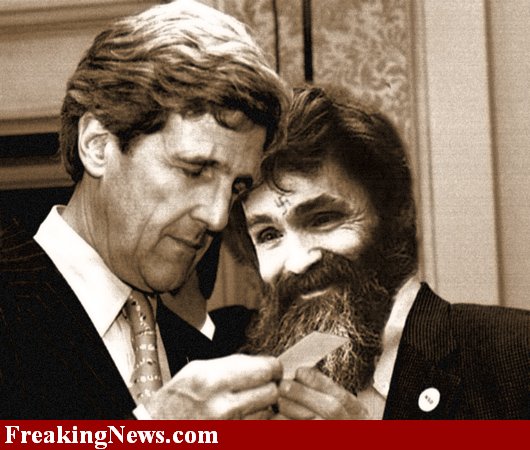
It is the elderly Manson who fuels the imagination of icon workers that use him in a politicized discourse, as witnessed first by a right wing manipulation of Manson’s image, photo-shopped into a photo of former Democrat candidate for President, John Kerry, who was the victim of a vicious slander campaign due to his past as an anti-Vietnam War activist. Here a grinning Manson in a suit modelled on Kerry’s (as is Manson’s hair style) shows the Senator a piece of paper or a photograph (perhaps a snapshot of the original Manson victims), and they appear to share a moment of confidence, although Kerry’s closed eyes might indicate that the image Manson shows him is a bit too much to take in. Note the Swastika on Manson’s forehead (he had used a knife to scrawl an 'X' on his forehead during his trial, and this 'X' later turned into a Swastika in popular legend), as well as the Kerry campaign button on his lapel.
In a parallel image, this time used to satirize Kerry’s defeater, George W. Bush, Manson’s photograph (the raw image is the same, and here the hair and attire are not airbrushed or photo-shopped) is used for a different type of collaborative icon work, this time more oppositional in nature. It is accompanied by an amusing text calling for the approval by the Senate of Manson as ambassador to the Klingon Empire (referencing the Star Trek universe). In this narrative Manson works for the Republicans as (crudely) indicated by the replacement of the Swastika on his forehead, which is substituted with a GOP Elephant, the symbol of the Republican Party. Bush and Condoleeza Rice are both ‘quoted’ as supporting Manson’s speedy appointment, saying for instance that “questions about Manson’s management style shouldn’t be part of the confirmation process”.
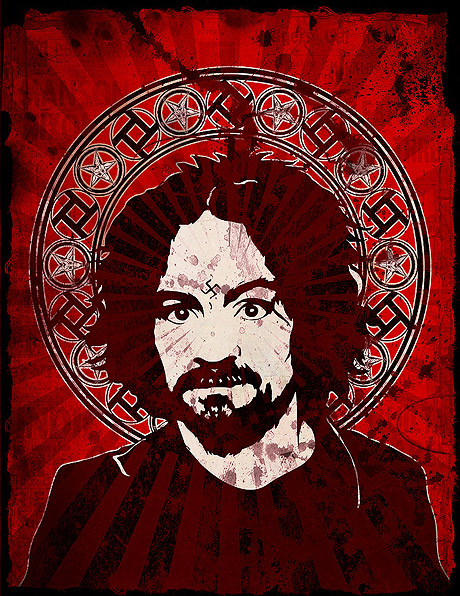
These two instances will be perceived as collaborative only from a politically partisan view. Both authors use Manson’s monstrosity to satirize the party he or she does not belong to. They are both hegemonically inscribed in a party political system, although not officially sanctioned by either party. The main iconic image I have selected for analysis is however a true homage to Manson.
Here Manson is a saint and a martyr, signalled as in classical religious iconography via a representation of his stigmata. Here we note again the Swastika on Manson’s forehead, echoed in even more stylized form in his halo along with pentagrams that associate Manson with Satanism. His other stigmata consist of the blood stains on his face and neck and the strange umbilical chord of blood stretching from the back of his skull into the background of the icon. The photograph used as template for the icon is one depicting Manson in a particularly wild-eyed moment, taken shortly after his arrest, but prior to the X’ing incident. The choice of red, black and purple colours for Manson’s halo and the background (the traditional rays of light signalling the subject’s holiness in religious icons is here turned negative and black) contrast sharply with his pale skin. Taken together with the Swastika this composition and colour scheme serve to underscore Manson’s racial programme which the creator of the icon obviously condones. On the website I originally located the image there is a click through link to a further shrine for Satanism and Alistair Crowley which opens when Manson’s image is clicked.
Manson’s afterlife as an icon is thus prolonged by oppositional, collaborative icon work, falling within at least three spheres (which are not as separate as they perhaps should be): political, religious and pop-culture discourses all feed off his image...
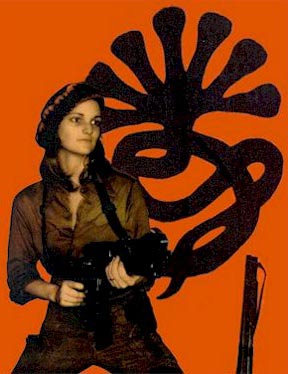
Turning now to Patty Hearst, we encounter a story much intertwined in the same counterculture background as the Manson legend. Heiress Hearst was the victim of an extremely high profile kidnapping in 1974, at the tail end of the armed struggle that militant splinter groups originating in the counter-culture and its anti-capitalist agenda was waging in America. The kidnappers, the bizarrely named Symbionese Liberation Army, carried out urban guerrilla warfare inspired by South American left-wing groups. Their agenda further included an attempt to free African-American inmates from the US prison system which their rhetoric compared to concentration camps and apartheid regime oppression a la South Africa. The SLA saw itself as spearheading a Black revolution in America and took as its symbol a seven-headed cobra snake – each head representing a Kwanzaa principle, such as unity, creativity and faith. After kidnapping Hearst and demanding various types of ransom payment (in kind, to be distributed among the poor), Hearst apparently willingly switched sides and joined the SLA in a bank robbery, generating one of the more iconic images of Patty (now known as Tania) wielding a sub-machine gun.
The SLA was eventually hunted down by the police and in an extremely violent shoot-out which resulted in a fire, most of the SLA members were killed. Hearst and a few SLA members escaped the siege and shootout, but were arrested soon after. During the trial, Hearst again switched persona and claimed that her participation in the robbery was coerced and that she had been sexually abused and brainwashed during her captivity by the SLA. She was sentenced to a fairly mild stretch in jail, her sentence was reduced by President Carter and eventually she was fully pardoned by President Clinton. A number of iconic cultural texts have been generated by this sequence of events.
The best known icon of Hearst is the image of her in front of the SLA cobra on a bright orange background. ‘Tania’ stares aggressively at ‘the Man’, ready to fire her Thompson gun – another weapon is ready in the background. This is revolutionary iconography 101, down to the army fatigues, the beret, the weapon and the surprising amount of cleavage shown. The phallic cobra offers a potent reminder of Tania’s taming, but also boosts her new-found revolutionary clout. As an ironic paean to this image Warren Zevon has put Patty Hearst into the lyrics of his tall-tale of mercenaries, post-colonial African liberation wars, upright, well-meaning Norwegian boys displaying bravery, sinister Danish power brokers, and CIA engineered betrayal followed by posthumous just deserts in the form of a headless ghost’s revenge: “Roland, the Headless Thompson Gunner”. The song ends on a didactic note:
The eternal Thompson gunner Still wand'ring through the night Now it's ten years later, but he still keeps up the fight In Ireland, in Lebanon, in Palestine and Berkeley Patty Hearst heard the burst Of Roland's Thompson gun and bought it…
What exactly the meaning of the closing phrase “and bought it” means is an interesting point of debate. To buy something, of course means to acquire it for money, but also to buy into a story hook, line and sinker. The court case against Hearst revolved exactly around this point: did she buy the rhetoric of the SLA, or was she coerced or seduced, becoming a case of Stockholm Syndrome? My take on Zevon, who has many songs about masculine exploits gone horribly wrong (“Send lawyers, guns and money – the shit has hit the fan” is a line that springs to mind), is that he is warning us all against being taken in by revolutionary bravado and romanticism. To him Hearst is the naïve, protected, socialite teen who temporarily falls for the seduction of revolutionary ardour (a sentiment I would guess many of us can recognize).
After last week's ABC Democratic primary debate, the Bag posted a great series of TV frames as a visual recap to the debate. In my earlier post I wrote;
This is by far the most succinct summary of last night’s debacle of a debate TV show hosted produced by ABC News Disney Entertainment. This captures the essence of what is, “the postmodern condition” of US politics.
I selected this image as the most telling frame of the set.
Tuesday was Earth Day btw, but most wouldn't have known if not for Google's always clever way of "holiday theming" their logo. Al Gore has recently launched a $300 million environmental ad campaign to increase awareness and apply political pressure. Likewise, some of the other major environmental organizations have also launched public advocacy campaigns like the Sierra Club's Power 2 Change. The environment is one of the top issues among Democratic voters but it wasn't discussed during the debate or in any meaningful way since.
But Tuesday was also Pennsylvania Primary Day, which dominated the news cycle. So fitting the severity and importance of the major issues at hand, the three remaining presidential candidates recorded statements on Monday, not to address global warming, poverty, the war in Iraq, or the economy but addressed fans of the WWE (World Wrestling Entertainment) for the popular program, "Monday Night Raw."
McCain, I would presume, won the verbal "smack down", with a subtle mispronunciation of Obama's first name and a not so subtle gender bias, "If you wanna be the man, you have to beat the man." Remember Bush Sr. used to deliberately mispronounce Sadam Hussein's first name in a similar fashion leading up to the first Gulf War. The right wing has repeatedly injected Obama's middle name, Hussein, at every turn.
Jeez, when will Democrats learn to stop playing in territory which give Republicans distinct advantages? Clinton as "Hill-Rod" was more on cue than Obama's inauthentic, "do you smell what Barack is cookin'?" Did the campaigns provide their own scripts or were the candidates scripted by the WWE? I initially associated "cookin" with "soul food" and the wrestling character who played Obama in the ring that night was fitted with grossly exaggerated "ape like" ears. But the cooking line could also just be a reference to one of wrestling's biggest stars, The Rock.
McCain's,"...and whatcha gonna do when John McCain and all his McCainiacs run wild on you?" was just disturbing. McCain with his own private paramilitary special force of brown shirt goons comes to mind. Obamabots and Hillbots seem to be the most common derogatory slang for their respective supporters. In 2004, Howard Dean's partisans were referred to as deaniancs. But coming from McCain's mouth, who's running a distinctly militarized campaign the personal "run wild on you" feels all the more threating. Of course, this is all just entertainment right? Corporate sponsored entertainment, which is what the Bag so aptly crystallized.
So here's where this post comes out of the Bag again and looks behind the curtain. President Bush, who now has the lowest approval rating of any president since Taft, appeared on the NBC game show program, Deal or No Deal to address one the contestants, a three tour Iraqi War veteran. See the video here.
There are far too many points to address here in this blog post. Many important ones have been raised at the Bag, not the least of which is the Bush administration's use of soldiers as political props. But I was most interested in how these three utterly bizarre media episodes might relate to each other.
During the last decade, TV programming has become notably dominated by "reality TV." For me, these three episodes; the debate, the WWE, and Deal or No Deal, all occurring within a week, signify a continued media commodification of the political public sphere into a realm which ceases to even attempt to recreate or reproduce reality. In it's place the entertainment industry creates "hyper-real TV" in essential Baudrillardian fashion.
My initial reaction to the Bush megatron appearance was not Orwell's 1984, which came next, but the Wizard of Oz.
It's become commonplace today to compare America's stumbling economy and increasingly economically stratified society to the Gilded Age. This was afterall the backdrop of L. Frank Baum's The Wonderful Wizard of Oz, which was first published in 1900.
While many scholars have read the Wizard of Oz as, "a parable of the Populists", does the story have any narrative power as an allegory today?[1] Annie Leibovitz's (stunning) December 2005 "Oz" inspired photo shoot for Vogue may be instructive. Like the first image in this post suggests, who is wagging the dog behind the curtain?
[1] Henry Littlefield was probably the first to critically analyze the Wizard of Oz as an economic parable in his 1964 essay which was published in American Quarterly, "The Wizard of Oz: Parable on Populism". (subscription required)
It seems ethnicity and commercials is a hot topic these days. Waves are still high over LeBron James allegedly being cast as 'King Kong' in Annie Leibovitz' April 2008 Vogue cover (see my recent post on this), and now the wires report that Woody Allen has decided to sue American Apparel over their allegedly unauthorized use of his likeness on commercial billboards in New York and L.A. in May 2007. What is particularly interesting about this, not in itself very unusual instance of an American celebrity engaging in the US national pastime of litigation, is that the billboards in question show Allen in costume from a scene in Annie Hall, his celebrated 1977 film, playing a Hasidic rabbi, complete with hat, full beard and ringlet tresses.
This scene from the movie is set at an Easter dinner which Woody's character is sharing with the Hall family (Here is the complete dialogue). Granny Hall's penetrating gaze 'others' Allen's character and the Hasidic stereotype is his character as seen by her "classic Jew hater"-eyes. Woody does all he can to adapt, even complementing Granny's cooking: "It's dynamite ham." Annie Hall is often considered Allen's best and wittiest film, full as it is of his trade-mark self-deprecating humour which often plays on the audience's stereotypical expectations of expressions of Jewishness.
What, then, might have possessed American Apparel, and their CEO, Dov Charney (a self-professed "Jewish hustler" - incisively profiled in this NYT piece) to use the stereotypically disguised Allen character on their billboards, complete with Yiddish writing in Hebrew letters: "Der Heilicker Rebbe" (The Holy Rabbi/Teacher)? Bloggers were intrigued already last year when the billboards made their first appearance - first in N.Y (on Allen St. of all places, indicating perhaps the jokey quality of the image!), then in a Latino quarter of L.A. - esp. when the commercials then rapidly disappeared again.
Also, founder Dov Charney is Jewish. Is it some Jewish-only hipster call? What a mystery. But better than pimply-faced teens, oops, legal-age models. Nice job, American Apparel. We hope Woody-as-a-rabbi helps you sell a lot of tube socks.
American Apparel founder Dov Charney is notorious for ads featuring scantily clad young women modeling his company’s clothes while striking provocative poses. Now, it appears, he’s found religion — or at least he’s found the appropriate rebbe: Woody Allen. Responding to an inquiry from the Forward, Alex Spunt of American Apparel explained, “Woody Allen is our spiritual leader.” But the feeling may not have been mutual. Within a week, both billboards were gone. American Apparel did not respond to a second request for comment, but the speculation in the blogosphere is that the clothing company didn’t secure permission to use the Woody Allen image. How it must sting when a rebbe spurns his Hasidim!
AA's target customers are probably too young to really know Woody Allen. But in New York, where everyone's a film expert and a vaguely Jewish neurosis seems to permeate daily life, Woody Allen may in fact be a spiritual leader of sorts. He elevates New York City as some sort of cinematic heaven, illuminating the life in different neighborhoods (most notably the Upper East Side). He shocks us with comedic human truths in his films and with scandalous behavior in his personal life. And even if we're appalled, we accept it because that's his particular genius. He's our Woody, and we laugh even if we wince, because we love him even if we hate him. By invoking the Woodman, AA's message may be that it doesn't matter how other people see you. Just be who you are.
The New York Post has this report on the suit in inimitable tabloid style, its headline reading: "Oh, No Jew Don't" - which goes to show that there are both kosher puns and distinctly hammy ones out there...
From my perspective the commercial is interesting as it constitutes a borderline case between collaborative and adversarial icon-work. Its indeterminable layers of irony become entangled in the interpretation the viewer reads into the image. Esther, for instance, sees it as cool and a clear homage to Allen who indeed to her is an intellectual leader in his capacity as an often imitated jester figure, constantly reminding the gentile-dominated, liberal intelligentsia of their 'others'.
Since the film where the still is taken from shows the power of the gentile gaze to 'other' even a liberal ham-eating Jew into an old-school stereotype, the billboard in a way forces us to see Allen-as-Rebbe as the Jew-haters do. This could be read as a sophisticated manipulation of the viewer into a dangerous situation where we are also prone to be Jew-haters by proxy (esp. if we do not immediately recognize Woody behind the beard)... Yet, this undercover subversion is still collaborative icon-work offering homage to Woody's powers.
Why then was Allen so upset that he sued? It is amusing to note that Allen has filed what is known as a 'trademark suit' - this at least seems to indicate that Woody has no doubts that viewers will recognize his brand (i.e. face) beneath the beard and hat. Woody has a history of suing, so maybe he is just in it for the money, as some newspapers have suggested (again treading perilously close to another cultural stereotype about Jews). Apparently AA had 'forgotten' to clear the property rights to Allen's image before posting the billboards...
Reached for comment, American Apparel spokeswoman Alexandra Spunt stated “Woody Allen is our spiritual leader and that’s the only statement the company will make on that issue.” I definitely heard snickering in the background. The same billboard also appears on the corner of Sunset and Alvarado in Los Angeles (right next to Burrito King). There’s no telling what the mostly Latino residents of the neighborhood are expected to make of the ad.
On American Apparel’s website, the company declares its devotion to “people, places and things that surround us” with photos of everyday streetlife in Hong Kong, signs in Montreal and mid-century architecture like Habitat ‘67. (Sound familiar?) This is a company with a heightened awareness of kitsch, and a passion for kitsch is what is driving a large part of our current urban culture. That might explain why, even though many people seem repulsed by American Apparel, even more are attracted to it.
A while back Stuart and I agreed that celebrating Women's History Month needn't be a purely American thing, nor a thing reserved purely for historians, so I thought I would post a bit about some recent work I've been doing on American, transnational poet, Meena Alexander:
My interest in her work is quite recent, so I am definitely not an expert on her poetry or scholarly practice yet, but I am currently reading as much as I can of her and on her work. The whole thing started, as it often does, with three apparently unrelated incidents.
First off, the launch of the excellent journal on poetry, Studio - which featured Meena Alexander in their very first issue. They reprint a lot of good selections from her 2004 collection, Raw Silk, as well as supplementary material in the form of a very rich talk on those poems and their writing which Alexander gave at Shippensberg U., and later at Dartmouth - titled "Fragile Places: A Poet’s Notebook".
Second, I was asked to be the external examiner for a superb MA-thesis on Indian, transnational poetry in English. The student had done a beautiful job in presenting his findings, had a good grasp of theory and of close reading, so we of course gave him the top grade available. One of his subjects was the poetry of Meena Alexander, which he read as an example of what Homi Bhabha calls unhomely texts.
Third (and according to Freud, the uncanny part of repetition is when things repeat themselves not once, but twice), I received a call for papers from a friend of mine who regularly puts on great conferences with themes such as 'Chaos and Order', or 'Pluralities of Interpretation'. This time Daniel in Reims wanted papers on what he proposed to call the 'Cultural Kernel', asking/stating provocatively: “The question is: how can we determine when our understanding of a literary work stops? There always seems to be a gap that cannot be bridged, a kernel that will always resist us.” For me it seemed a short leap to start thinking of Alexander as a producer of texts that ought to, for me at least, have a number of culturally specific elements that might be investigated as 'kernels' resisting interpretation. Thus, I was all set to propose a paper on her work, and I was accepted and in fact presented my work last week in France...
Even a cursory glance at Alexander's bio will peak your interest in her: She was born in Allahabad in 1951 to Syrian Christian parents, raised in the Sudan, educated in English-speaking contexts there (BA in English and French from Khartoum University) and in Nottingham, England (PhD in English), returned to India for a number of years, married another Indian academic, and is now residing in the USA, where she is a Distinguished Professor at Hunter College and CUNY in NYC. Her linguistic history is, if possible even more fascinating: Mother tongue: Malayalam, with a knowledge of Hindi on the side - in Khartoum, exposure to Arabic and French - after return to India, exposure to other Indian languages - throughout a tendency to exploit English as lingua franca, but not stopping at that: developing an acute poetic ability in that language too...
I knew that in Alexander I had found a subject that was extremely different from my own background as a male, white, European academic and that, given my reading protocol with its foundation in those identity positions and difference discourses, I might well hit a few interpretative bumps in my reading of her texts. As it turned out I was to be positively surprised...
Alexander is a very political individual and poet. Her work speaks out for the weak and marginal groups and individuals. She is also extremely conscious of her native country's troubled history and political conflicts. Raw Silk is written in the aftermath of the violence of two Septembers: Her adopted country, the USA's 9/11 trauma, and her native province, Gujarat's ethnic unrest in September 2002. The result is erudite, compassionate poetry about the effect of violence on victims and poets alike, and the poems weave an intricate intertextual web with precursor poets, politicians and philosophers from India: Rabindranath Tagore (Nobel Laureate, 1913), Mahatma Ghandi, and Sankara, the 8th C. Vedantic philosopher and religious teacher...
The poem I mainly analyze is "Fragile Places" which closes the Raw Silk collection. I cannot share my entire paper with you before its eventual publication, but here is an excerpt from the analytical part, where I endeavour to give a 'classically founded interpretation' of this particular poem and the collection as a whole:
The key poem in the collection is “Fragile Places”, which is set partly in Gujarat where Mahatma Gandhi lived and partly in Kerala where the 8th century Vedantic philosopher Sankara was born. These two figures, both associated with intense religious and pacifist feelings and ideas, function to structure the poem. Sankara, whose desire was to revitalize Hinduism and point to the identity between self and the whole, figured as the highest (and ultimately only) deity Brahman, is addressed at the poem’s beginning and end, so that the poet speaker’s desire to hear the words of Sankara comes to frame the whole poem. The effect is heightened by the use of a quote by Sankara, “The world is a forest on fire,” as the poem’s motto. The reading protocol an experienced reader of poetry will invoke here is to expect that the motto will set the tone of the poem, as is quickly borne out by the poem’s insistence on violent images involving fire, culminating with the references to the burning child in the second to last group of couplets. Similarly the custom of addressing an absent interlocutor, akin to invoking a distant deity will be familiar from much Romantic poetry and the whole set of conventions concerning the ode. Therefore one experiences little difficulty in encountering the beginning exhortations of the poet speaker addressed to Sankara, pleading for shelter, refuge, protection: “carry me through the house of silt/ the low slung bone,/ wind me in raw silk” – and ultimately insight: “Who dares to burn/ with the stamp of love?/ Words glimmer/ then the slow/ march to sentences./ Sankara speak to me.”
The role of Gandhi in the poem is less clear as he is not referred to explicitly. Only the place of the poem’s setting indicates his role in the poem and the culturally competent reader will associate the location of Gandhi’s ashram in Gujarat with the site of the ethnic unrest the poem describes. The ashram would historically be just such a place of refuge as the poet speaker calls for, but in other poems in the collection with the give-away title “Letters to Gandhi”, the nation’s father is gently chastised for not having influenced his inheritors sufficiently, and the shame of his old ashram barring the doors for Muslims seeking shelter from violence, rape and murder is pointed out. Gandhi’s grandson is also mentioned in the notes to these poems, as well as in Alexander’s talk on the poems.
Yet another figure ghosts the poem “Fragile Places”, this time through a more conventional intertextuality, as his poetry is quoted in the Alexander poem. This figure is Rabindranath Tagore, the 1913 Nobel Laureate, who is remembered and revered in India along the same lines as the philosopher and the politician discussed above. The biography of Tagore at the Nobel Prize Organization’s website emphasizes some similarities between Sankara and Tagore’s origins, mentioning his father’s sect which “attempted a revival of the ultimate monistic basis of Hinduism as laid down in the Upanishads.” It is well-known that Tagore and Gandhi were close friends, and we thus have a closely linked trinity of men from the past history of India, all representing similar ideals of unity, peace and non-sectarian beliefs, all present in the poem. The quote from Tagore is: “I lay with you at the water’s edge/ a red rose blossomed in my breast.” The complex symbol of the red rose blossoming is decodable as feelings of erotic love (“I lay with you”), or as agape (love for one’s fellow man), or as the blood of the heart running out of a dying man’s body after a stabbing or shooting, or as yet another image of the fires that otherwise crowd the poem. These readings are all fairly conventional, and intertextual precursors including at least Dante, Shakespeare and T.S. Eliot could be invoked here. Again, while the symbol cannot be decoded in an entirely unitary way, the gap presented by the text is not unbridgeable – rather there are almost too many bridges crossing this particular gap, which then hardly constitutes an uncrackable kernel.
If one now turns to the presence of difference discourses in the poem, one is surely not disappointed, nor particularly surprised to find an implicit dichotomy between the three great men, who are ultimately all portrayed as powerless to influence the course of history in a non-violent direction (the two Septembers’ violence was perpetrated regardless of their lasting presence on Indian soil, and Tagore’s words displayed on giant posters in Kolkata have little effect), and the female poet speaker and her references to her matriarchal lineage back to her grandmother whose house the speaker inherits (grandmother’s birthplace is the same as Sankara’s). Another important figure in the poem is the woman who responds to the burning of the child by stopping in her washing of the rice in her kitchen and turning to write instead. This mirror image of the poet is more of an insider to the region, and her donning the writer’s mantle is a sign of hope and her inscriptions a guarantee of the lasting memory of the events: “Words glimmer/ then the slow/ march to sentences.” It is therefore clear that we have a case of the gender difference discourse playing out in a form of reversal in Alexander’s poem. Nothing new or challenging here.
Likewise her figuration of the transnational self is a variation over the in-group/out-group dichotomy that is typical of the national difference discourse. The poet speaker has a foot in each camp: she is rooted in India, yet has left the country only to return and mourn its state. Her presence is problematized as not entirely authentic. While she claims: “I have come to ground/ in my own country,/ by the Pamba’s edge” and her grandmother’s house is her inheritance, there is still a doubt spurred on by her role as an interloper. The poem’s words on identity illustrate this dilemma: “Unable to reconcile those that are scattered/ with those bound in fragile places/ we turn to where alms/ are collected for the poor,/ identity pulled apart/ on the tongs of war.” Scattered, yet bound as the migrant figures are, it is the unpleasant tool of war that creates the identity split in the poet speaker’s tenuous ‘we’.
As you can begin to see, I was not finding the uncrackable cultural kernels I had been expecting in Meena Alexander's work. I read her memoirs, Fault Lines, where she reflects on her multicultural background, tells stories of her grandparents whose house she has inhereted, and who received Ghandi as a visitor. I read her poetry and reflections in The Shock of Arrival: Reflections on Postcolonial Experiencewhere her academic analysis enriches her poetic practice. I read more of her poems, including her most recent collection, Quickly Changing River, from 2008. I still feel that I understand her very well...
At the conference my colleagues did not disagree with my interpretation of her poem, nor with my observation that her knowledge of and mastery of Western poetry in all its forms, conventions and intertextualities helped us all to engage with her work. On the question of how I felt as a white, male, not-quite-dead European after having interpreted her work so 'fully', I had to answer that such an experience inevitably makes you feel like God in some 'omnipotent' way. Of course, in that context, we must always remember that God is a black, lesbian woman....
The final instalment in my Beat Generation Revisited course dealt with Beat aftermaths, in the sense of what cultural legacies of the Beat Generation texts and ideals might still be present in the 21st century - whether specifically in the US, or in a Danish/Scandinavian context - or at large in a globalized space/time compressed world... For this session I had asked my students to mail in references they might have come across, whether specific intertextual references or just Beat traces and influences they thought were apparent. 10 of my great students came through with links or tips that they shared with me and the class. This post will mainly serve as a reservoir of those references...
One way of systematising such legacies is to first distinguish between texts that really are straightforward adaptations of Beat texts, on the one hand - and more indirect textual influences, on the other. An example of the first would be movies based on iconic Beat texts, such as Cronenberg's version of Naked Lunch, or the horrible old Hollywood version of Kerouac's The Subterraneans. Both these would be examples of adaptations, but of course adaptations that either add or subtract essential elements of their original 'seed-texts': Cronenberg's film adds a substantial amount of biographical material on Burroughs which is not to be found in his novel, whereas The Subterraneans a la Hollywood has removed the central tension of the novel, which is a portrait of an inter-racial love affair...
Overall, there are surprisingly few film adaptations of Beat novels, and most other Beat inspired films are based on autobiographical material, such as Heart Beat(based on Carolyn Cassady's memoirs), or The Source, based on reenactments of biographical scenes from the lives of prominent Beats (We need this one out on DVD now, please!). TV has also virtually only used stock stereotype characters and incidents in its representations of Beats and Beatniks, and not really done major adaptations. Maynard Krebs is cool, but we could use some real Beat characters on the small screen - why not do Dharma Bums as a mini-series? Anyone? Mr. Spelling??
These and other adaptations are also examples of remediations of Beat texts - all involving shifts from the written medium of literature to other more visually oriented media. A very good example of this is the comix that one of my students found, which is a remediation of Kerouac's life as The Shadow - a reference also to his novel Doctor Sax. Mark Beebe's A Vision of Kerouac as the Shadowis terrific noir stuff, but ultimately also more of a Beebe memoir than a real adaptation of Kerouac.
Other remediations would involve turning Beat characters or narratives into songs, and there are literally hundreds of those, so that would be impossible to cover fully here. Some of my favourite songwriters such as Tom Waits and Van Morrison, should be mentioned here, though, as Beat fans and remediators... If for some reason you are into modern crooners, working in commercial styles that would have sounded familiar to Kerouac and his generation of radio listeners, you could do worse than checking out this video:
Leaving adaptations and remediations, we enter a more loosely defined category of influences from Beats and Beat texts on other, later artists, or artists working in other parts of the world than the US. Starting in a Scandinavian context, I guess the best-known case is Swedish singer-songwriter, Ulf Lundell, who references a Beat ethos in many of his songs and who is also the author of a road novel with the obvious title Jack... In a Danish context I would briefly suggest poets Poul Borum and Dan Turéll as carriers of the Beat spirit, and also as translators and disseminators of the great Beat inspirators in a Danish literary and critical context. More recent 'tough' realist prose literature such as Jakob Ejersbo's novel Nordkraft could also be forwarded here (the book refers specifically to both Naked Lunch and On the Road)...
Ultimately, almost every country in the world has its Beats, and it would lead too far to cover that in this post. I would like to mention, though, as some of my students pointed out, that for instance the poetry slam movement owes a lot to the Beats' practices of spontaneous, uncensored speech. See this example:
I would like to suggest that we now look at more specific intertextual references, because they also lend themselves to categorization as icon-work - either collaborative or adversarial interactions with the famous (hence iconic) Beat figures and/or their texts. Here one can also distinguish between homage and pastiche, all according to the intentions of the new texts: to celebrate or to imitate (and possibly make fun of) the original. My students found several wonderful examples of this:
Here is a U2 music video which features William Burroughs as 'The Light', playing with all sorts of apocalyptic ideas, alien invasions etc.
More unclear examples of pastiche, where the intention seems both to poke fun and to give tribute can be found in these two wonderful Simpsons episodes:
Bart vs. Thanksgiving where Lisa rewrites the beginning of "Howl"! (c. 13 min, 7 secs in)
Hurricane Neddy, where we finally get the back-story for how Flanders became the present-day sanctimonious hypocrite we all love to hate (clue: Beatnik parents) (c. 14 min, 50 secs in)
Both examples reference their objects of pastiche 'silently', relying on our cultural competence to decode them. Therefore I read them as primarily collaborative icon-work - while we are meant to laugh, we laugh with "Howl", rather than at it. In the example with the Flanders parents, we are not so sure, until we learn that the experimental 'cure' that made Ned what he is today involves years of spanking-therapy - thus relatively speaking making the Beatnik style of upbringing ("We've tried nothing, and now we are out of ideas!") seem marginally preferable, at least from my point of view!
In closing we should perhaps mention that hundreds of books and films are dedicated to Beat figures or cite Beat texts as mottoes. Also thousands of web pages and e-mail signatures use Beat quotes in a similar fashion. There are Beat portals galore - some of which I have mentioned in previous posts...
It seems that it is fair to say that the Beat legacies are thriving and more with us than ever. Can we have a movie version of On the Road now, please?
This is Ginsberg reciting his poem but I don't know why the word order is changed from the original. I'm sure Bent could help us with this.
I think this re-mix is fantastic. I've emailed the creator of the video to ask her/him about the music and video that was chosen. I love how Ginsberg is adopted and recreated as contemporary political and social commentary.
UPDATE: Here's the reply I received from the video's author.
The project had more to do with American history (1932-62) than Ginsberg himself or the Beat movement. It accompanied an essay about how we got from the New Deal to the Communist witch hunts and Cuban Missile Crisis.
The music is from Angelo Badalamenti and the Prague Philharmonic. The reading is from a Library of Congress recording from San Fransisco in 1959. The video is public footage from news reels from the above period and my own archive of family home movies from the Fifties and early Sixties.
I suppose the intention is to project how the population's own divided feelings about the national identity reflect Ginsberg's confused feelings about his own identity as American.
Something I've been thinking about but just never got around to writing about is the use of visual media in these presidential campaigns. Much has already been written about the explosion of internet based communications this cycle, from blogging to user created video. One of things I had looked at early on were the candidates' front page web presence, especially their logos. Now the field has narrowed to 3 remaining candidates so I missed my chance at a grand comparative visual analysis of all the campaign websites. C'est la vie.
However, Karrie Jackobs does a wonderful job reading the remaining candidates' logos with this essay at Salon.com, "May the best logo win."
She begins;
Given that branding is our true national pastime -- the swoosh, the golden arches and the mermaid in the green circle are now more ubiquitous, and arguably more potent, than the eagle and the flag -- you would think that a candidate's graphic style would be as strategic as every other piece of his or her message. A strong logo or visual identity should be part of any leading candidate's package.
She then goes on to look at Hillary's logo, which is notably uninspiring and utterly unoriginal. She also mentions George W Bush's "W" logo. In Texas, nearly every oversized $50,000 SUV on the road had the ominous white "W" on a black background smacked on the back bumper.
McCain's logo, as she notes, is unmistakably militaristic. It also works very well in so much as it conveys the message McCain is promoting. The logo leaves no doubt what McCain is about this election cycle. But Obama's logo is the real focus of this article. I found this quote particularly interesting;
Of the current campaigns, Barack Obama's is the best at getting his message across through graphics -- think of all those "Change we can believe in" signs -- and most careful observers see his as the first sophisticated corporate-style identity to emerge from presidential politics.
Now this really caught my attention. The idea of creating a corporate-style identity. Obama inc. The use of visual imagery in campaigning is certainly nothing new. However, branding in this sense seems to me something a bit unusual. Is this the essence of postmodern politics?
I also liked this analysis by two type designers writing for the Boston Globe;
Obama's type is contemporary, fresh, very polished and professional. The serifs are sharp and pointed; clean pen strokes evoke a well-pressed Armani suit. The ever-present rising sun logo has the feeling of a hot new Internet company. His sans serifs conjure up the clean look of Nike or Sony. This typography is young and cool. Clearly not the old standards of years past.
and about McCain's logo;
Everything about this logo says you can buy a car from this man. From the perfectly centered star to the perfectly spaced type, the entire design looks like a high-end real estate company. McCain has done something no other candidate has done, he uses all blue, no red - not even a dash. If we were to predict the results based on typography and design, we would pick McCain and Obama.
Agreed. But, does the attention to detail also not point to the campaigns themselves? Clearly these campaigns have put a lot of thought into their visual messages. Obama gets all the digital hype, but I recall McCain's campaign in the 2000 primaries was the first to ever do online fund raising.
So the general election (presumably) looks like this.
vs
Imagine you’ve never heard of McCain or Obama. You’ve been tucked away up in the mountains without any connection what so ever to the outside world. But come election day, you hike down into town, walk into the voting booth and grab a ballot. The only thing standing on the ballot are these two logos, no political affiliation, no information, nothing but these two logos. The choice visually in very clear. Black (darkness) vs. White (light), Death vs. Life, War vs. Peace, Authority vs. Inclusion, Determination vs. Hope.
Naturally, this is my own subjective construction of a visual stimulus. And I haven’t been tucked away in the mountains, but rather deeply connected. Something else that comes to mind about McCain's logo, the white letters on black resemble those black and white Vietnam POW posters. I think I picked up on the tubes somewhere that McCain’s font is the same font used on the Vietnam War memorial wall in Washington D.C. Clearly not everyone will read these visuals exactly how I have.
I’m not entirely comfortable with using the term branding in democratic political discourse but that is clearly what the Obama campaign has been doing, creating and building the Obama brand. Both McCain’s and Obama’s logos stand head and shoulders above the pack but Obama’s goes much further. The Obama logo, like any really good corporate brand is not only readily identifiable, but also easily duplicated for other strategic branding campaigns. It seems the Obama campaign has incorporated the Obama brand logo into nearly everything under the Obama (apparently) rising sun.
As I mentioned, an effective brand (I have zero marketing training mind you) should be easily duplicated so that it can be readily appropriated by others and into other branding campaigns. Here are some great examples of what I mean.
1. Lefties for Obama
No, not political Lefties, but left-handed people. Obama is a Southpaw.
2. Vermonters for Obama
Here the famous Vermont dairy cow (home of Ben and Jerry’s Ice cream) grazing on Obama’s field of hope.
3. a "user created" logo incorporating the iconic apple logo.
4. Gays and Lesbians for Obama, a rainbow field of hope.
Who can remember any past presidential campaign logo? Furthermore, has a presidential campaign ever carried a logo forward into the presidency? It will be interesting to see how Obama (if elected) carries his visual brand into the White House. Should Obama become elected next president, I wonder if 50 years from now people will still be able to identify that "O" as Obama, the 44th President of the United States?
This week's blog version of The Beat Generation Revisited lecture takes us on a journey into a dark continent of drug abuse, pretty boys who orgasm as their necks snap in the hangman's noose, and marks and narcs melting into one another - in the flesh - turning into ectoplasm. You've guessed it: we are not Stanleys looking for Dr. Livingstone here - rather the topic of inquiry is William Burroughs and his gallery of characters from The Naked Lunch, led by the mad master surgeon, Dr. Benway who's never met an abdomen he didn't want to slice open and eviscerate...
Unlike Kerouac and Ginsberg, Burroughs came from a wealthy background, as his grandfather was the founder of the Burroughs Adding Machine Company and holder of a lucrative patent on such machines. The family was located in St. Louis, and Burroughs was brought up to appreciate a Southern upper class life style (leisured and hedonistic), which - combined with his keen and curious mind and voracious appetite for reading - seems to have left a permanent stamp on Burroughs from his formative years and onward. Another contrast with the other Beats is the lack of a non-default ethnicity in Burroughs - no hyphenation in his Americanness. On a balance, Burroughs was, however, quite ready to leave St. Louis at the earliest opportunity - finding it stuffy and intolerant towards his queer sexual tastes which were manifest from an early age.
Whether or not Burroughs continued to benefit directly from the family fortune after his graduation from Harvard (where he studied English from 1932 to 36) is a matter of some small controversy. Certainly, Kerouac seems to have gotten the impression that Burroughs had a monthly allowance from his family to fall back on when the younger Beats first became acquainted with him in NYC in the mid-1940s. Burroughs has, however, since denied this fact.
What seems indisputable is that Burroughs worked a number of short-term jobs in the late 30s and early 40s, including a stint as an exterminator in Chicago, either to supplement his income or simply to scrape by. Upon coming to New York he seems to have made a deliberate decision to join the criminal world and make a living selling stolen goods - including narcotics, which he soon found himself addicted to. Some of his old acquaintances from St Louis and Chicago had also come to the City (among them Lucien Carr, later to be one of the dedicatees of Ginsberg's "Howl", and a former Boy Scout friend of Burroughs, David Kammerer. In 1944 Carr stabbed the homosexual Kammerer to death, causing a sensational trial where Carr pleaded self-defense and that the act was an 'honour killing'), and new friends such as Herbert Huncke, Bill Gaines and other small-time crooks and junkies were soon added to the circle, which also included Ginsberg and later Kerouac, who were both Columbia boys at the time.
Burroughs' role as a mentor for these wannabe writers is significant. He seems to have been an almost hypnotic figure, holding forth on complex issues in philosophy, history and sociology, which the younger Beats found new and fascinating. Kerouac in particular seems to have fallen for Burroughs' worship of Oswald Spengler's The Decline of the West- a transhistorical systematization of civilizations following one after the other as seasons follow each other with inexorable logic. An idea from Spengler which appealed to both Kerouac and Burroughs was that the time of the Fellaheen peoples of the earth (Arabian & North African people of the land) might be dawning to replace the decadent West. In general, Burroughs seems to already have shown a predilection for grand systems of thought and for ideas that diminish the role of human agency in favour of fatalism and the crushing power of ideological apparatuses.
To begin with, Burroughs seems, much like Neal Cassady, to have been a talker rather than a writer. It was only after his relocation to Mexico City (after stints in New Orleans and later East Texas where he has a half-successful project as a marijuana-farmer going) that he was persuaded to attempt to write a confessional book about his life as a junkie. The ensuing manuscript was ready in late 1950 but did not appear until 1953 as part of a true crime pulp paperback: Junkie: Confessions of an Unredeemed Drug Addict, pseudonymously ascribed to William Lee. The volume was an "Ace Books Original - Two Books for 35 c.", packaged with a memoir by a former FBI narcotics agent, Maurice Helbrandt! Thus Ace Books covered themselves from potential lawsuits by representing both sides of the crime, as it were... (Copies of this pulp now sell for 1.000$, btw... Currently you can see a copy advertised here with both cover images displayed in all their faded pulp colours.)
In fact Burroughs was inspired by the success of writing his memoirs as a junkie that he followed it up with a sequel focusing on the other illicit part of his life, that as a practising homosexual. This manuscript, titled Queer, turned out to be too explicit even for the pulps and did not find a publisher until many years later when Burroughs' fame as an author was much more established, and more importantly the homophobic climate of the 50s had been replaced by a somewhat greater tolerance for sexual deviance in the US.
Burroughs was, however, getting worn out by a life lived always outside the law. His growing opiate habit was also impeding his creativity and in general his capacity to function intellectually. As detailed both in Junkie and later in Naked Lunch, junk reduces the addict's humanity and drives to a very simple equation: junk rules your every move and motive, as everything and everyone else becomes a simple commodity or pawn that you will not hesitate to use or sell to ensure your next fix. This economy of junk was rapidly enslaving Burroughs who also was weary of the very logistics of relocating, being on the lam from the law, constant bribery of authorities, doctors, cops etc. The 'menagerie' he found himself in (numbering various so-called friends and hangers-on, as well as his wife Joan Vollmer, a Benzedrine addict, and her daughter from a previous marriage plus the Burroughses own son, Bill) was also becoming unmanageable as even in cheaper Mexico City the expenses continued to mount.
Whether what happened next is due to Burroughs, consciously or subconsciously, needing to break away from this situation will remain a matter of speculation. The fact remains that on September 6, 1951 Burroughs shot Joan Vollmer through the temple during a "William Tell act", which involved her placing a glass on her head and Burroughs attempting to hit it with a shot from one of his handguns. Both were apparently extremely drunk at the time, and reports indicate that Joan had been taunting Burroughs all day, daring him to prove what a marksman he was. She died instantly as a result of the head wound. In the aftermath Burroughs was imprisoned, but released on bail a couple of weeks later (bribery and bent lawyers no doubt being involved in this turn of events). He was eventually charged with criminal negligence but decided to skip bail and not appear at the court case - ultimately fleeing Mexico and travelling throughout South America in search of new, exciting telepathic drugs he had heard rumoured to exist down there.
The trauma of the killing of Joan was however a watershed event for Burroughs. The ghost of her and the guilt he continued to feel no doubt coloured his writerly temperament. Burroughs' own evaluation of the import of the events is worth quoting at length:
I am forced to the appalling conclusion that I would never have become a writer but for Joan's death, and to a realization of the extent to which this event has motivated and formulated my writing. I live with the constant threat of possession, and a constant need to escape from possession, from Control. So the death of Joan brought me in contact with the invader, the Ugly Spirit and maneuvered me into a lifelong struggle in which I have no choice but to write my way out.
I am quoting this statement by Burroughs from the excellent 'alternative' biography (all pages are on vivid multicolour background, liberally collaged with photographs, drawings, texts etc.) of Burroughs by Graham Caveney, Gentleman Junkie. Along with Ted Morgan's more traditional biography Literary Outlaw, Victor Bockris' With William Burroughs: A Report from the Bunker, and Barry Miles' El Hombre Invisible, these volumes covers almost all biographical aspects one needs to know about the life and times of William Burroughs.
Burroughs criticism also continues to blossom, led by Oliver Harris' impressive volume William Burroughs and the Secret of Fascination from 2006. (I had the honour to serve on a panel at the British Association of American Studies annual conference with Oliver Harris and Ginsberg-expert, Franca Bellarsi in 2007. Harris presented vividly on Burroughs' Paris years where my idea of seeing Burroughs as a postmodern flaneur found its seed (i.e. I stole it from Oliver), Franca masterfully compared Ginsberg's aesthetics with William Blake, whereas I attempted to trace the influence of the Beats on selected immigrant writers from Eastern Europe who came to the US and melded Beat aesthetics together with their own cultural influences). Burroughs' cultural legacy is particularly strong in sub-cultural and anti-capitalist circles, as I shall return to later in this post.
We now return to our scheduled program of literary history: Post-Mexico City and Yage-quest (documented in The Yage Letters Redux which contains letters exchanged between Ginsberg and Burroughs, again edited by Harris), Burroughs relocated to Tangiers in Morocco - another location which had the distinct advantages of being cheap, having easy access to drugs and a relaxed view of homosexuality. While in Tangiers Burroughs began the therapeutic process of writing almost compulsively about his life and fantasies. In the published version of The Naked Lunch he describes the experience of awakening from his drug addiction and finding these mounds of pages with writing he claims not to remember producing. On a visit to Tangiers by Kerouac and Ginsberg the two younger men were also astonished both at the quantity of writing and the nature of the material. Quickly Kerouac begins typing up some of the handwritten pages and together with Ginsberg an editorial process of sorts begins. Kerouac also dreams up the title of the soon to be born 'novel': The Naked Lunch.
The ordering and mixing of the pages is apparently quite haphazard, and this of course greatly adds to the fragmentary and disjointed nature of the book. It consists of 'routines' - comical narratives (imagine cutting-edge stand-up material) told in a sardonic voice by a lizardy, Burroughs-like narrator, featuring escapes from narcotics agents, the setting-up of 'marks', scoring dope from seedy, undercover characters like Bradley the Buyer, etc., etc. Much of it has to be heard to be understood, and preferably in Burroughs' own drawl. YouTube has a wealth of clips with material, but there is also a complete audio book version read by Burroughs himself. Of the many available clips I particularly enjoy this early TV-appearance by Burroughs, featuring the "Twilight's Last Gleaming"-routine from a later novel Nova Express which illustrates the transgressive nature of the typical 'routine', but also both its humour and social satirical aim:
The Naked Lunch can also be seen as a compendium of parodies of the various pulp genres, such as crime, thriller, sci-fi, porn, and so on. For more hints on possible readings of the novel, see my agenda for analysis at the course website. Burroughs quickly gained notoriety for the manuscript, which had a fairly hard time finding a US publisher - even Olympia Press in Paris which had published Marquis de Sade were hesitant to accept the manuscript, but eventually realizing that controversy and transgression sells, they put out an edition in 1959. In '63 an American Grove Press edition followed. By this time Burroughs had once more relocated - to Paris where his stint at the Beat Hotel produced another chance meeting of great importance for his later prose style, the so-called cut-up technique which painter and collage master Brion Gysin introduced Burroughs to. The video below (pardon the subtitles) explains:
I think there are already traces of cut-ups in The Naked Lunch: certainly it contains pregnant strands of repetitions of phrases with various riffs (minor variations) or fugue-like passages - all features that often are the result of the manual cut-up and post-cut-up palimpsesting done by writing on top of the new sheet on a typewriter, as shown in the clip. Passages in the appended "Deposition: Testimony Concerning a Sickness" from 1960, clearly show cut-up having been applied to it. Nowadays cut-ups are most easily performed with small computer programmes - try this simple on-line cut-up engine...
Other 60s novels by Burroughs, such as The Soft Machine, Nova Express and The Ticket that Exploded continue to evince pulp influences, increasingly so from science fiction and space opera, as Burroughs' ideas of language as a virus from outer space find creative outlets in these experimental books. Work from the 70s and 80s draws on other mythologies, for instance gangsters (The Last Words of Dutch Schultz) and outlaws of the old West (The Place of Dead Roads). Some of Burroughs' last works can perhaps best be categorized as post-colonial in their solidarity with the oppressed peoples of the world and their unwritten histories and myths (Cities of the Red Night; The Western Lands). His last book, My Education: A Book of Dreams, is perhaps the closest we get to an autobiography - but all his books are strongly imbued with elements of life writing, drawing on personal experience.
Burroughs' legacy within alternative culture - globally and in the US is immense. Part of the reason for that is collaborative work with subcultural figures already while Burroughs was still alive. You of the most viewed YouTube clips with Burroughs is his reading to the accompaniment of Kurt Cobain: The Priest They Called Him:
Other tremendously popular stuff is a recording from the late 80s of an alternative Thanksgiving prayer which is the most direct and sharp social critique Burroughs ever produced:
Even his foray into commercial work (for NIKE) is tinged with irony and (not) coincidentally presents some of his ideas on the alienating effects of language itself and of technology:
Another very concrete cultural legacy is in the form of the numerous bands paying homage to Burroughs by taking their names from his books, or characters therein. Some of the best known are prog-rockers Soft Machine; Steely Dan, named after a mean dildo in The Naked Lunch; and Thin White Rope, borrowing a metaphor from Burroughs' description of the ejaculations of the hanged young men in the "Hassan's Rumpus Room"-portion of The Naked Lunch.
Many of you may first have been exposed to Burroughs through the film medium, whether it is via Gus Van Sant's indie film Drugstore Cowboy from 1989 (Van Sant also directed Thanksgiving Prayer), or David Cronenberg's biographically enhanced version of Naked Lunch from 1991, for which I also recommend the excellent companion book Everything is Permitted: The Making of Naked Lunch which contains a wealth of extra material and historical background, as well as an intro by Burroughs himself.
Burroughs died in 1997 of a sudden heart attack, having spent the greater portion of his last years in his compound in Lawrence, Kansas, known affectionately as The Bunker - the facility offered him ample space to pursue his hobbies: target shooting, painting and pet cats...
For those of you who can read Danish, I have a long review of Todd Haynes' 'Dylan'-film I'm Not There at Kulturkapellet. Check it out, if you like Dylan, or postmodern meta-film, or both...
For those of you who don't read Danish, here is a clip from the film, depicting the hilarious first meeting between Cate Blanchett's Dylan character (Jude Quinn - one of the six 'Dylans' in the film) and Davis Cross' Allen Ginsberg, who pulls up alongside Quinn's limo in a weird golf cart-like vehicle driven by the actor who plays Peter Orlofsky, Ginsberg's long time lover...
Another great moment in the film occurs when 'another' 'Dylan', Arthur Rimbaud (played by Ben Whishaw) gives his simple rules for a life as "a complete unknown" as one real Dylan put it in "Like a Rolling Stone":
Seven simple rules for a life in hiding: One, never trust a cop in a raincoat. Two, beware of enthusiasm and of love, each is temporary and quick to sway. Three, if asked if you care about the world's problems, look deep into the eyes of he who asks, he will not ask you again. Number four and five, never give your real name, and if ever told to look at yourself, ever look. Six, never say or do anything which the person standing in front of you cannot understand. And seven, never create anything. It will be misinterpreted. It will chain you and follow you for the rest of your life, and it will never change
Rimbaud's tenets - which he himself tried in vain to follow, giving up writing at the tender age of 21 - illustrate every artist's dilemma with creation and audience. They also marvellously illustrate Rimbaud's famous claim: "Je est un autre" ("(The) I is another"). The artist committing acts of autobiography is always suspect, always an outlaw, always an other to oneself. An insight both Dylan and Todd Haynes seem to subscribe to, but also an insight which turns out to provide no valid defense when the desire to create becomes too overwhelming and must be obeyed...
4 free songs from the film are on offer from the movie's MySpace site. Jim James' "Goin to Acapulco" - performed by him in the film wearing whiteface a la Rolling Thunder Revue-era Dylan, set in the carnevalesque town of Riddle where it's Halloween all year round - is a stand-out. Jeff Tweedy, Cat Power and Sufjan Stevens all do credible work on their cover versions too...
One of my "hobbies" as it where, is studying and reflecting upon political imagery. This image here reminded me of a photo I saw last June on Michael Shaw's blog, Bag News Notes.
Shaw has a new piece at American Photo, "Campaign Visuals in the Age of Facebook." In it, he interviews photographer Stephen Ferry to discuss this photo which resembles a "Facebook mashup." Ferry says his photo captures what he calls the, "Facebook zeitgeist." He explains the action of the photo thus, " this is a photograph of a transmission: from subject into camera and from camera onto the Web."
I'm intrigued by the act of transmission and how transmission is reconceptualized within a digital culture. In the Ferry photo, the subjects are both Obama and a "fan taking a photo" ready for immediate upload onto Facebook or some other online social media. In this image above, there are also two subjects, but they are not Hillary and the person shooting the video. The "real" Hillary is blurred, the campaign sign is even upside down. However, the digital image of Hillary is clear and focused which is connected to the video camera being held by an anonymous hand. The two subjects are thus machine and digital image, even the human hand is secondary. From this perspective, the image portrays a postmodernization of political campaigning. It's the political reflection of TIME's 2006 person of the year as the new citizen journalist. The digital transmission onto the Web is naturally assumed.
However, this image for me captures more than just the "Facebook zeitgeist." It also reflects the shift away from the hierarchical broadcast model of information transmission to the decentralized network model of inter-subjective community driven "transmission." Perhaps this could be called the era of post-broadcast politics. The centrality of the camera's view finder, which invites everyone into the role of transmitter reinforces this shifting narrative. What do you think?
UPDATE: Matt Stoller has an article in the Nation, "Dems Get New Tools, New Talent," where he analyzes the impact of internet technologies on Democratic campaign organizing.
We are in the middle of a massive wave of campaign innovation, led by organizers who will eventually spread outward to every nook and cranny of progressive politics. The larger significance of this architectural revolution in progressive politics isn't clear, but it is the first sustained challenge to the dominance of television and direct mail in the political system since those media displaced urban party machines in the 1960s.



 After last week's ABC Democratic primary debate, the Bag posted a great series of TV frames as a visual recap to the debate. In my earlier post I wrote;
 There are far too many points to address here in this blog post. Many important ones have been
  My initial reaction to the Bush megatron appearance was not Orwell's 1984, which came next, but the Wizard of Oz.


